

Snickers Vs Milky Way: How The Classic Candy Bars Are Actually Different
We may receive a commission on purchases made from links.
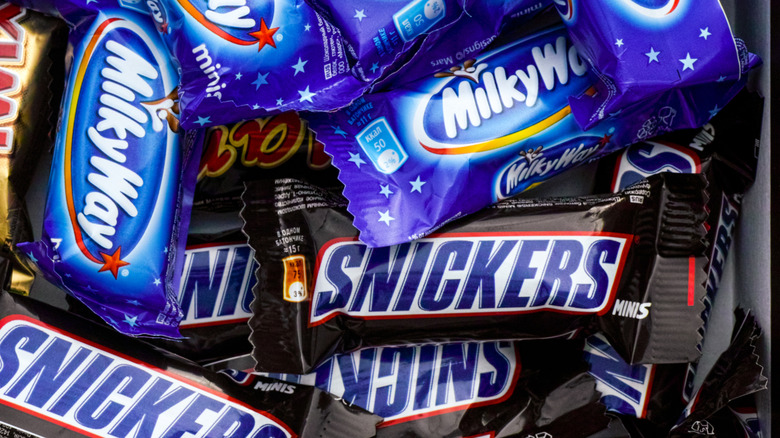
If you're thinking that the answer to Snickers versus Milky Way is simple — one has peanuts, duh — there's actually a bit more to discover than that. Both are Mars products, though Milky Way is older. It debuted in 1924, whereas Snickers came about six years later, in 1930. What about their names? A racehorse lent its name to the Snickers candy bar, while the true inspiration behind Milky Way candy bars came from a sweeter place: a malted milkshake that was popular in the '20s.
History aside, a Snickers consists of roasted peanuts, nougat, and caramel, all coated in milk chocolate. Milky Way bars boast the same ingredients, except the lack of peanuts means that its texture is softer, whereas Snickers bars have a crunchier mouthfeel.
So which of these two bars is more popular? According to Statista, it was Snickers in 2025. Some analysts attribute this to those peanuts, which arguably make it a more satisfying treat. A standard Snickers bar has 5 grams of protein versus 2 grams in a Milky Way. Otherwise, the nutritional profiles are relatively similar, though a Snickers has almost double the sodium of its peanut-free sibling. And though a Snickers has slightly more fat, it has less saturated fat than a Milky Way.
Product variety keeps Snickers and Milky Way fresh today
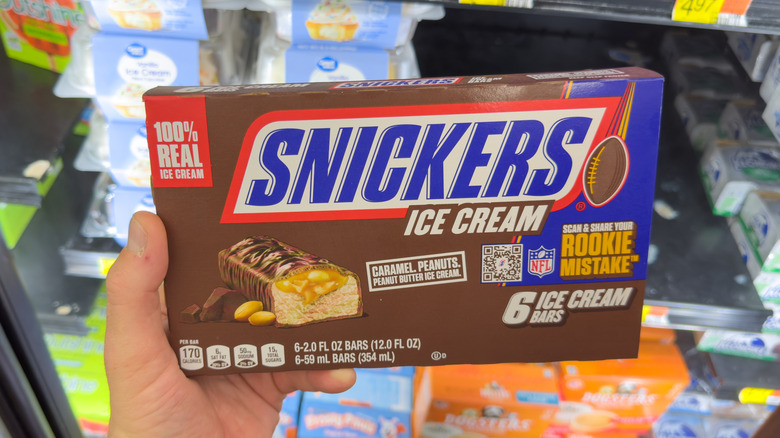
Although roughly a century has passed since Snickers and Milky Way bars first debuted, they haven't relied on their original recipes to keep them relevant. Over the years, a number of iterations have entered the crowded candy bar market. Snickers has had its well-received ice cream bar, an almond version, and a peanut butter bar (we ranked seven Snickers flavors from worst to best, if you want to see where your favorite lands). Milky Way hasn't stuck to the classic, either, branching out to include a cookie dough version, a dark chocolate coating, and an ice cream bar. It appears, however, that Snickers has considerably more variations than Milky Way.
So we've considered taste, texture, nutrition, popularity, names, and available varieties. But what about that all-important measure of comparison, price? While those may vary by location and change over time, as of this writing, a Snickers share-size bar (3.29 ounces) at Walmart costs $2.78, whereas a share-size Milky Way (3.63 ounces) at Walmart is also $2.78, proving that these two have more than just nougat, caramel, and milk chocolate in common.