

These 1940s Pyrex Mixing Bowls Are Worth A Pretty Penny, But You Have To Know What To Look For
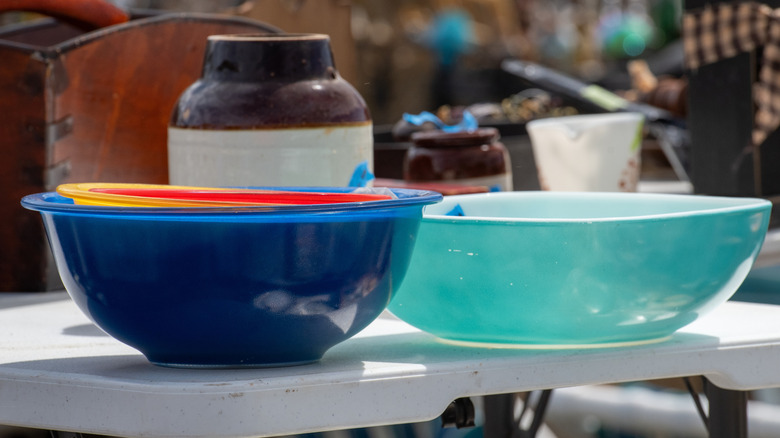
If you've ever browsed the kitchenware section of a second-hand store or estate sale, you know the joy of finding colorful vintage Pyrex among the mismatched mugs and orphaned casserole dishes. A little historical knowledge of vintage Pyrex markings might be all that stands between you and a thrifted bargain. One particularly recognizable find is the original Primary Colors nesting bowl set, introduced in 1945, with four graduated bowls in staunchly pigmented blue, red, green, and yellow.
In the ensuing 80 years, these cheerful kitchen workhorses have become desirable collectibles. A complete set, advertised as dating to the 1940s, sold for $135 on eBay in September. There are higher priced active listings, some upwards of $250, but as we know from the misshapen Doritos listed on eBay for thousands of dollars, sometimes sellers just set crazy, aspirational prices. The trick is figuring out whether the bowls you spotted at the swap meet are really of the era, since the familiar color scheme was in production for decades.
According to the Corning Museum of Glass, the four-piece set sold for $2.50 in its time. It was the first Pyrex product made from white opal ware, with a brightly painted exterior. In fact, Corning Glass Works worked with the U.S. government on lightweight glassware for military use during World War II. Unsurprisingly, the results found a more domestic secondary purpose afterward. By 1946, advertisements were promoting new bowls in "the colors of spring flowers," bringing postwar optimism to the happier business of mixing batter for bizarre vintage cakes no one eats anymore.
The proof is on the bottom
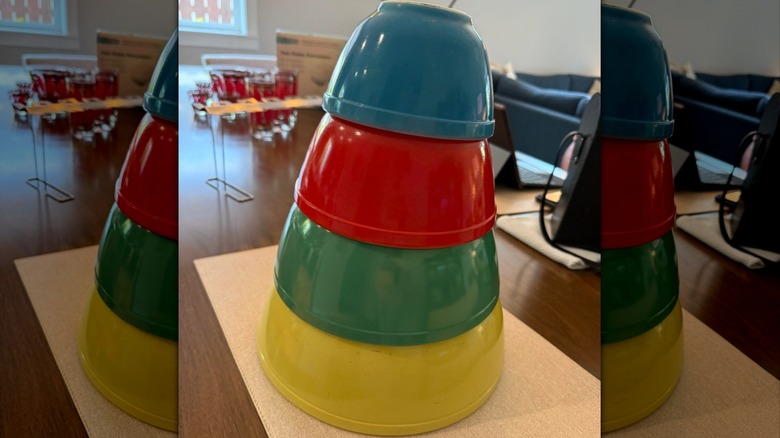
If you're fortunate enough to come across a set of Primary Colors bowls in the wild, first admire their beauty before turning them upside down. The underside reveals more about the age than the enticing, familiar colors. The Corning Museum of Glass notes that the earliest bowls didn't have the numbered markings which appeared on later versions. They also had a more pronounced foot ring — that raised, circular ridge that allows the bowl to sit flat on a countertop. If your bowl has one, it most likely dates before 1950.
There are a few less obvious clues, too. In a Reddit thread about a set of bowls found at a yard sale, experienced Pyrex enthusiasts posit that the 1940s versions feel heavier than their successors, partially due to the thicker glass. Additionally, some older green bowls may be more jade colored in appearance. Before getting too excited about a potential windfall, inspect the bowls for chips and scratches. Condition and completion can make a difference in their resale value.
If you plan to really cook with your colorful vintage kitchen thrift store finds, get a lead testing kit and give them a swipe, because cracks and exploding glass are not the only potential safety concerns. The sturdy bowls continued survival is a testament to their durability and aesthetic prowess, but beautiful set of Primary Colors bowls doesn't necessarily mean you've found the earliest version — and markings can change with age, so it's worth looking for several signs of manufacture before paying premium for a supposedly rare set.