

Why A Sub And A Hoagie Aren't Actually The Same
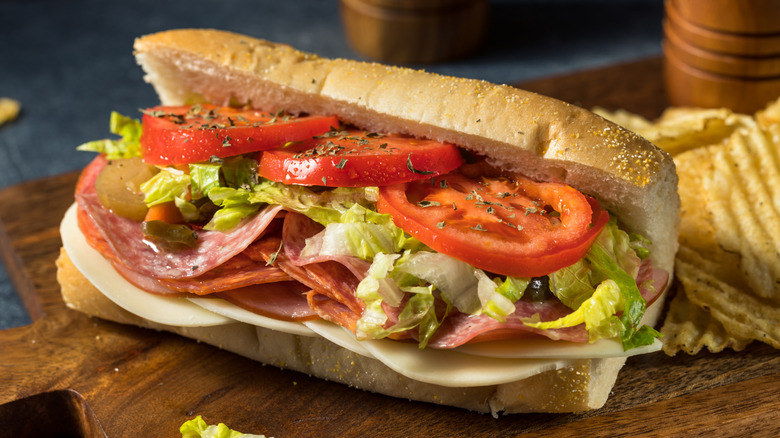
Sub, hero, hoagie, grinder, po'boy, bomber, zep. All of these are words used to describe what is essentially the same thing: a bunch of meats, cheeses, and (sometimes) assorted vegetables, all stacked on a long roll. But while there are certainly structural and functional similarities between all those sandwiches, they are not the same. Every regional variation brings its own style (and history) to the sandwich party, but the differences between the sub and the hoagie are worth looking at all on their own.
The submarine sandwich is the easiest to define and classify in the wild. The extended oblong shape looks like a submarine, hence the name. Simple, right? The sub is probably the most widely-used piece of sandwich nomenclature, knowing no particular regional or ethnic boundaries. As a result, it can be made of almost anything, and the word has become a kind of universally accepted definitional description. Bunch of stuff crammed into a split roll longer than it is wide? Call it a sub, and everyone will know what you mean.
The hoagie, though, has a much more rigidly defined characterization, based largely around its most common region of use (primarily Philadelphia and North Jersey). A hoagie is always served on a long roll, sometimes seeded. Normally served cold, it will always come with vegetables (lettuce, tomato, and onion), often with seasoning and/or vinegar and sandwich oil, and is at its most traditional when made with Italian deli meats. It also comes with a slightly murkier origin story.
You gotta be a hog to love a hoagie
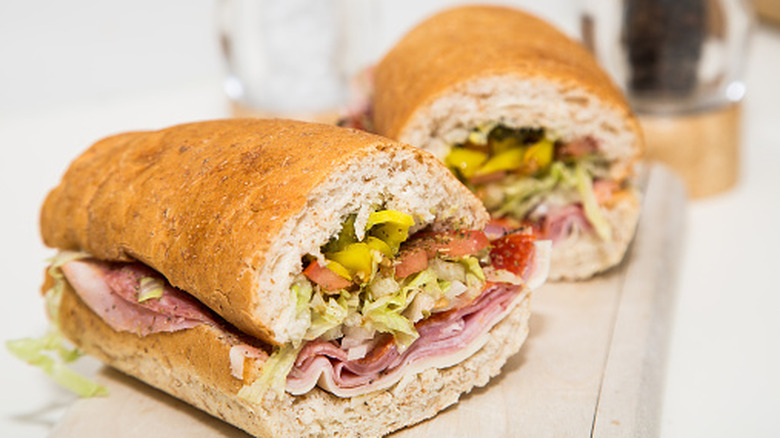
The most common etymological explanation for the name "hoagie" comes from the old Hog Island shipyard in Southwest Philly and the Italian-American immigrants who worked there during and after World War 1. The men who worked the yards were called "hoggies" and, over time, the lunch sandwiches that they brought to work — usually made of sliced Italian meats and cheeses on a roll — began to be named for them. Say that word with a thick, South Philly accent, and what you get sounds a lot like "hoagies," so it makes sense.
Except that word? It doesn't really appear in print or common usage until long after the war. According to The Encyclopedia of Greater Philadelphia, a more likely explanation is musician Al DePalma, who used the name "hoggie" at a restaurant he opened because, years before, he'd seen someone eating a really big sandwich and thought they'd have to be a hog to finish it. Apparently, the idea stuck. And, owing to the accent again, "hoggies" became "hoagies" in due course.
And while it is true that any hoagie could technically be called a sub, it does not work the other way. A hoagie, by definition, must contain vegetables, differentiating it from, say, a meatball sub. This rule is so ingrained into the sandwich consciousness of the Philadelphia region that, should you care to, you can actually order a cheesesteak hoagie-style, which means adding lettuce and tomato to the top of your standard-issue cheesesteak. Though why anyone would want to do that to a perfectly good cheesesteak is a different conversation entirely.