

Burger King's Whopper Vs Culver's ButterBurger: Which Is The Healthier Burger?
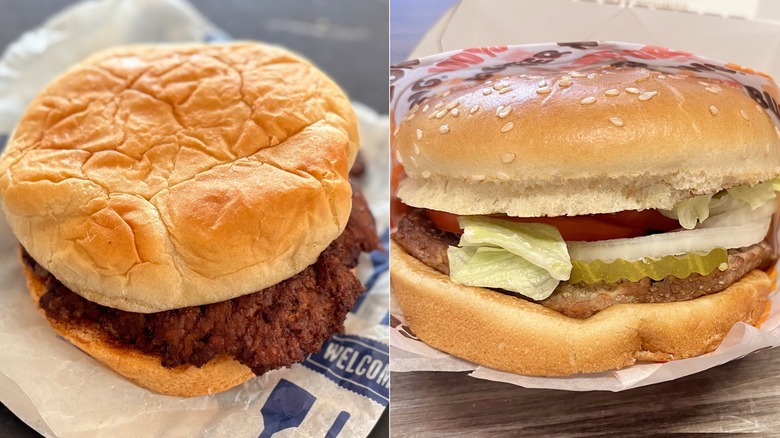
Putting up the Burger King Whopper against something called a ButterBurger may seem like a slam dunk from a health standpoint, but Culver's may surprise you. First off, the ButterBurger isn't as butter-heavy as the name makes it sound — Culver's just butters the bun a bit. The Wisconsin-based chain also leans heavily on fresh ingredients, and while we don't know exactly what makes the difference, the brand must be doing something right. Culver's not only has some of the best burgers in fast food, its ButterBurger is also noticeably healthier than the Whopper.
To make the most direct comparison to the Whopper, which uses a quarter-pound patty, we used the Double ButterBurger, since it's the closest to having the same amount of meat by weight. For both chains, we also went with burgers over cheeseburgers as the default, as it's a simpler baseline. While the Whopper and ButterBurger were similar in some areas, those where Culver's had the advantage were pretty significant.
According to the U.S. Food and Drug Administration (FDA), sodium, sugar, saturated fat, and trans fat are the biggest red flags on a food label. The worst offender for the Whopper is sodium. One burger contains 1,250 milligrams of sodium, which is 54% of the FDA's daily recommended maximum intake based on a 2,000-calorie diet, though individual calorie needs may vary. Conversely, Culver's Double ButterBurger offers only 580 milligrams, which is a bit more reasonable — and only about 46% sodium as much as the Whopper.
Culver's ButterBurger is the more nutritional choice
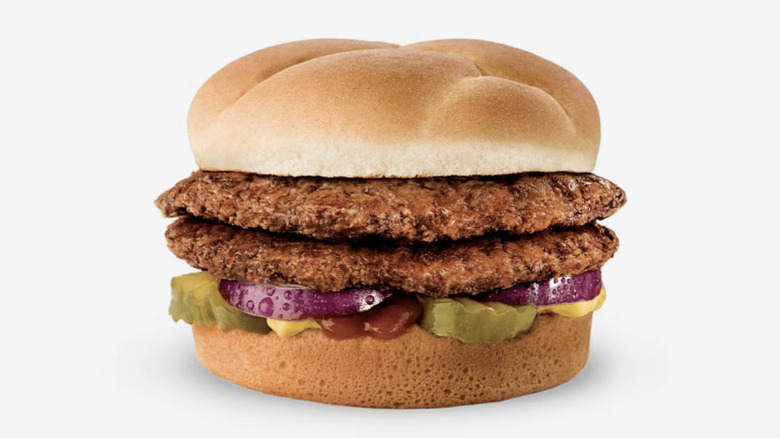
The other big difference between BK's Whopper and Culver's ButterBurger is sugar. The former has a surprising 14 grams, while the latter only contains 6 grams, once more cutting your consumption in half. If you're watching your saturated and trans fat intake, however, it's a draw. Both burgers offer an identical amount: 12 grams of saturated fat and 1 gram of trans fat. That's a good chunk of your daily saturated fat, and with the recommended level of trans fat being zero, neither is great here.
It's also basically a draw for more positive nutrients, although this is the one area where Burger King's famous Whopper has a slight advantage. While both the Whopper and the Double ButterBurger contain 34 grams of protein, the Whopper delivers a modest amount of fiber at 4 grams. The ButterBurger, meanwhile, only contains a single gram of fiber.
Finally, there are calories. While calorie count is a blunt, imperfect way of measuring nutrition, it can be helpful for some and serve as a point of comparison when food is nutritionally similar in other aspects. Here, Culver's has the advantage again, offering 560 calories compared to the Whopper's 710 calories, despite identical protein counts. Neither will mess up a balanced diet as an occasional meal, but if you'd prefer an option with fewer calories and less sodium and sugar, go with the Double ButterBurger.