

Popular In The '90s, This Cheap American Beer Still Tastes Better Than Budweiser And Miller Lite
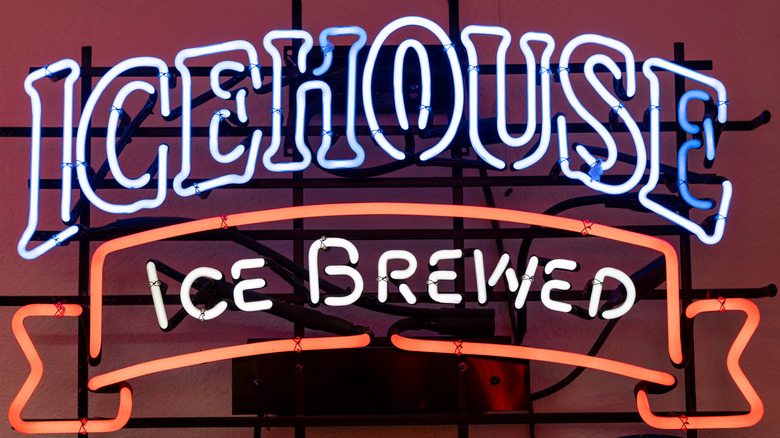
For beer fans tracking iconic American beers, finding out that the oldie-but-goodie Icehouse beer outranked Budweiser and Miller Lite for taste can come as a surprise. Icehouse was the first American-brewed ice beer, launched in 1993. It was Miller Brewing Company's answer to a new 1990s gimmicky claim that ice crystals were becoming the industry cornerstone to a new age of brewing. American beer manufacturers at the time were facing sales numbers that had stalled thanks to a new excise tax that the big brewers were newly passing on to consumers. Plus, smaller, independent microbrewers were beginning to pop up. The big breweries needed a spunky marketing tactic to compete.
The ice beer idea was simple. Before the aging process, chill the water, barley malt, corn syrup, yeast, and hop extract lager mix until ice crystals form. Just like that, you've got an ice-brewed beer with a concentrated taste and boosted alcohol by volume (ABV) percentage. Miller advertised Icehouse as having an icy, refreshing taste without any watered-down effect and said it was produced by Plank Road Brewery, a throwback to its original small 1855 brewery location, as an attempt to appeal to a growing consumer affinity for microbreweries.
The appeal of Icehouse beer
The attraction to ice beer held for a bit into the late 1990s, then began a slow descent. Consumers liked the advertising hype, but the ice-brewed differential did not deliver strong flavor profiles, despite the origin of ice beer stretching back to a German tradition called "eisbock," where rich, full-bodied beer was frozen enough to separate water from the alcohols and sugars in the aging lager. Eisbocks are known for their intense, rich, full-bodied taste, but the American iteration of the 1890s practice didn't have the same effect.
Icehouse did win awards into the early 2000s. It earned several World Beer Cup golds — one in 1996, another in 1998, and again in 2006 — and a few silver and bronze awards in premium lager and specialty lager categories for a few years following that. It then started to tank around 2011, posting some of the country's steepest sales declines in the beer industry, and never turned around. Ice beer hadn't solidified an audience, plus craft beer was bursting onto the scene, bringing beer back to pre-Prohibition quality and flavor levels, which captured the consumer's attention and never let up.
Yet, Icehouse has not gone down in infamy like some other American beer brands that are beloved but taste terrible. Instead, Icehouse continues to receive consumer praise, in part thanks to its smooth texture and crisp finish, and in part due to a factor that can reframe our tasting experience with an even stronger pull: nostalgia.