

Does Campbell's Use Real Meat In Its Canned Soups?

We are in a bit of a food reckoning right now as consumers become more sensitive about making sure there is real meat and vegetables in their products, and brands like Campbell's are under the microscope. On its website, Campbell's claims it does not use "any form of artificial or bioengineered meat in [its] soups," and that is a strong, clear statement, but a leaked audio clip from an executive in 2025 gave some people pause.
That recording was allegedly of a disgruntled executive going on a tirade about the quality of Campbell's soups, including saying the brand used bioengineered and 3D-printed meat. The company quickly fired him and said he had been with the company for less than five months. In an interview with ABC News Campbell's called the claims "false and completely inaccurate." A spokesperson for Campbells referred the Florida Phoenix to the aforementioned website.
Well, it's hard to say for sure, but what evidence there is does point to Campbell's using real meat in all its soups. The biggest source of information is the ingredients list, and Campbell's soups clearly list things like chicken, beef, and pork on the labels with minimal additives to the meat itself, usually just salt and spices.
While there is small leeway in the accuracy of nutrition labels, the ingredients themselves must by law be listed in order of weight. And "3D-printed," which usually means the growing field of lab-grown meat, is required by the U.S. Department of Agriculture (USDA) to be listed as "cell-cultivated" or "cell-cultured." None of Campbell's meat is listed this way.
Campbell's products are all labeled as containing real meat
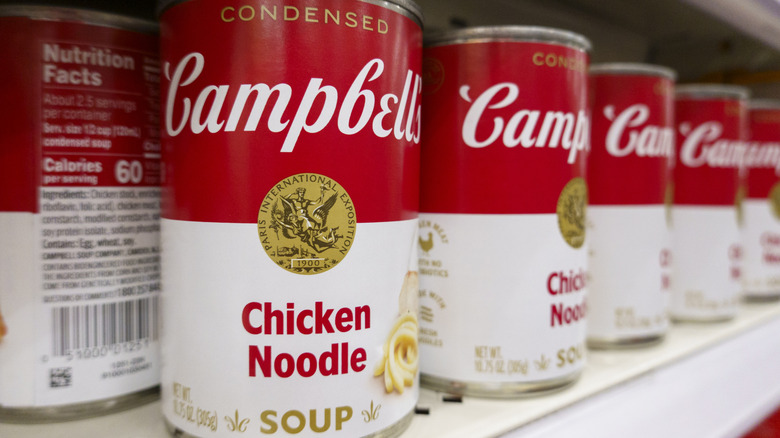
There is one area that might raise eyebrows with Campbell's meat, and that is in the disclosure of bioengineered ingredients on the label. The USDA requires by law that bioengineered labels appear on packaged food, and Campbell's soups do have this disclosure, but it's for ingredients other than meat. The labels on Campbell's Chicken Noodle Soup, for example, say the bioengineered ingredients are corn and soy. The company itself also says that all of its bioengineered ingredients are genetically modified (GM) crops that are commonly grown by most American farmers, including canola, corn, and sugar beets.
The reality is that, for most Americans, you are unlikely to find "fake" meat in them without it being clearly labeled in the ingredients. Lab-grown meat is still a nascent field, and is actually more expensive than the real stuff, giving companies little incentive to try and trick people. Most GM foods are crops, not animals, and GM foods are "real" food as far as most definitions go. GM corn is still corn, and most crops have had their genes manipulated for thousands of years by farmers.
GM ingredients are subject to tests to ensure they are nutritionally equivalent to previous forms of the food. Animals raised for meat that are fed GM crops are not required to disclose that; however there is no evidence GM crops have any effect on the final DNA of the animals that consume them. While there is understandable nervousness over scientific tinkering with our food, there is no evidence that Campbell's sources any meat like this, so you are free to continue enjoying your favorite Campbell's soups if that is a concern.