

Johnnie Walker Black Label Vs. Black Ruby: What's The Actual Difference?
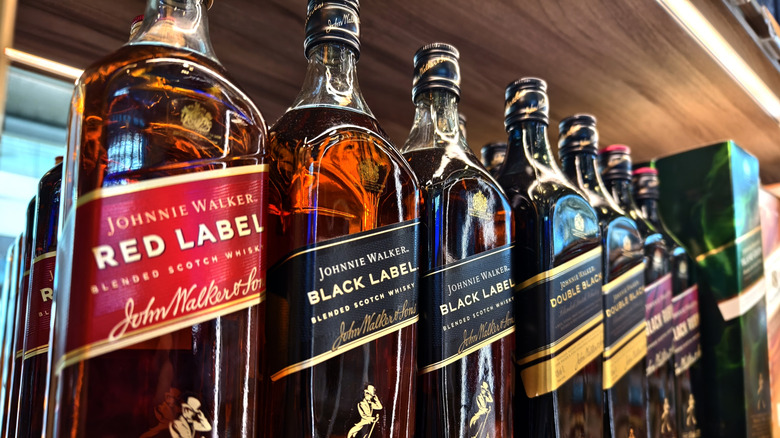
Johnnie Walker is the best-selling Scotch brand on the market, thanks to its budget-friendly Red Label that's a lot of people's first taste of Scotch. And its Black Label, the older and more refined version, has been a Scotch shelf staple for a little more than a century. So a new bottle carrying the Johnnie Walker Black name is bound to get a double-take.
Released globally in 2025, Black Ruby makes a tempting promise to Black Label fans: that same base of gentle peated smoke, but with a lot more fruit. It shares shelf space with other spinoffs like Johnnie Walker Double Black and the U.S.-only Black Cask, which arrived in March 2026, but Black Ruby is the one built around fruit.
The two have plenty in common. Both are blended Scotches bottled at 40% ABV, and Johnnie Walker describes Black Ruby as a sweeter blend that stays true to Black Label. But they differ in two big ways. First, while Black Label is a 12-year-old blend, Black Ruby has no age statement. Secondly, and perhaps more important, are the cask types. Johnnie Walker doesn't say much about the casks used for aging Black Label, but it's upfront about Black Ruby's: red wine casks seasoned with sherry, alongside ex-bourbon barrels. It's because of this that, side by side, you have two distinctly different pours.
The background behind the Black Label
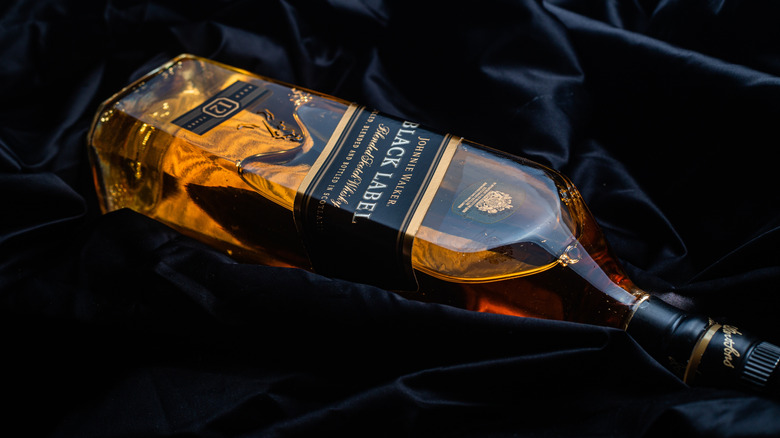
It may sound like a marketing term denoting exclusivity, but the Black Label was originally a sorting system. In the early 1900s, the Walker family sold three Scotch blends, and drinkers referred to them by the color of their labels. The oldest was a 12-year-old called Extra Special Old Highland, and it came with a black label. After a 1909 rebrand, which also introduced the Striding Man logo, the bottles officially took on the names of their label colors. The 12-year floor is still in place today, covering both the malt and grain whiskies in the blend.
Johnnie Walker has never published Black Label's full recipe, but according to liquor.com it contains as many as 40 malt and grain whiskies from across Scotland. When we broke down the bottle, the nose was sweet and oaky with a hint of smoke. The first sip is mostly honey and stone fruit with some vanilla. Spice and toffee show up after that, and it finishes with light smoke.
Where the Black Ruby differs
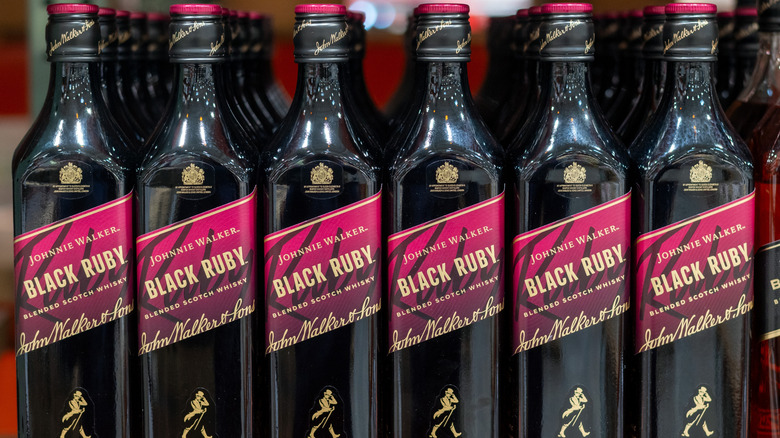
Black Ruby is the first core-range blend from Emma Walker, who became Johnnie Walker's master blender in 2022. The whisky was first rolled out in Mexico City, Sydney, and San Juan in 2024, then globally in March 2025. According to Walker, the idea behind Black Ruby is a sweeter, more versatile Black Label that works in cocktails as well as it does neat. With the smoke toned down, it should also be less intimidating for anyone trying Scotch for the first time.
Since Black Ruby has no age statement, the interest here lies in how it's made. Most of Black Ruby's flavor starts at Diageo's Roseisle distillery. Walker's team let the fermentation go longer than usual there, which made the spirit fruitier. They also ran the stills more slowly, and the extra time in contact with copper took out some of the heavier notes.
The Roseisle whisky was aged in first-fill red wine casks. The rest of the blend came from ex-bourbon barrels and casks that had held Pedro Ximénez and oloroso sherry — which explains why Black Ruby's tasting notes read like a dessert menu. Walker lists raspberry jam, blackberry pie, honey, figs, plums, and maraschino cherries. There's some spice, too, and a little smoke on the finish that ties it back to Black Label. Try it in an Old Fashioned or a Scotch take on a Negroni. If you like sweeter spirits, it also holds up neat or over ice.