

Canadian Whisky Vs American Whiskey: What's The Difference?
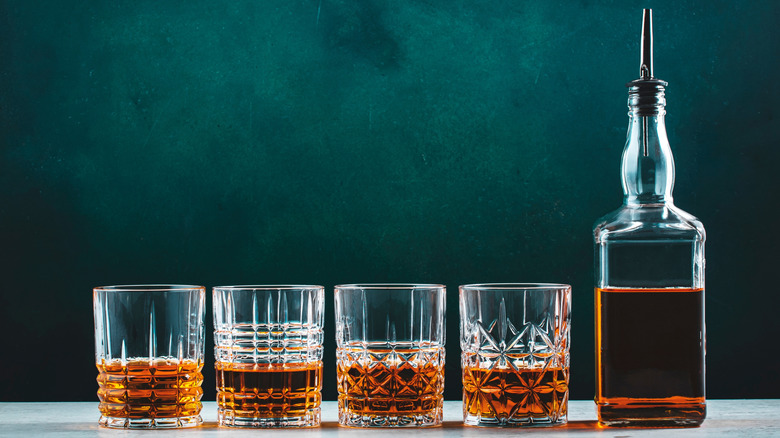
Whiskey fans know there's a whole world of regional styles out there, from Ireland and Scotland to Japan. But you don't have to cross an ocean to find plenty of variety: Both the United States and Canada have rich whiskey-distilling cultures. While some may assume Canadian and American whiskey are basically the same, others might expect them to be completely different. The truth is somewhere in the middle.
First of all, American whiskey has that "e," but Canadian whisky doesn't. Beyond that, one of the biggest differences between American whiskey and Canadian whisky is how they're defined. American whiskey is broken down into different types of whiskey, each with its own ingredient and aging requirements, while Canadian whisky is more loosely defined.
In the U.S., there's bourbon, rye, Tennessee whiskey, corn whiskey, wheat whiskey, and malt (barley) whiskey. To be classified as one of these distinct categories, the spirit must be made with at least 51% of its characteristic grain — that's corn for bourbon, rye for rye, and so on. There are also rules governing how strong these whiskeys can be when distilled and bottled, as well as how they're aged, including the use of new, charred oak barrels. Canadian whisky, meanwhile, is more loosely defined. Confusingly, it's also often referred to as "rye," even when it contains relatively little rye, since there is no 51% grain requirement. As long as it's aged in wood barrels for at least three years and bottled at more than 40% ABV, it qualifies as Canadian whisky.
How different barrel-aging requirements create different flavors
That flexibility in barrel aging gives Canadian whisky more potential for flavor diversity. Both American and Canadian whisk(e)y can have grain- and fermentation-derived notes like caramel, vanilla, chocolate, caraway, black pepper, nuts, stone fruit, and orchard fruit. Barrel aging can add flavors of its own: New oak tends to lend more spice, bourbon barrels can add vanilla and caramel, and sherry barrels can contribute dark dried-fruit notes. Canadian whisky, however, can be aged in new or used, charred or uncharred barrels made from different types of wood, including barrels that previously held other spirits or wine.
Canadian whisky generally tends to be smoother and lighter in character than American whiskey. Many Canadian whiskies use a corn whisky as a base, which is then blended with rye and/or wheat whiskies. They're also commonly made in column stills, which produce a less pronounced distillate than pot stills. American distillers use both methods, so some American whiskeys can have a more pronounced character from pot distillation.
The last thing to know before shopping for American and Canadian whisk(e)y is how the brands differ. Some of the top American whiskey brands include Jack Daniel's, Old Forester, Buffalo Trace, Angel's Envy, Four Roses, Wild Turkey, WhistlePig, and Blanton's, spanning Tennessee whiskey, different types of bourbon, and more. Prices can vary widely, from around $12 for a 750-milliliter bottle on the low end to $60 or more for higher-end brands, while rare, collector-worthy bourbons can cost $1,000or more. Top Canadian whisky brands include Crown Royal, Canadian Club, Wiser's, Alberta Premium, Lot 40, and Pike Creek, with prices generally ranging from $30 to $60. However, Canadian whisky also includes rare and collectible releases that can sell for significantly more.