

8 Iconic Foods Invented In The American South
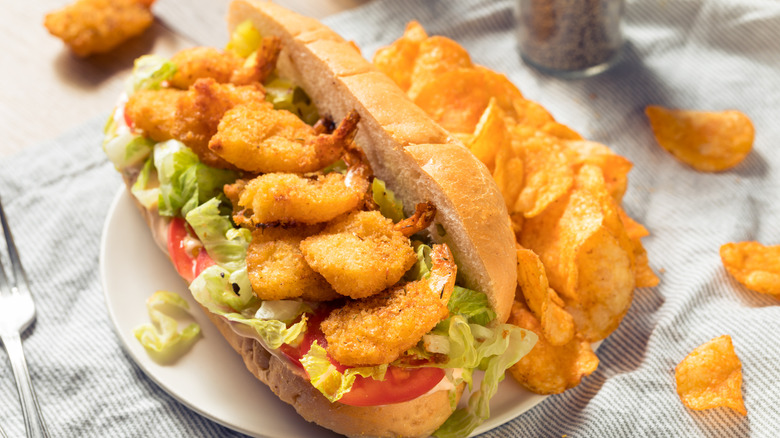
The South has produced some of the most iconic cuisine in America, from hearty stews to fried chicken to fluffy biscuits. But how, exactly, did this region come to produce so many culinary delicacies? It's a straightforward question, but more often than not, it has a less than simple answer. Most dishes are emblematic of this region's complicated history — shaped by centuries of slavery and European settlement, as well as Indigenous ingredients and cooking techniques.
Here, we take a closer look at the origin stories of some of the most popular and recognizable Southern dishes, from gumbo to fried chicken. But just a warning, not everything we discuss here is definitive. As with most of food history, the roots of certain dishes are murky and tangled, and the best information we have comes from the research from historians. Still, arguably, as you'll find out, sometimes, this makes things even more interesting.
Gumbo
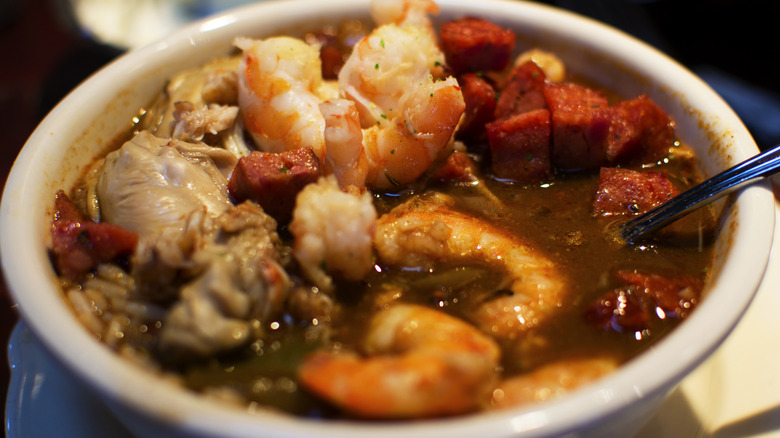
Before they were removed from their homes, many enslaved people in countries like Ghana, Nigeria, and Benin regularly ate okra stew, often served alongside rice or a type of bread made from cassava, called fufu. To this day, okra stew remains a West African staple, but it's also the backbone of a thoroughly Louisianian dish: Gumbo.
In American kitchens, enslaved Africans continued cooking okra stew (rumor has it, some brought okra seeds with them in their pockets), and people took notice. Not just in Louisiana, but across the South. Mary Randolph, often credited as a pioneer of Southern cuisine, was heavily influenced by enslaved people's cooking techniques. In "The Virginia House Wife," published in 1824, she includes a recipe for gumbo, which she refers to as a "West India dish." This version, though, is incredibly simple; washed okra is cleaned and stewed with salt and pepper, and then served with melted butter.
"La Cuisine Creole," a collection of recipes from Creole housewives published in 1885, is evidence that throughout the 19th century, gumbo started to take shape as a uniquely Louisiana creation. The book includes multiple recipes for "gombo" with filé, which is ground sassafras, an Indigenous crop. And around the same time, the French influence started to creep in with the addition of roux. Though two recipes are rarely the same (and Creole gumbo recipes differ from Cajun ones), modern gumbo is kind of like an edible amalgamation of Louisiana and the south's tumultuous past.
Shrimp and grits
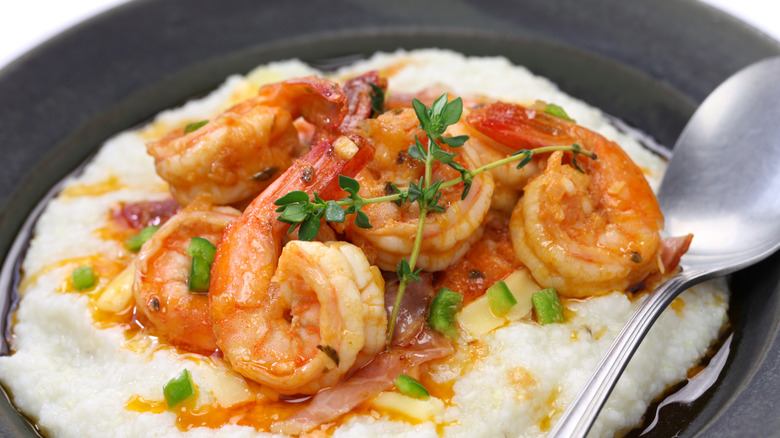
Originally published in 1930, "Two Hundred Years of Charleston Cooking" is a goldmine of Southern culinary history. Curated by Blanche S. Rett, the book features an extensive collection of recipes from Southern housewives and enslaved African American people. One dish, which Rett claims is served for breakfast in "every house in Charleston during the shrimp season," is shrimp and hominy. In fact, Rett adds that one "charming" 78-year-old man told her he'd eaten the dish for breakfast for as long as he could remember.
But Charleston families didn't invent shrimp and hominy, or grits, as we would call it now (grits are often made with ground hominy). It was likely inspired by the Gullah Geechee people of the region, who would also regularly combine hominy with shellfish. It makes sense that the combination has a long history, as South Carolinians have always had easy access to the three species of shrimp native to its waters.
Clearly, many Southern cooks have been making shrimp and grits for centuries, but the dish really took off in the 1980s. Back then, The New York Times helped to popularize shrimp and grits nationally when it featured a profile of Bill Neal, a North Carolina chef and restaurateur. Neal died in the early 1990s, but his now-shuttered restaurant (a victim of the Covid-19 pandemic), Crook's Corner, was beloved for its signature shrimp and grits recipe, which features fresh shrimp, Tabasco, bacon, mushrooms, and finely grated sharp Cheddar cheese, for decades after his death.
Po'boy sandwiches
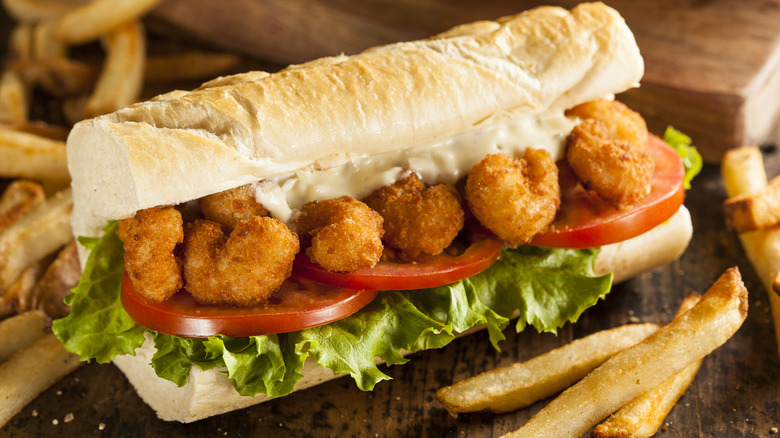
In the 1920s, working as a streetcar conductor wasn't an easy job. It involved a lot of crowd control, dealing with unruly, rude customers, and constantly being at the mercy of the weather. So it's not all that surprising that conductors would want to be paid well and treated fairly. In 1929, more than 1,000 streetcar conductors and motormen in New Orleans went on strike to negotiate better working conditions. Why are we telling you this? Well, without all of this strife, we wouldn't have po'boy sandwiches.
Wait, what? It does sound like an odd connection, until you know the details. While inconvenient, those New Orleans strikes were widely supported by locals. Some showed this support by boycotting public transport, while others, including restaurant owners and brothers Clovis and Bennie Martin (two former streetcar workers themselves), fed the strikers free food.
The Martins took to handing out large, hearty sandwiches to hungry strikers, who they called "poor boys." But they had to be economical about the whole thing; they went to their French bread supplier, John Gendusa, and negotiated the supply of 40-inch long, uniformly shaped loaves, which could be easily stuffed to the brim with cheap cuts of meat. Over time, those Poor Boy sandwiches became known as po'boys. Makes sense now, right? Fun fact: if you want to make a truly authentic po'boy, the John Gendusa Bakery still sells those special loaves today.
Brunswick stew
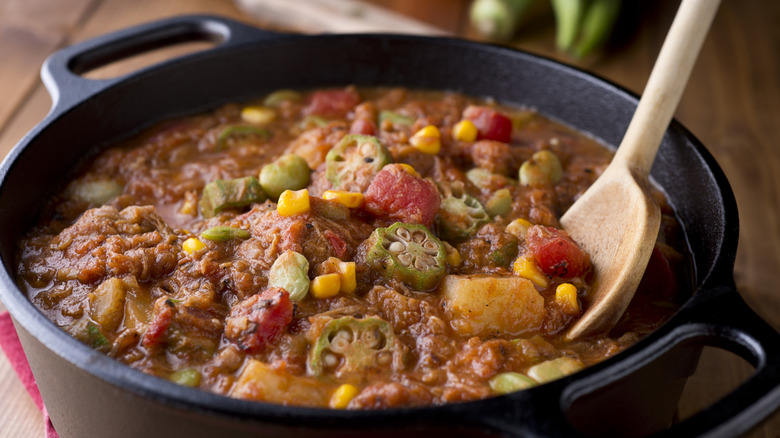
Originally published in 1867, "Mrs. Hill's New Cook Book," written by Georgia homemaker Annabella P. Hill, is filled with recipes from the pre-Civil War South. There's gumbo, for example, as well as hominy cakes, fried catfish, and camp stew. The latter is simple; ingredients like chicken, squirrel (yes, squirrel), pickled pork, Irish potatoes, onions, butter beans, corn, and tomatoes are thrown in a pot and simmered together for hours. If the dish sounds kind of familiar, that's because Hill's recipe is widely considered to be one of the earliest versions of Brunswick stew. Modern recipes are similar — only most skip the squirrel these days.
So, thanks to Hill, we know that Brunswick stew was born in Georgia, right? It makes sense: There is a whole port city called Brunswick in the state, after all. Well, it's not that simple. It's well established that Brunswick stew was born in the South, but nobody can decide exactly where. It turns out, Brunswick County, Virginia, also lays claim to the stew. In fact, if you enter the county today, you'll encounter a plaque telling you all about the story of local chef Jimmy Matthews, who cooked the stew during a hunting expedition with Dr. Creed Haskins.
So which state is right? Maybe both, maybe neither. It's possible that similar stews evolved in two different places. However, it's also crucial to note that the true creators of Brunswick stew were probably Native American, as Indigenous cooking techniques heavily influenced old camp stew recipes.
Biscuits
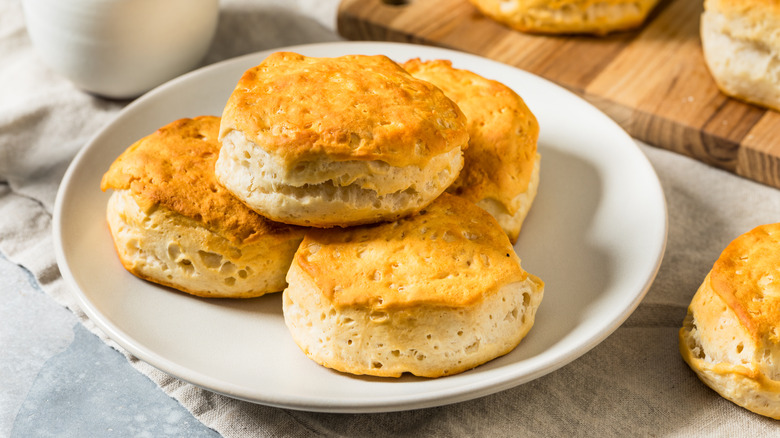
If you ask for biscuits in the U.K., you'll be handed a hard, flat, cracker-like snack, much like an American cookie. They've been eaten in the country for centuries (since long before America was even a thing), and provided vital sustenance for sailors — including those who first landed in Jamestown, Virginia, back in the 1600s. The fluffy, buttery, flaky biscuits, synonymous with the South descended from these hard cracker biscuits, but they weren't invented until many years later.
Those hard, cracker-like biscuits evolved into chewy, beaten biscuits (also known as Maryland biscuits). The clue is in the name, but these biscuits were literally made (usually by enslaved boys) through the process of beating the dough intensely and repetitively, allowing the dough to rise a little more. In the early 19th century, Southern cooks kept experimenting with biscuits. In "The Virginia Housewife," for example, Randolph includes several recipes, including tavern biscuits, made with flour, mace, nutmeg, and brandy.
Everything changed in the middle of the 1800s, though, when Harvard chemist Eben Horsford patented baking powder. Horsford's creation not only made baking easier than ever, but it also gave baked goods a better texture, paving the way for those iconic fluffy golden Southern biscuits that are widely beloved today.
Fried fish and spaghetti
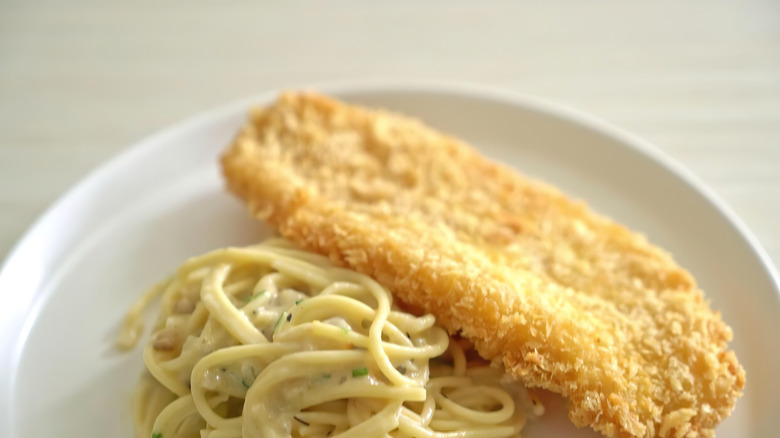
Many traditional dishes from the Deep South tell a story about the region's turbulent past, and fried fish and spaghetti is no exception. The dish is a blend of two cultures, each of whom arrived in the region via very different paths. The fried fish element originated with enslaved Black Americans, many of whom relied heavily on the wild seafood they could catch for sustenance. For those who lived in the Mississippi Delta, this meant eating a heck of a lot of catfish. In the few hours they had to themselves, fish fries provided an opportunity for enslaved people to gather, socialize, and eat together.
Now, the spaghetti. This part of the dish came with Italians, of course, who were encouraged to immigrate to the South during the late 19th century to fill the gaps left by formerly enslaved Black Americans (many of whom were moving north for a fresh start). At some point, the two signature cultural staples were combined to make an entirely new Southern dish: fried fish and spaghetti.
It's not entirely clear who put the two together for the first time. However, it was probably the result of Black Americans discovering spaghetti through new Italian eateries, which started to crop up in the region in the late 1800s and early 1900s. Today, fried fish and spaghetti is also a popular Midwestern dish, likely as a result of the Great Migration of Black Americans in the 20th century.
Hushpuppies
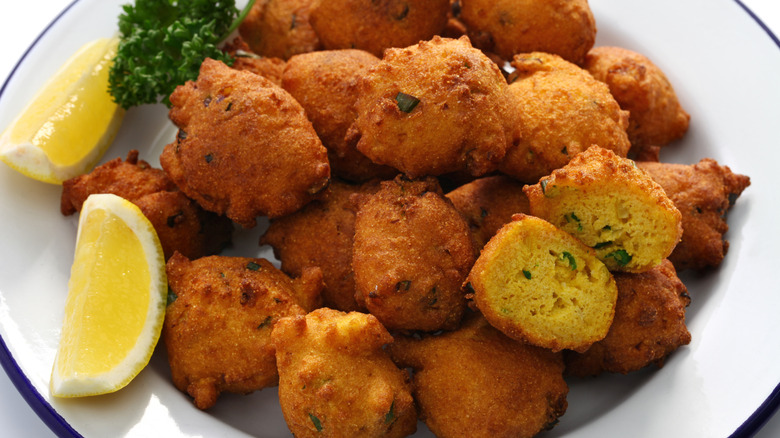
Like many Southern dishes on this list, the origin of hushpuppies isn't clear cut. Most can agree that the simple dish of deep-fried cornmeal batter and seasoning came from the South, but as for its exact creator, well, historians have trouble coming to a definitive conclusion. But we'll give you a few theories, and yes, most actually do involve telling puppies to hush.
One theory credits the creation of hushpuppies to Floridian hunters. According to this origin story, the hunters would fry fish on their expeditions, and then throw the batter to the dogs to keep them fed, happy, and quiet. Another similar theory credits Civil War soldiers with the invention of the fried snack. Only in this story, the dogs needed to be quiet for the purposes of war tactics, and not hunting ones.
There's also an arguably stranger origin story that involves salamanders. Yes, as in, the amphibious animal. Some believe that poor Cajuns in Louisiana would eat deep-fried salamanders (known as water dogs), but they wouldn't want people to know about it, so they'd refer to the food as hushpuppies. Wherever they came from, hushpuppies are still a Southern delicacy today, and there's certainly no shame around eating them anymore.
Fried chicken
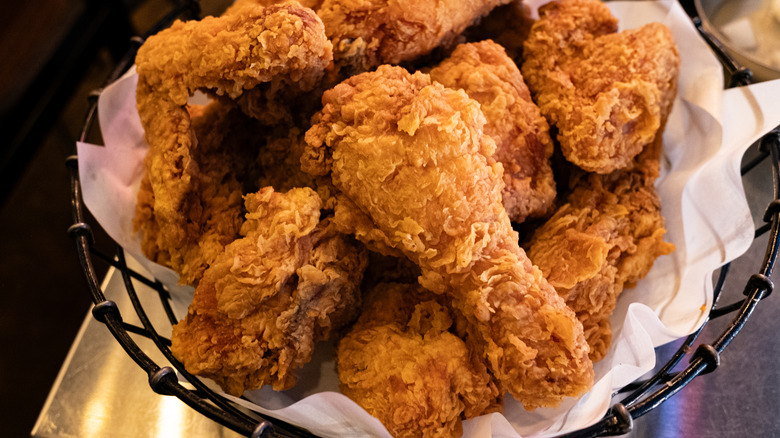
The concept of frying chicken isn't unique to the South. In fact, people all over the world have been eating fried chicken for centuries — even the ancient Romans had their own recipes. However, the South did create its own version of the dish, of course, with flour, spices, and plenty of hot oil. Arguably, it is the most famous version of fried chicken, thanks to a certain colonel's major fast food franchise.
While it did help popularize the dish, KFC didn't invent Southern fried chicken. Like gumbo, the recipe likely evolved from similar West African dishes, but also interestingly, Scottish techniques, which arrived in the South with settlers in the 18th and 19th centuries.
The version of fried chicken we know today was honed and refined in the South, probably by enslaved people, who did most of the cooking in enslaver's homes and then went on to sell the dish after emancipation. One of the first printed recipes for Southern fried chicken appears in Randolph's "The Virginia Housewife," which, as we explained earlier, was heavily influenced by the cooking techniques of enslaved people.