

Actually, Bananas Do Belong In Your Fridge — But Only Under One Condition
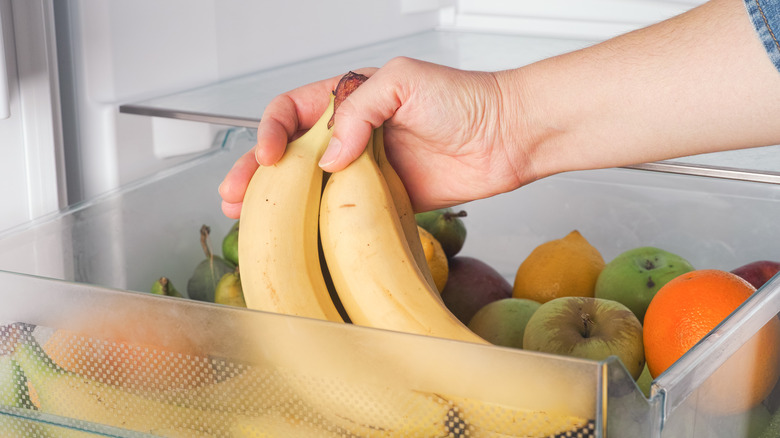
Bananas have a reputation for ending up perfectly ripe at the most inopportune times. But luckily, there's an easy way to slow that down. You've likely heard that nothing good happens when you put your bananas in the fridge, but that's not necessarily true. Refrigerating bananas at the right stage can significantly slow the ripening process, which gives you several more days to enjoy the fruit at its peak. The tip is simply this: wait until the bananas have reached the exact ripeness you covet, then pop them in the fridge. Given their tropical upbringing, bananas are particularly sensitive to cold temperatures, so the chilly temps of refrigeration interfere with the normal ripening process.
Unless you plan to eat your bananas that day, it's likely you purchased your Chiquitas slightly green. Depending on how quickly you want them to ripen, they'll be hanging out on your kitchen counter or stored in a brown paper bag (a scientifically proven method to speed up the ripening process). The minute your bananas turn fully yellow and have reached your desired level of softness, that's your cue to move them to the crisper drawer of your fridge. While everyone's preference for banana softness varies, this trick will immediately stop your bananas from ripening any further.
We have chemistry to thank for this magic. As bananas ripen, they release ethylene, a plant hormone that promotes ripening and converts starches into sugar. Higher temperatures accelerate this process, so if you suddenly cool the fruit, it slows that progression. Basically, you're hitting pause on those perfectly speckled 'naners.
Refrigeration might turn the skin black, but the fruit is still edible
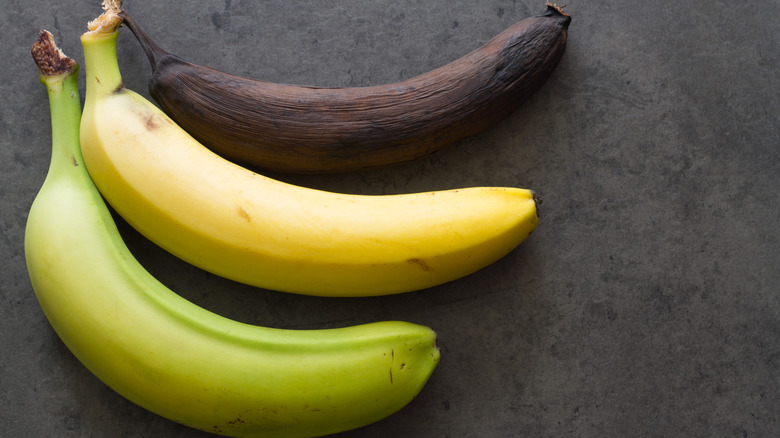
Of course, there is a catch. The peel may start looking pretty yucky, though the flesh inside remains perfectly fine. Refrigerated bananas can develop dark brown or black skins because of something called "chilling injury." Scientific research has shown that bananas exposed to 54 degrees Fahrenheit or lower can develop peel discoloration. In other words, don't panic when your banana turns ugly. The good news is, a dark peel doesn't mean the fruit inside has gone bad.
Always peel your brown or black bananas to check the flesh before tossing (ideally, you wouldn't be throwing them away at all, as there are so many uses for banana peels). If the fruit smells normal and hasn't developed mold, it may be perfectly suitable for eating. If it's too mushy, you can still save it for this brown butter banana bread recipe. Speaking of banana bread, you'll want those bananas to skip the fridge entirely. The fridge is no substitute for letting them naturally develop that sweet, soft, overripe texture.
If you don't feel like baking, bananas are also great to throw in the freezer for future extra-thick smoothies. Just remember to peel and chop them first, because trying to peel a frozen banana is more difficult than you'd think. No matter how you use the tropical fruit, just remember that, while magical, the fridge can't stop the clock entirely.