

Step Away From The Pan: Your Fried Eggs Will Be Ruined If You Crack Them Like This
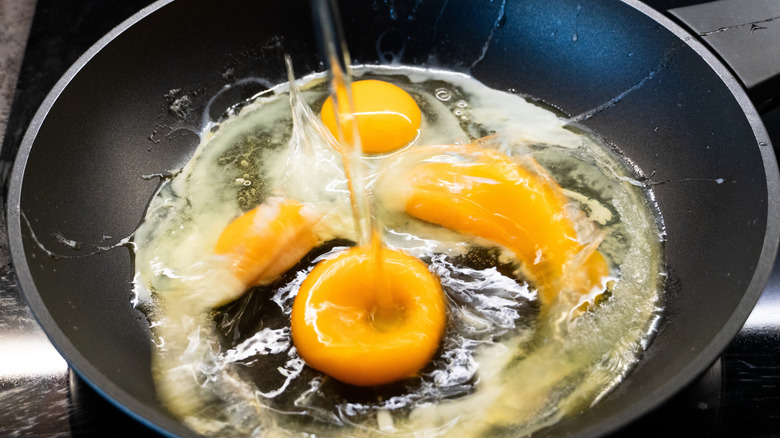
An intact, raw egg seems like one of the simplest foods in the world, but it's actually a surprisingly elaborate little piece of biological engineering. Cracking it is the precarious moment you dismantle the protective structure and assume responsibility for managing the delicate parts. If you're making fried eggs, cracking each egg into a separate bowl or ramekin before it starts cooking gives you more control, more time to intervene, and a better outcome.
A raw egg may pour out of its shell like a single liquid form, but structurally, it's a collection of components. Beneath the brittle, calcium-carbonate shell are additional membranes and layers of albumen, or egg white. At the center, the yolk is contained within a thin casing, called the vitelline membrane, which does the important work of keeping your future perfectly runny egg yolk from spilling before you want it to, but its strength can vary. As the egg ages, its white becomes thinner, water moves into the yolk, and the vitelline membrane loses some of its elasticity, which makes an older yolk more vulnerable to breakage.
You can't know exactly how sturdy any particular yolk will be until you've already cracked the egg. If it breaks in a ramekin, you can decide whether to fry it anyway, scramble it, or start over. If it breaks while falling directly into your hot skillet, the decision has been made. The separate bowl provides a staging area between biological package and frying pan, where you can make sure everything survived the transition before adding heat.
A clean break
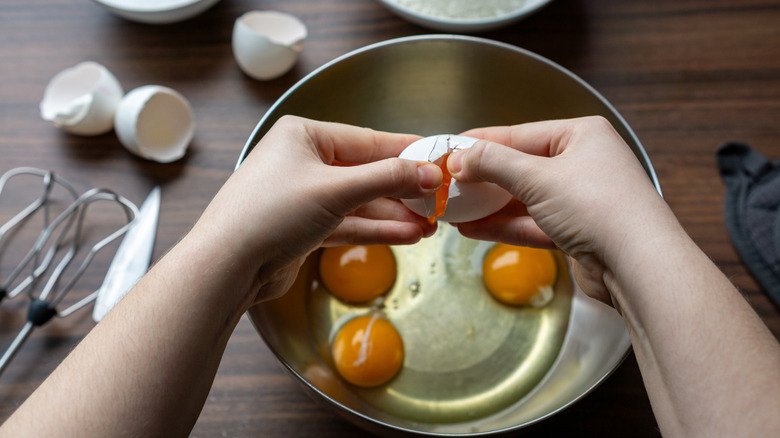
Perfect eggshell cracking is an art, and doing it correctly to begin with will increase the odds of the ramekin technique actually being helpful. The trick to getting it open cleanly is using enough force to break the shell without damaging what's inside. Give the egg a decisive crack, then use your fingers to pull the shell halves apart, rather than repeatedly striking it until the shell shatters, which can cause many tiny and annoying fragments. If one of those does get in, the ramekin at least gives you a relatively stationary spot to retrieve it from instead of sending you after a tiny piece shell that won't stop slipping away from your fingertips in a hot pan.
Once you're in the ramekin, gravity is the next concern. The greater the distance an object falls, the more gravitational potential energy is converted into motion before impact, and cracking directly over a skillet usually means dropping the white and its membrane-bound yolk into the pan at some distance. Using a ramekin allows you to lower its lip close to the pan and slide the egg into the pan. A short, gentle slide gives the fragile yolk membrane less of an impact to withstand.
The ramekin also gives you a moment for quality control. You can inspect and smell each egg before it joins your breakfast, and if you're cooking several, cracking them individually means one compromised egg doesn't have to take the whole meal down with it.
Setting boundaries
Once you start cooking, your window for fixing problems starts to close. Egg white is mostly water and protein, and heat causes those proteins to unfold and bond with one another, before coagulating into the opaque, solid white we want in a cooked egg. That starts happening as soon as the egg encounters sufficient heat, which is what makes a sizzling skillet such an inconvenient place to discover a stray piece of shell or a yolk that didn't survive the crack.
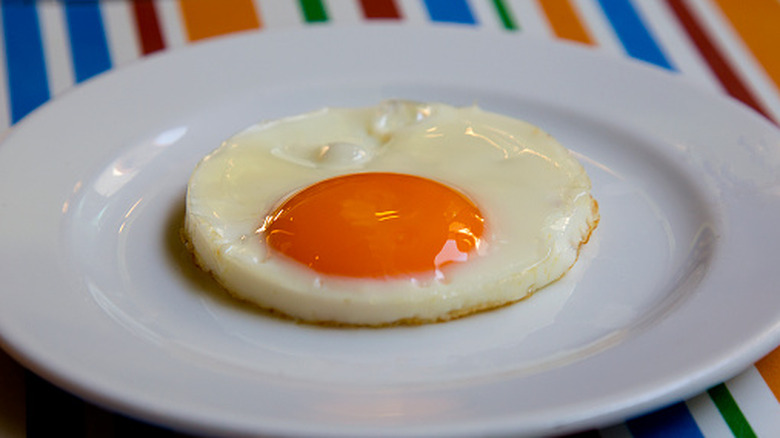
Keeping the yolk intact is important for a fried egg because the proteins in egg white and yolk set differently as they cook, which is what allows you to cook a fried egg with a set white and a still-gooey center. The vitelline membrane maintains a boundary around that yolk while the surrounding white cooks. If you've already ruptured it during the cracking or the trip into the pan, the yolk can spill into the white instead of remaining contained for you to puncture with a fork once it's on your plate.
With all of that settled, you can concentrate on how to fry the egg and cooking it to your preferred level of doneness. The ramekin adds a few seconds to the process and another dish to wash, but it gets an unpredictable part of the process out of the way, setting you up for success.