

The Chicken Sandwich Your Grandparents Ate That Sounds Stomach-Churning Today

We may receive a commission on purchases made from links.
Look, never let it be said that we here at Tasting Table look down our nose at strange sandwiches. Banana and mayo? To some, a Southern classic. Peanut butter and onion? A 'poor man's' sandwich that neither Stephen King characters nor social media can resist. That said, occasionally we are confronted with something lurking between two slices of bread that just seems plain wrong. It may sound stomach-churning today, but there's a chance that your grandparents were eating jellied chicken sandwiches.
Recipes for this curious repast can be found in a number of vintage books of sandwich recipes, some of which call for mixing cooked chicken meat into a combination of gelatin and water, along with some seasoning and horseradish, and then incorporating whipped cream, before the mixture is left to set until it can be sliced for sandwiches. Another recipe featured in the 1936 cookbook "1001 Sandwiches" by Florence A. Cowles (available on the Internet Archive) calls for using the chicken's bones and skin to make a broth along with celery, onion, parsley, bay leaf, and curry powder. Once reduced and the fat has been removed, water-soaked gelatin is added, and the broth is strained over chicken. Capers are added, and the result is turned into a wet mold until the jellied chicken becomes firm.
For those unfamiliar with this technique, the Cowles recipe essentially involves a simple aspic, which is made with gelatin to turn meat broth into a wobbly, Jell-O-like consistency, in which various fillings can be encased. Aspic itself can be flavorless, but can be infused with the savory flavor of the stock, or potent seasonings like horseradish and curry powder. While it may not taste like the Jell-O you remember from childhood, the jelly's texture will be similar.
Savory gelatin dishes were once all the rage in the U.S.
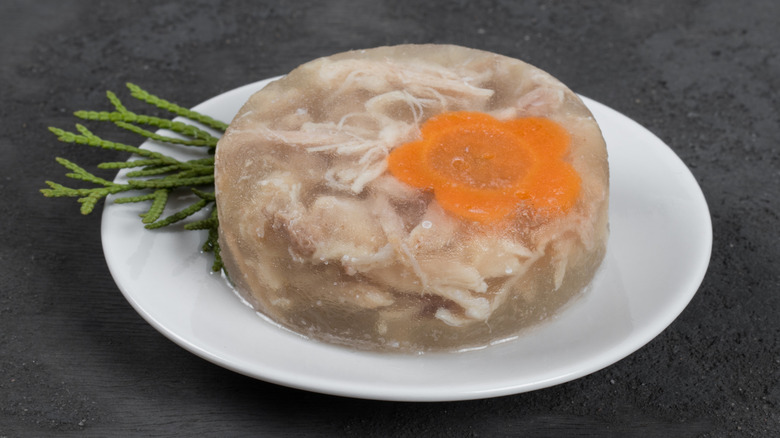
Aspics have been around for hundreds of years and were much favored by the famous French chef Marie-Antoine Carême, who fashioned enormously elaborate aspic creations for the imperial court of Napoleon Bonaparte. In the United States, recipes for molded dishes of jellied meat grew in popularity once powdered gelatin became commercially available in the late 19th century, making the process considerably less labor-intensive. As demonstrated by this vintage seafood dish we can't believe people actually used to eat, that popularity would arguably peak in the 1950s and 1960s — right around the time your grandparents might have been tucking into a jellied chicken sandwich — when these kinds of recipes were perceived as representing both modernity and convenience.
As you have probably guessed, savory dishes that rely heavily on gelatin and aspic have sharply fallen out of fashion since the 1970s. The late writer Julie Powell, who spent a year cooking her way through every dish in Julia Child's "Mastering the Art of French Cooking", found Child's numerous aspic-based recipes to be particularly unpalatable. Today, you can visit a Facebook group called "Aspics With Threatening Auras", in which members post pictures of aspic dishes "that make you feel unsafe while viewing." However, as there have been some recent stirrings of an aspic revival, you may want to check out everything you need to know about aspic – though we accept no responsibility should you decide to serve up some jellied chicken sandwiches for lunch.