

The Cookware Material That Holds Heat The Longest
We may receive a commission on purchases made from links.
Ever burned your hand on a "cool" cast iron handle twenty minutes after the burner clicked off? You're not the first: cast iron pans don't let go of heat easily. While that lingering heat can be frustrating, it's also what makes cast iron the best pan for searing a steak — especially compared to the thinner stainless steel or aluminum pans in your cabinet.
Cast iron's ability to hold heat has a lot to do with how much metal you're working with. A standard 12-inch cast iron skillet, like a Lodge 12-incher pre-seasoned cast iron pan, weighs 8.22 pounds, compared to 4.7 pounds for a 12-inch All-Clad D3 stainless fry pan, and 3.8 pounds for a 12-inch Tramontina Professional 12-inch "heavy-gauge" aluminum pan. Neither comes close to cast iron's weight — but this is the secret behind cast iron: A hot pan holds energy in proportion to its mass, meaning that at the same temperature, an 8-pound skillet carries roughly twice as much total heat as a 4-pound one.
Ironically, pound for pound, aluminum actually holds more heat than cast iron. Cast iron makes up for this with its thickness: These pans are typically 3 to 5 millimeters thick, giving them enough mass to retain heat without becoming unreasonably heavy. Combined with iron's density, that extra mass helps keep a cold steak browning as the pan's surface temperature dips rather than crashes.
Slow to heat, but also slow to cool
So what's the catch? The trait that makes cast iron hold heat so well also makes it slow to take on heat. Gray cast iron conducts at around 53 watts per meter-kelvin, versus roughly 237 for aluminum — about a fifth the rate. That means heat creeps outward from the flame rather than spreading evenly: a big skillet on a small burner runs hot in the center and noticeably cooler at the edges — one cast iron skillet myth you need to stop believing.
You can see this in action in real time: Sprinkle flour across a dry cast iron pan and turn on the heat. The flour scorches directly over the burner and stays pale everywhere else. Run the same test on a clad aluminum-core pan, and the flour browns far more evenly as the aluminum spreads heat across the surface instead of leaving it concentrated over the flame. It's a cheap, practical way to see thermal conductivity working... well, against you.
Cast iron takes its time heating up and cooling down, but that's also what makes it so good at searing — a fair trade. If you own one, or you're planning to buy one, it's worth learning how to cook with it in a way that plays to its strengths.
How to actually cook with that in mind
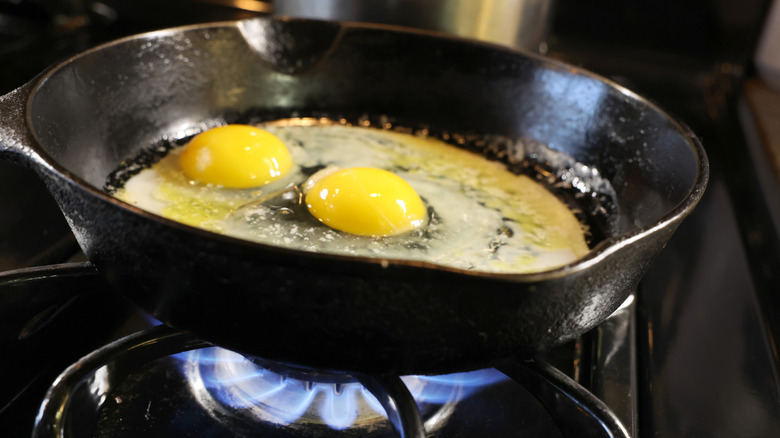
First, it's important to give cast iron time to preheat. About three to five minutes over medium-low heat should do the trick, ideally on a burner close to the pan's own diameter to prevent warping. If your burner is smaller than your skillet, as is often the case with a 12-inch pan, rotate it every minute or two during preheating so the metal outside the flame gets a turn. Otherwise, you'll end up with the scorched-center, cold-rim pattern.
If the most even heat is what you're after, preheat the empty skillet in the oven instead, where heat surrounds the entire pan. Transfer it — oven mitts on! — to a burner set lower than you might normally use. The skillet is already up to temperature and only needs to maintain that heat, though cast iron will continue absorbing energy even after food goes in. And when you take it off the burner, remember that it won't stop cooking immediately. If you're frying bacon and hash browns for breakfast, for example, there may still be enough residual heat left to cook a few sunny-side-up eggs.
One last thing: a screaming-hot skillet dunked straight into cold water can warp or even crack. Metal doesn't like sudden temperature swings — it swells slightly when hot and pulls back in as it cools, and rapid changes can cause damage. So give the pan a few minutes to cool before it goes anywhere near the sink.