

The '50% Rule' For Bartenders Has One Big Problem, According To An Expert
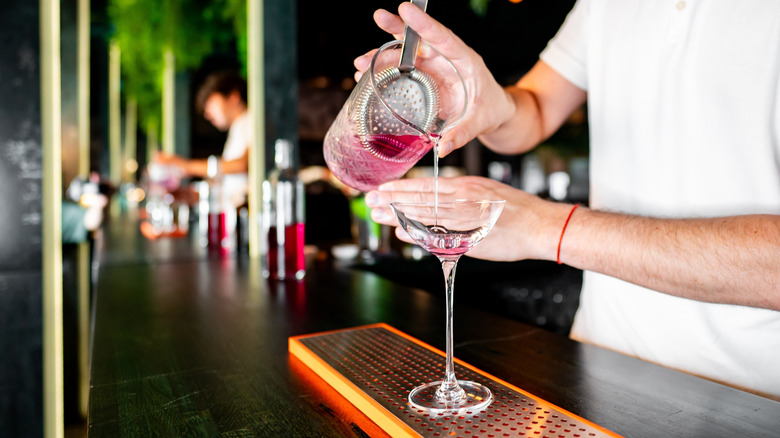
There are a lot of unwritten rules around drinking, but as a customer you might not realize there are some quiet rules for bartenders as well. Some apply to little hacks around how cocktails get mixed or presented, others include basics like keeping the bar clean and dry, but most apply to dealing with the customers themselves. One big rule some may have heard of is the 50% rule, which essentially says bartenders should spend half their time making drinks, and half interacting with customers (there is a second interpretation which says that bartenders should ask guests if they'd like another drink when the first is down to 50%, but that's not the one we're referring to). But ask Justin Lavenue, the Austin, Texas-based master mixologist and co-owner of The Roosevelt Room, and owner/operator of The Eleanor and RoadHaus Mobile Cocktails, and he'll let you know that like many hard rules, this one doesn't always hold up to scrutiny.
According to Lavenue, bar businesses are just too diverse to always stick to the 50% rule. He says, "I understand what it's trying to say, but I don't think any fixed percentage makes sense across every bar, every station, and every moment of a shift." He explains that some high-volume bars simply force bartenders to spend 90% of their time mixing cocktails and pouring drinks, and that you need to be ready to make the remaining 10% meaningful for a guest. Lavenue also tells us, "At a smaller neighborhood bar, that ratio may be completely reversed, which is why those places are often so good at building regulars." Instead of following a strict time rule, a good bartender is someone who can adjust to their circumstances.
What good bartenders should do instead
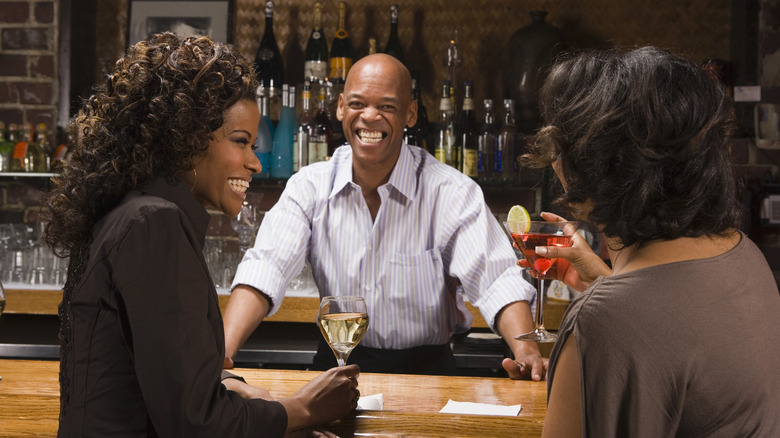
Even at the same bar, the night of the week or the way the bar is laid out can completely change a bartender's workload. Justin Lavenue explains to us that at one of his bars, The Roosevelt Room, they have dedicated service wells on busy Thursdays, Fridays, and Saturdays. He says, "A service-well bartender might be close to 100% drink production at certain times, while a bartender in a guest-facing well may need to be much more conversational." This is because they have 120 seats and a maximum wait goal of 10 minutes, so they have to split up and prioritize to be able to make drinks fast. As Lavenue puts it, "The best bartenders can read the room, turn the jets on when tickets are printing, and still find small moments to make guests feel taken care of." What you don't want is someone who is a preacher, or doesn't talk at all.
That said, Lavenue tells us that engaging with customers is truly important, and talking to guests should be prioritized. He simply notes, "guests are human beings, and human beings generally enjoy being treated like they exist." Lavenue admits that sounds obvious, but thinks lots of bars fail at even that low bar. It don't always have to be a profound conversation either, even just eye contact, a quick greeting, and a check-in go a long way. You don't want people ordering drinks at your bar to think they're invisible. Lavenue's advice ends with this: "Guests are the lifeblood of this industry. A bar whose staff does not genuinely appreciate the people walking through the door is probably not long for this world."