

Does A Hotter Coffee Maker Make Better Coffee?
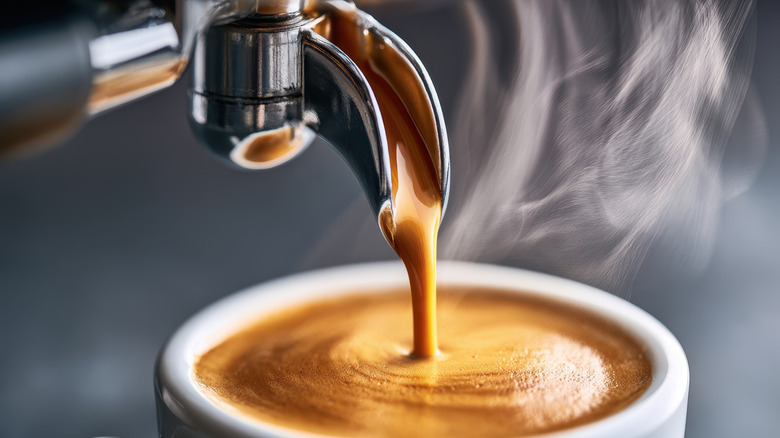
If hot water pulls flavor and caffeine from coffee grounds, it seems logical that hotter water would extract even more, making for a better cup. But the relationship between brewing temperature and a good cup isn't quite so linear. According to Matt Woodburn-Simmonds, ex-barista and founder of Home Coffee Expert, temperature is only one of several variables that determine the taste, strength and quality of what ends up in your mug. "Higher temperatures don't guarantee better or worse coffee by themselves," he says. "Higher temperatures speed up flavor extraction from coffee grounds, adding more energy to the system." Like hitting a gas pedal in a sports car, it'll make it go faster, but that's not necessarily a good thing in every context.
Any barista will tell you that coffee brewing is fundamentally an extraction process: water mingles with the grounds, dissolving soluble compounds and carrying them into the finished beverage, and each element of the process influences the outcome. "There are other factors such as grind size, brew time, and pressure which can also change how much flavor you get from your coffee, making a higher temperature unnecessary," Woodburn-Simmonds says. A finer grind changes the rate of extraction, and a longer brew gives the water more time to do its work.
Coffee type also plays a role in extraction, Woodburn-Simmonds explains. "Lighter roasts and higher-elevation-grown coffees are denser; this means flavors are harder to extract, so you need [a] finer grind, more pressure, longer brew times, or higher temperatures to extract them," he says.
Juuust right
The ideal brewing temperature, therefore, depends partly on what kind of beans you're starting with and how you're preparing them. "Coffee machines that can brew at higher temperatures ... are better for light-roast coffee and high-grown single-origin beans," says ex-barista Matt Woodburn-Simmonds.
That's especially important to keep in mind when making espresso, where some of those other variables have practical limits. "With espresso machines, you're usually limited on how fine you can grind and how much pressure you can put the water under," Woodburn-Simmonds says. Brew time isn't infinitely adjustable, either. As he explains, "If you want an espresso shot, you can't brew for longer either without weakening the final product, so you need to brew at a hotter temperature."
Woodburn-Simmonds identifies an upper temperature limit, warning that "Once you get over 205 [degrees Fahrenheit] you're in danger of burning your coffee grounds and ruining the flavor of your coffee," and nobody wants burnt-tasting coffee. This is why, he says, "Using boiling water to make coffee is never a good idea if you're looking for the best possible flavor." A coffee maker capable of those higher temperatures can be genuinely useful. But the hottest machine isn't inherently the best one; what matters is understanding your beans, and having enough control to match the ideal brewing conditions of the coffee you're using.