

You Can Cook Steak In Olive Oil, But There's A Catch
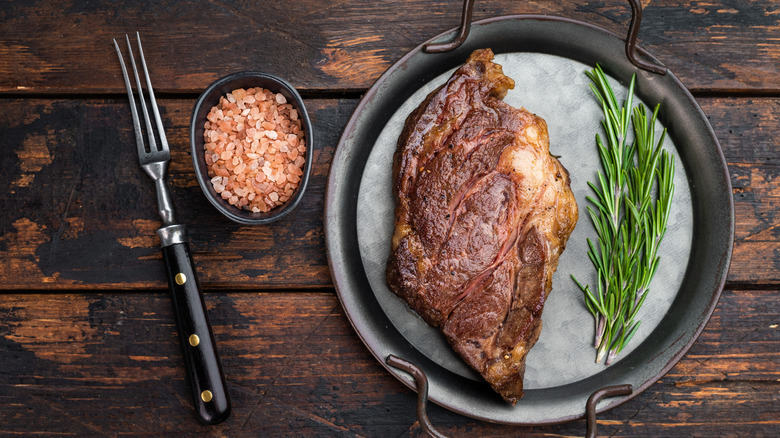
In many kitchens, olive oil is the go-to for all manner of cooking. It can be used to make a nice salad dressing, but it is equally good for a quick sauté. There are, however, certain tasks that this favorite oil is not considered suitable for — like searing a steak. As it turns out, however, this is not a hard-and-fast rule. According to Leandro "Lean" Gentini, the world's first international meat sommelier, it's just a matter of choosing the right type. In this particular case, you'll want to use a refined olive oil rather than that nice bottle of extra virgin.
"The purpose of using olive oil when searing a steak," he explains, "is not primarily to add flavor, but to help create a more even Maillard crust." As such, the benefits of choosing one of the better bottles of olive oil don't really matter. What does matter is how it performs in the pan. "A very thin film of oil fills the microscopic gaps between the steak and the hot cooking surface." Gentini says. "This improves heat transfer and allows browning to occur more evenly across the meat, producing a uniform, well-developed crust. For this purpose, refined olive oil is generally better-suited than extra virgin olive oil." The reason that refined oil is the superior choice for such a task is that its smoke point is a touch higher than that of extra virgin oils, which pairs perfectly with the conditions of creating a good sear.
What dictates the smoke point of different oils
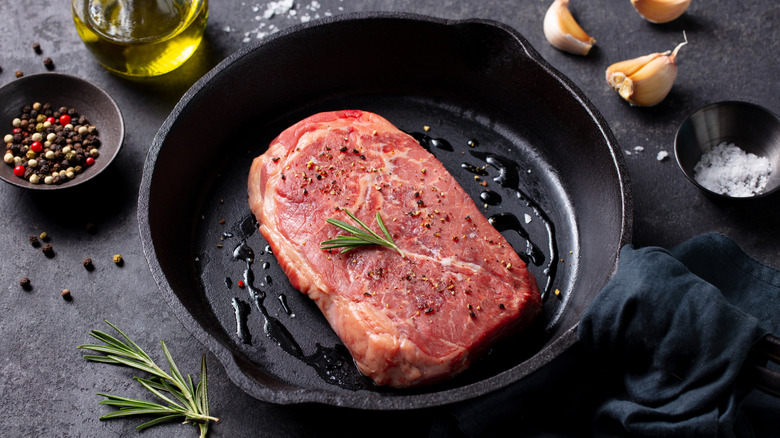
It may be a meat-searing myth that you need a screaming hot pan to achieve an effective Maillard reaction and create that beautiful crust — that begins to occur at around 280-330 degrees Fahrenheit – but it is the typical practice. According to Lean Gentini, the cooking surface often ends up in the 390-480 degrees range, which puts it in line with the qualities of refined olive oil, but not so much with extra virgin.
The smoke point of oil is largely tied to its quantity of free fatty acids (FFAs), which occur as triacylglycerols in the oil break down. Oils with higher quantities of FFAs are slightly acidic and typically have a lower smoke point. The acidity of olive oil is important when it comes to frying or searing for this reason: It is indicative of a low smoke point.
For refined olive oils, FFAs are inherently low. This means that these oils have smoke points of around 390-470 degrees — a good match for those previously mentioned searing temperatures. With extra virgin olive oil, FFAs are more variable. In some cases, they can also be quite low, but in others they can rise quite a bit. As such, the smoke point of extra virgin olive oil tends to fall around 350-410 degrees Fahrenheit — not quite as good a match. And while you might think that clearing smoke is no problem — that's the role of your hood fan, right? — there's more to it than that.
Tips for cooking steak with olive oil
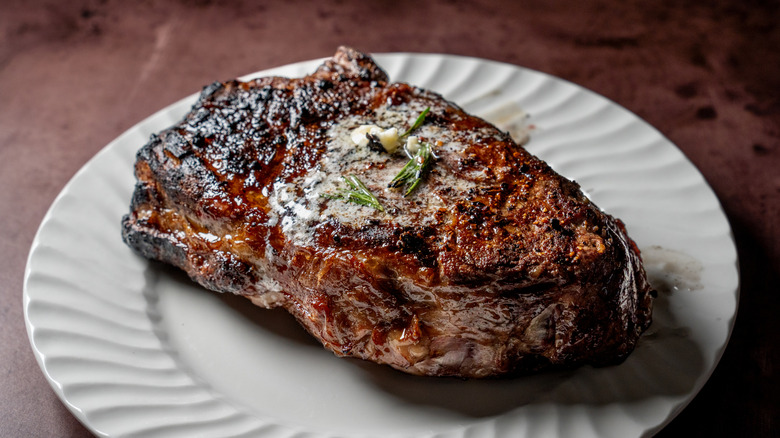
"When an oil is heated beyond its smoke point, it begins to smoke and potentially produces bitter or acrid flavors," Lean Gentini says. This, really is the bigger problem. If you are cooking outdoors or simply have a powerful ventilation system, smoke can be mitigated. Accidentally seasoning your steak with bitter and acrid compounds, on the other hand, is something that you want to avoid at all costs.
According to Gentini, in addition to using refined oil, there are a few other best practices that can help ensure an olive-oil-seared steak comes out just right. First, you want to pat the steak dry, as that lovely crust can't form in the presence of too much moisture. Next, apply a thin layer of oil to the steak itself. "The oil should lightly coat the surface and fill the tiny gaps where the meat does not make direct contact with the cooking surface," he explains. Be sure as well to preheat the cooking surface before adding the meat. And, finally, you want to use no more oil than is strictly necessary. "Excess oil can smoke, splatter, and make temperature control more difficult without improving the sear," Gentini says.
Refined olive oils don't have the same flavor as their extra virgin cousins — they aren't what you want for drizzling over freshly baked bread — but when it comes to the high-heat environment typically used to put a good sear on steak, that's exactly what you're looking for. "The objective is not to transfer the oil's flavor to the steak," Gentini says, "but to improve heat transfer and promote an even Maillard reaction."