

You'll Never Make The Best Burgers At Home If You Keep Making This Stovetop Mistake
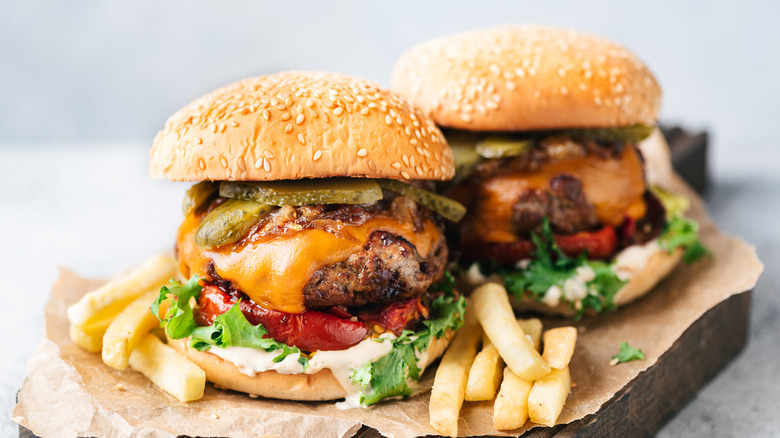
When you're frying a burger in a screaming hot pan, and the grease is spattering everywhere, grabbing a lid to contain the chaos seems like a good idea. Unfortunately, it's also going to contain something you're ideally trying to get rid of — water. When you put a lid over the pan while your patties cook, all that moisture escaping from the meat has nowhere to go, and your burger gets a steam bath. A good burger technique is mostly about setting up the right environment, then letting it cook, so leave the lid off.
This is because of the Maillard reaction, which is the complex series of chemical reactions between amino acids and sugars that creates the flavors and aromas of browning meat that we all know and love. A hot skillet creates the ideal conditions for it, especially once surface moisture has evaporated and the exterior of the patty can climb well above water's boiling point of 212 degrees Fahrenheit. As long as there's liquid water sitting on the surface, some of the pan's energy is being spent converting that water into vapor.
When you use a lid to cover the pan, you're trapping heat and accelerating the cooking, which is why you should boil water with a lid on — but when you're frying a burger, the vapor released by the raw meat becomes trapped beneath the lid, condenses, and falls back onto the food and into the pan, leading to more steamy sputtering. The humidity interferes with your efforts to keep the burger's exterior hot and dry enough for the development of the nice, crusty bark that indicates a perfect sear. The meat will cook, but you'll sacrifice the exterior texture and miss the concentrated, roasty, caramelized flavors that would otherwise be building up in the pan and on the meat.
Fry me up! Fry me down!
There are a few mistakes everyone makes when cooking burgers, and a related one is crowding too many patties into one pan, which will cause a similar steam problem. Collectively, they'll release moisture faster than the pan's heat can evaporate it away, so make sure to give each of your burgers some personal space, crank the heat, and let them actually fry instead of simmering in their own juices.
The lid isn't entirely banned from burger making, and it can actually help your cheese to melt completely when used intentionally. Once you've browned both sides and the crust is fully developed, a brief blast of trapped steam is just what you need, because you need ambient heat for perfectly melted cheese. Lay a slice over an almost-finished patty, add a splash of water, and cover for a few seconds. The steam will transfer heat efficiently around the cheese, helping soften it up before the burger underneath has time to overcook.
The same technique can help with an especially thick patty or stuffed burger like the Juicy Lucy, where the cheese is sealed inside the ground beef. Brown the outside uncovered first, then a brief covered finish will help the heat penetrate toward the center to melt the inner cheese. The emphasis here is on brief covering; there's no benefit to leaving your burger sweating underneath. Ground beef should ultimately, technically reach 160 degrees Fahrenheit internally, food safety-wise. An instant-read thermometer can help out there. The trick is to use both heat and moisture together — dry, high heat encourages browning, while trapped steam is useful when you deliberately want moist, efficient heat. Using the pan lid properly is how you control this.