

What Happens When You Never Descale Your Coffee Maker

Most devoted coffee lovers instinctively know when something is "off" with their morning brew. Even when a coffee maker looks fine from the outside, there could be a problem developing in the nooks and crannies. It's quite possible that the "D word" is to blame: descaling. It's a term that's increasingly prominent in modern coffee vernacular, and many folks know it needs to be done on a regular basis. But what exactly is descaling and what happens if you never descale your coffee maker?
To learn more about descaling, we chatted with expert Matt Woodburn-Simmonds, ex-barista and founder of Home Coffee Expert. "If you never descale your coffee machine, then minerals that are naturally dissolved in the water will eventually build up in the internal parts of the machine," Woodburn-Simmonds explains, "to the point where it gets blocked, and no water will come out."
But there's more at stake when failing to descale, including how it affects your enjoyment of the coffee. "Hard-water minerals like calcium and magnesium are what slowly build up in the boilers and pipes inside our coffee machines," he says. "These minerals can insulate heating elements, ruin the taste of your coffee, block pipework, and permanently damage your coffee machine." These aren't invading unnatural substances, but ordinary minerals commonly found in water supplies that can remain even when using commercial filters. In a nutshell, this is what you're facing with neglecting descaling for too long.
Tips for descaling a coffee machine
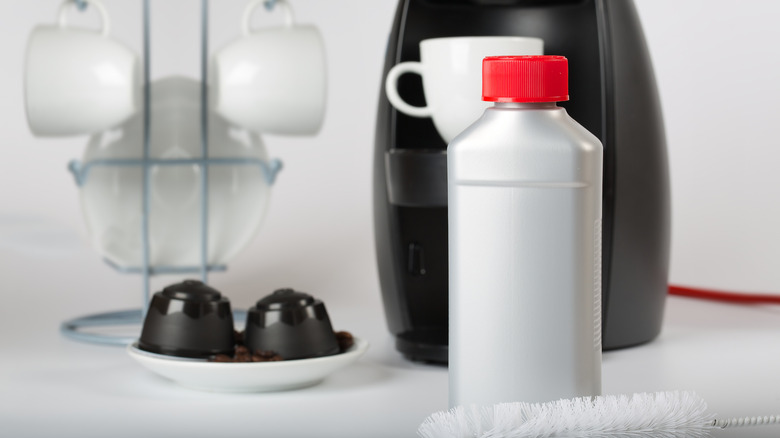
It's easy to assume that routinely washing the coffee carafe and wiping down the machine is enough. But while regular cleaning gets rid of stray grounds, coffee oils, and other residue, it doesn't tackle those minerals accumulating inside the machine's water system. Descaling may sound intimidating, even conjuring images of heavy scrubbing or special equipment, but it's actually quite simple. Descaling essentially just means eliminating limescale buildup inside the machine using a simple liquid solution.
Descaling does, however, take a bit of time. Some of it may be hands-on, depending on your machine, such as monitoring the stages and pushing buttons at certain intervals. But today's coffee machines often have blinking-light alerts and automated systems for descaling. If you have an older or basic machine, there are simple ways to do it on your own. As noted by Woodburn-Simmonds, you'll need either a commercial descaling solution or a DIY version using equal ratios of white vinegar and water.
"You can just run a bunch of cycles with no coffee/pods in your machine using the water-vinegar solution if you want to make sure the internals of your machine are clean and it doesn't have a descaling mode," he says. "Just be sure to rinse thoroughly, or you'll have a very unpleasant first few coffees after." Rinsing can be accomplished by running several cycles of plain water until the vinegar taste disappears.
For a deeper look at the process, including alternatives to vinegar, check out this highly effective way to descale your coffee machine. Nespresso devotees can also get intel here on how to know when your Nespresso machine needs descaling.