

How To Know If Alcohol Is Safe To Drink After Sitting On The Shelf For Years
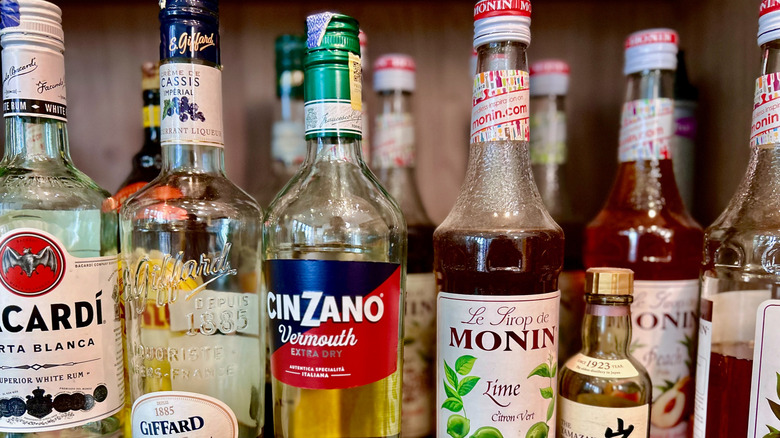
Be honest — there's a fair chance your liquor cabinet contains bottles that have been gathering dust for a long time. Whether it's an increasingly aged single malt Scotch you've been saving for a special occasion, or a bottle of Prosecco you never quite got around to drinking several Christmases ago, how do you know if alcohol is still good to drink after sitting on the shelf for years? More importantly, is it even safe to try?
To answer this question, Tasting Table turned to Molly Horn, chief mixologist and spirits educator at Total Wine & More. Horn emphasizes that there is no universal conclusion, but rather it depends on the type of alcohol and the manner in which it's been stored. "With full-proof traditional spirits," Horn says, "you may see some breakdown of flavor over time — particularly if the bottle is being stored in a location exposed to sunlight or temperature fluctuations — but the liquid likely won't look different. If it's a bottle with a cork that has been stored on its side, unlike wine, it will likely also have an altered, 'corky' flavor — it will not be enjoyable."
Liqueurs and lower-proof spirits, Horn warns, are a different matter. The older these types of alcohol are, the more likely it is that you will encounter not just a disappointing drop-off in flavor, but also signs of spoilage. The more sugar a liqueur contains, the faster it will deteriorate, hence why some experts advise you to throw out any bottle whose contents show signs of discoloration, curdling, or sugar crystallization (the last point being why you should always keep the cap clean when storing sweet liqueurs).
How to know if your wine is fine (don't fear the sediment)
When it comes to wine, the warning signs to look out for are markedly different. As mixologist and spirits educator Molly Horn explains, "Wine is very different from spirits in that color fall-out is usually a sign of a purposefully aged wine." This benchmark varies depending on the grape and appellation of the wine. For example, red wines aged between five and 10 years often develop sediment, which is commonly mistaken as evidence of poor storage (and may prompt some to ask if it's okay to drink the sediment at the bottom of your red wine bottle). Reassuringly, Horn says that sediment is almost never a sign of poor storage, but instead, "Sediment is the breaking down of tannins in the bottle that, as the chains thread together, settle to the base of the bottle (which should always be stored sideways)."
Instead of being overly concerned about sediment, you should pay heed to any bottle of wine that has a "super-crumbly" cork. This definitely could be a sign of poor storage, the effects of which could manifest in what Horn calls "notes of damp cardboard, wet dog, or a skunky note," none of which you want at your next dinner party. To play it extra safe, you can read up on how long unopened red wine lasts before it spoils, or you could avoid the risk altogether and drink your wine and liquor shortly after purchase.