

How Cold-Pressed Juice Is Different Versus Regular Juice

It's a well-documented fact that fruits and vegetables carry a multitude of health benefits, making them essential for reaching daily nutritional goals. But let's be real; getting the amount you need for maximum impact takes a good bit of planning and precious kitchen time. That's why lots of folks turn to juiced versions, whether store-bought or homemade. Two major categories of juicing machines — centrifugal and cold-pressed — extract those nutrients in different ways, with one supposedly providing superior nutritional value. To explore that claim, and to discover the actual difference between cold-pressed and regular juice, we reached out to Angel Luk, a registered dietician.
Luk first discusses what those two terms actually mean. "Cold-pressed juice is juice extracted from a machine that uses low speed to crush and press fruits and vegetables, with the intention of minimizing friction or heat that could theoretically destroy heat-sensitive vitamins," she explains. By contrast, Luk states that what's often referred to as "regular juice" is typically "extracted with a machine that uses fast, centrifugal force to separate the juice from the pulp."
Claims about the superiority of cold-pressed juice center on several factors. The lower amount of heat generated by the machines during extraction reportedly leaves more natural flavors intact, as well as the nutrient-bearing vitamins, enzymes, minerals, and more. According to advocates of cold-pressing, these types of juices are also easier to digest and be absorbed by the body. However, Luk says it might be more nuanced than that. In fact, despite considerably higher prices for the best cold-press juicers (also known as masticating juicers), some of those touted benefits may not hold up under scrutiny.
Does cold-press juicing significantly affect what's in your cup?
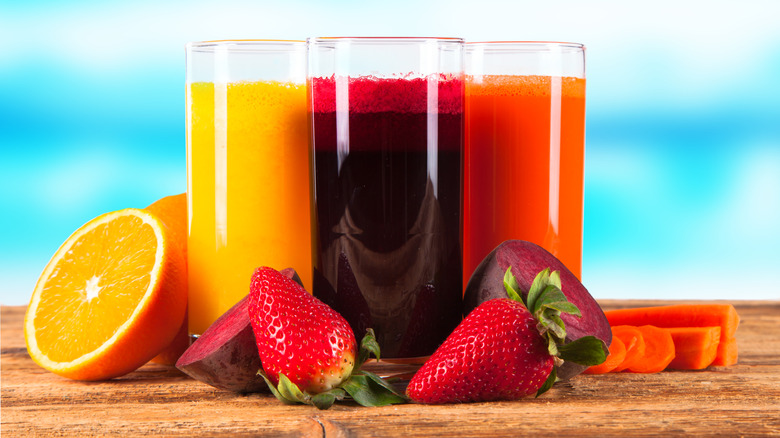
Luk first weighs in on the supposed taste superiority of cold-pressed juices. "Truthfully, I can't say I notice any difference between flavor," she notes. "Taste is very subjective, with some people being 'super tasters' and others more average, like myself. I think it comes down to preference, and for some, personal beliefs around how food, or in this case, fluid, is processed."
As for how masticating fruits and vegetables at very low temperatures affects the finished product, Luk says that, according to a reputable study, it doesn't actually impact the nutritional value of the juice. She notes, "The researchers stated that they 'observed no significant differences ... in terms of the contents of bioactive compounds and antioxidant capacity.'" The referenced study appeared in 2019 on the National Library of Medicine's Pub Med Central, a site that provides public access to scientific literature and findings. The posed question and research focus was: "Effect of cold-pressed and normal centrifugal juicing on quality attributes of fresh juices: Do cold-pressed juices harbor a superior nutritional quality and antioxidant capacity?"
Researchers prepared fresh fruit juices using both cold-press and centrifugal juicers, finding no immediate nutritional benefits of one over the other, as noted by Luk. They then monitored the cold-pressed juice over several days under room-temperature and refrigeration storage. It showed degradation of beneficial properties within 48 hours at room temperature, and after five days when refrigerated. In summary, the researchers reported, "Our results strongly question the claim regarding the superior quality of cold-pressed juices."
Regardless of which juicing method you choose, check out these 12 tips and tricks for using a juicer — and take care to properly store freshly juiced drinks to preserve flavor for as long as possible.