

Make Your Fridge More Eco-Friendly By Checking This One Setting

A refrigerator's job is to keep our food and drink cold, and provided they do so, most of us don't give these appliances any more thought than that. Yet with mounting environmental concerns and rising energy bills weighing on many people's minds, it is well worth considering how a simple adjustment to your refrigerator's settings could not only render it more eco-friendly, but potentially save you some money.
Adjusting your fridge's temperature setting to 40 degrees Fahrenheit is one of our 11 money-saving tips for cutting a refrigerator's electricity costs. According to the FDA, 40 degrees Fahrenheit is the absolute warmest temperature at which a refrigerator can be kept without risking the development of bacteria and foodborne illness — an important refrigeration safety tip you might have overlooked, as anything between 40 and 140 degrees Fahrenheit puts your food into what is rightly referred to as the "danger zone".
You might assume that a few degrees of variance wouldn't make much of difference, but you would be mistaken, as setting a refrigerator 10 degrees colder can use as much as 25% more electricity. Keeping your fridge too cold won't do what you're keeping in it any favors, either. The U.S. Department of Energy also endorses keeping your refrigerator between 36 and 40 degrees Fahrenheit, as temperatures below this range won't provide any greater safety benefit to food preservation and will only waste energy. Sticking to 40 degrees Fahrenheit, on the other hand, will keep items chilled and protected, whilst achieving maximum energy efficiency (not paying attention to which, is one of 13 mistakes to avoid when buying a new refrigerator).
How to change your fridge's temperature and make sure it stays that way
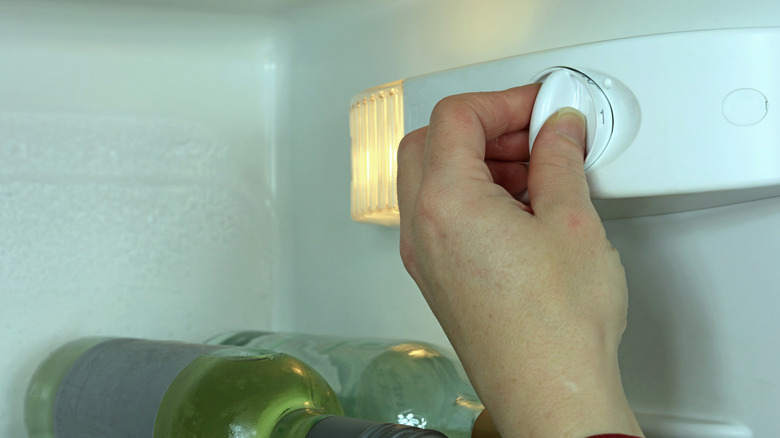
So, how can you make sure you refrigerator reaches precisely 40 degrees Fahrenheit? It's not always as simple as adjusting the temperature setting. The FDA warns that the temperature should be checked periodically, noting that using a freestanding appliance thermometer is the way best of doing so, as your refrigerator might not have a display showing you what the current temperature is or may only have a numbered dial.
What about other factors that may affect your refrigerator's temperature? You've probably heard that you should let any hot foods cool completely before refrigerating, but this is actually a myth that doesn't reflect how technology has changed over the years. Since modern refrigerators are designed to maintain a consistent temperature, putting still-warm food in the fridge should be safe, provided it is properly stored. Still, if you're still concerned that the residual heat of your leftovers may affect the fridge's temperature when it's already at the maximum safety threshold, remember that the USDA advises that food can be kept at room temperature for up to two hours, or half that time if that temperature is 90 degrees Fahrenheit or above.
However, you will still need to make sure that your refrigerator is functioning optimally for everything in it to stay at the desired temperature. In order to keep the contents of your 40-degree-Fahrenheit fridge safe, the FDA warns against overpacking it, as this can disrupt the circulation of cold air within the appliance, which can thus raise the temperature and waste electricity.