

Meant To Compete With KFC, This Classic 1960s Chain Collapsed After Just A Few Years
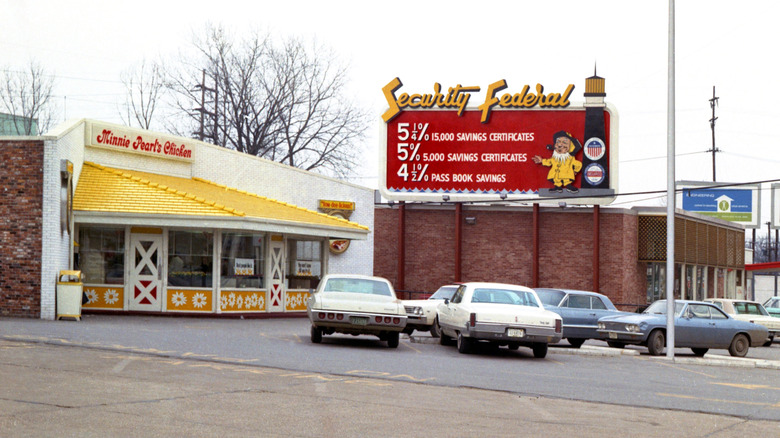
America isn't short on fried chicken fast food chains. Yet, when you stop to think about the type that exist out there, it can feel like a carefully crafted ecosystem. Sure, competition exists, but anyone hunting for fried chicken might feel that each chain is unique in its own way. Popeyes isn't Chick-fil-A, and Zaxby's is distinct from Raising Cane's. To that end, it's hard to imagine a chain giving KFC a run for its money in a category of food that it basically invented. Yet back in the 1960s, that's exactly what one classic chicken chain tried to do. The company was known as Minnie Pearl's Fried Chicken (legally, Minnie Pearl's Chicken System Inc.), and it lasted shorter than a bubble of oil in a fryer — metaphorically, of course.
Nashville is known for two things: country music and its own spicy style of chicken. Before the hot stuff took off, there was the possibility that Nashville could've been known for Minnie Pearl's version of fried chicken, had things gone differently. Back in the '60s, Sarah Cannon was a popular comedian at the Grand Ole Opry, famous for a tv show called, "Hee Haw" and the persona Minnie Pearl. Cannon was convinced to license her name for a chicken chain that would put KFC on notice, and the brand quickly went into franchising using her likeness and the slogan, "How-dee-licious!" Unfortunately, some suspect accounting made for a quick end to the budding company.
Cooking the books
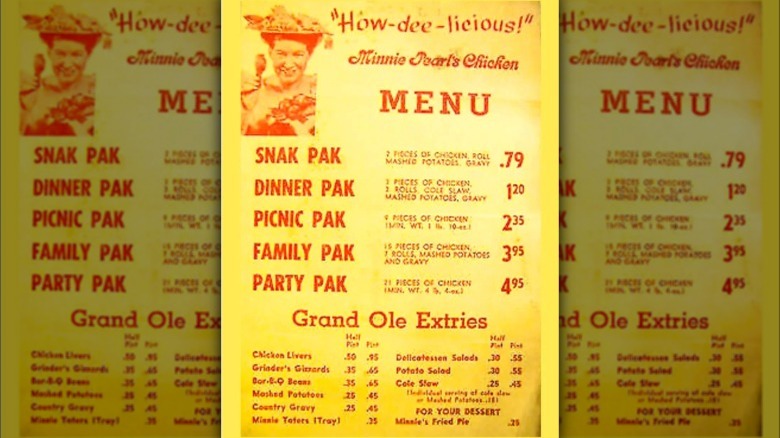
Minnie Pearl's Fried Chicken began and ended as a company bent on franchising at the expense of all else — even the fried chicken. Although the business's inexperienced proprietors, John Jay and Henry Hooker, initially did hire a Chicago food lab to develop a recipe that could stand toe-to-toe with Colonel Sanders' stuff. The "dee-licious" menu included various chicken "paks" by the piece, some of which came served with "Grand Ole" sides like mashed potatoes, gizzards, barbecue beans, or slaw. Thanks to the deceptively busy location of the prototype store and persuasive selling techniques, franchisees bought in. Having a down-home legend like Minnie Pearl on the marquee helped sell the story that the chicken was from some family recipe.
In the model of KFC, the Hookers began selling shares of their business in '67, and took their company public, circa 1968. However, business documents declared to the Securities and Exchange Commission (SEC) clearly stated that the company's income was primarily from franchising fees, not from the growing flock of locations. The stock price took off. By 1969, Minnie Pearl's had 40 open locations and 400 in some type of development. Few of those restaurants were actually successful, and there seemed to be a lack of consistency in what was served. But John Jay Hooker continued developing an umbrella company that diversified the business into hamburger joints, barbecue restaurants, and more, striving to greater ascension.
Eventually, an SEC investigation was opened into the company that revealed the Hookers had submitted falsified reports. The company was proven to have lost millions where it previously reported profit. Investor (and customer) trust eroded when the company was forced to revise earnings reports in '68. By the mid-1970s, stock was going for pennies, and by 1975, Minnie Pearl's parent company had sold all of its major assets.