

Why Jack Daniel's Tennessee Honey Isn't Technically Whiskey
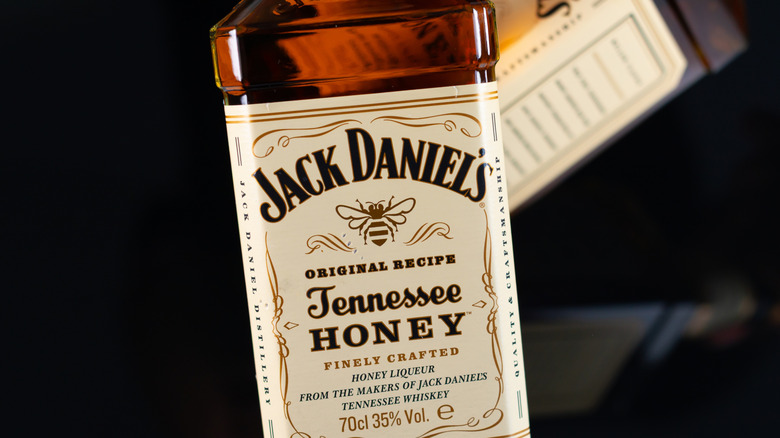
Scan the Jack Daniel's section at your local liquor store, and you're likely to spot a bottle of Tennessee Honey. What you won't spot, however, is the word "whiskey" anywhere on its label. This is because Jack Daniel's Tennessee Honey is not actually a whiskey, but a whiskey-based liqueur. Why does this classification matter?
In order for a spirit to be legally labelled as whiskey, it must adhere to a specific set of criteria. Namely, the liquor must be distilled from a fermented grain mash at less than 95% ABV and bottled at 40% ABV or higher. Jack Daniel's Tennessee Honey clocks in at 35% ABV, slightly below the industry standard for full-proof liquors. It's still punchy — about on-par with the potency of herb-infused Jägermeister – but doesn't cut the mustard, legally. The addition of honey, which is not a traditional whiskey ingredient, also disqualifies Jack Daniel's Tennessee Honey from true whiskey status.
Still, this spirit has some claim to the cosmetic dressings of the distinctive Tennessee whiskey subcategory. Tennessee whiskey must be produced in the state, made mostly of corn (at least 51% in the mash bill), aged in new charred oak barrels, and use a charcoal-mellowing process. Jack Daniel's Tennessee Honey is a blend of the distillery's flagship Old No. 7 Tennessee whiskey and a honey liqueur made from real honey. With this formula, the bottle tenably straddles the categories of liquor and liqueur. Subsequently, its mouthfeel is also markedly thicker than that of traditional whiskey.
The honey infusion makes this spirit a whiskey-based liqueur
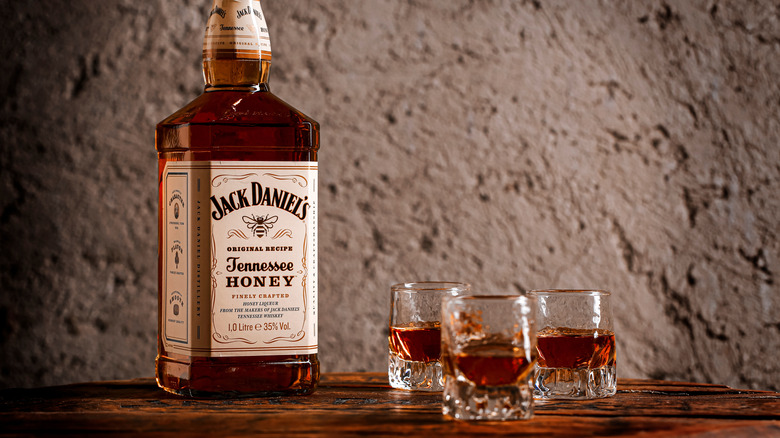
Seasoned barflies may note that this bottle isn't a far cry from another backbar staple whisky liqueur: Drambuie. Sweet, gold-toned Drambuie is made from honey-infused Scotch whisky. But Drambuie carries a richer, sweeter flavor due to the Scotch base's malted barley mash bill (traditional whiskey uses mostly corn or rye). It also delivers a spiced bouquet absent from Jack Daniel's Tennessee Honey (think licorice, clove, and star anise). With Jack's contender, it's all about the marriage of honey and whiskey — nothing else.
While it may not technically be a whiskey, Jack Daniel's Tennessee Honey offers a sweeter, more approachable alternative that retains the foundational profile of that Old No. 7. fans love. Tasting notes of honey, caramel, and maple follow a strong vanilla-forward nose. The touch of honey balances the oaky, woody, grainy tones of the Old No. 7, ending in a smooth finish that tames the whiskey's sharpness while retaining some alcohol bite. Admittedly, a common criticism of Jack Daniel's Tennessee Honey is that it lacks the complexity and depth of traditional craft whiskeys, and might not be the best option for pious whiskey aficionados.
This honey-infused liqueur first hit shelves in 2011, when flavored, high-proof liqueurs were enjoying a moment. Fireball, another popular flavored whisky, saw sales of $1.9 million in 2011 alone, a figure which would skyrocket to $863.5 million in 2014. Today, Jack Daniel's Tennessee Honey is easy to sip over ice or in a highball with ginger beer; the dilution helps stave off a cloying aftertaste. It also makes a dynamic cocktail ingredient, bringing subtly-sweet roundness to classic sippers like the whiskey sour or a cozy hot toddy.