

What Happens When You Use Too Much Flour When Baking Cakes
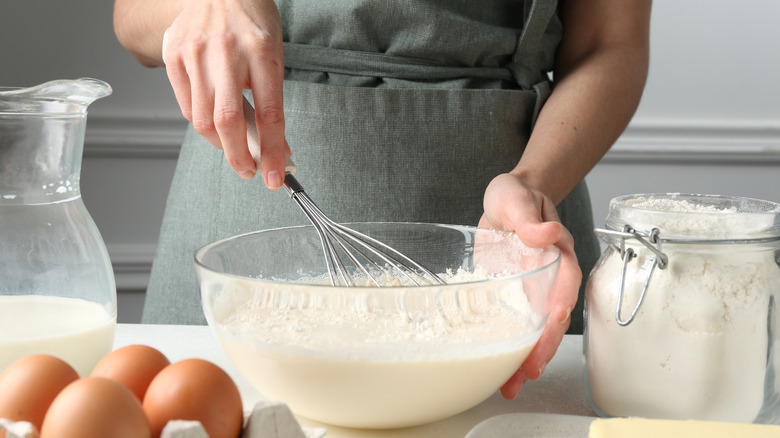
Few things are more satisfying than baking your own cakes, but as any home baker knows, there are always going to be new things to learn and skills that take some practice to perfect. Out of the many common mistakes people make when baking cakes, one of the most detrimental is adding too much flour. When this happens, you'll likely end up with a dense, dry cake.
Similar to what happens if you add too much flour to your homemade bread, a cake batter with an abundance of flour means that wet ingredients will quickly be absorbed by the dry ingredients; this results in a dry cake with little (if any) moisture left. A heavy, dense quality and tough consistency go hand-in-hand with this, as the extra flour simply weighs the batter down.
There are different types of flours that affect cakes in various ways, so it's important to know what kind to use in your recipe in order to achieve the ideal texture — tender shortcake requires something different than an airy sponge cake, for example. But, generally, flour's protein content is key. It creates the gluten net when introduced to moisture that, in partnership with rising agents like baking soda, help the cake rise into its fluffy texture. Too much of that protein, though, and the moisture gets sucked right up. This can also lead to a big crack in your cake.
How to avoid adding too much flour
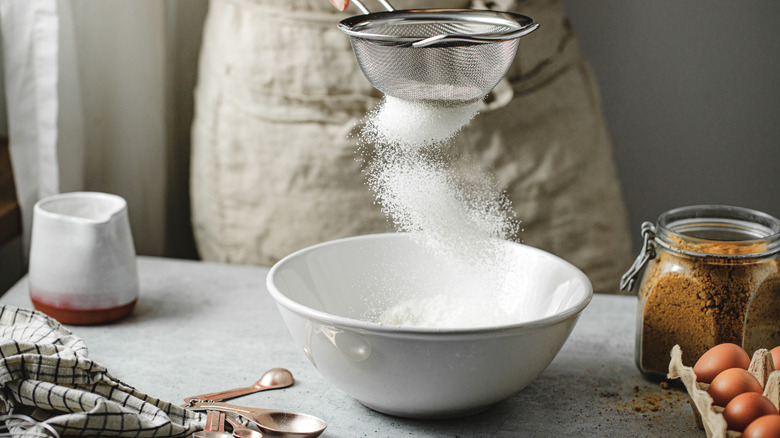
Adding too much flour is a fairly easy blunder to make, but it's just as easy to avoid with a little know-how. The most important step is to measure flour properly for better cakes. For starters, remember that flour sitting in your pantry is compact in its container, but you want it aerated and loose. Sifting is crucial. Changing the flour's texture impacts its volume, which is why you may see some recipes refer to flour measurements as "one cup, sifted" instead of "one sifted cup." The former tells you to measure out a cup of flour and then sift it, while the latter means you should sift it, then measure.
Using a digital scale and knowing exactly how many grams of flour your recipe requires is also a game-changer. "One cup" can leave things unclear — how packed in is that cup? Knowing you need a precise 125 grams of flour, however, leaves significantly less room for error.
Keep in mind that different flours may also have different weights. One cup of all-purpose flour equals 125 grams, for instance, versus one cup of cake flour that weighs about 114 grams. Different flour types also have varying amounts of protein — remember, that will affect how tough those gluten nets are. So, if you try to make a cake that calls for 125 grams of cake flour, but you only have pastry flour or you're using almond flour to go gluten-free, the measurement won't be the same. So, check your flour types, use a scale, and sift, and you'll have a decadently moist, light cake.