

Is Seafood Actually More Eco-Friendly Than Red Meat?

There might have been a time when the week's grocery list was determined entirely by prices and preferences, but that time is gone. These days, another question guides what will actually end up on your plate: How does this meal affect the environment? When it comes to weighing surf versus turf, there is a clear winner across the board — seafood.
When weighing the environmental impacts of food, we first look at the carbon footprint. Eating meat affects your greenhouse gas emissions, but fortunately for pescatarians, the average emissions for seafood products are much lower. According to Oceana, average emissions come out to 39.5 grams of carbon-dioxide per gram of protein with wild-caught seafood, and just 24 grams for farmed products. That puts aquaculture all the way at the bottom of the list, as the least carbon-intensive protein source studied — below even milk and eggs, which emit 27 and 38 grams of carbon dioxide, respectively.
Measuring at around the same levels as vegetarian-friendly products like milk and eggs should make it clear that the greenhouse gas emissions for seafood are quite low. To really understand how low, though, we need to shift the lens to red meat. According to the same research, pork products release 65 grams of carbon dioxide per gram of protein, cheese measures in at 85, mutton leaps up to 200, and beef tops the list at 238 grams of per gram of protein — six times as much as wild-caught fish and almost 10 times that of farm-raised seafood.
Other environmental factors to consider with your seafood order
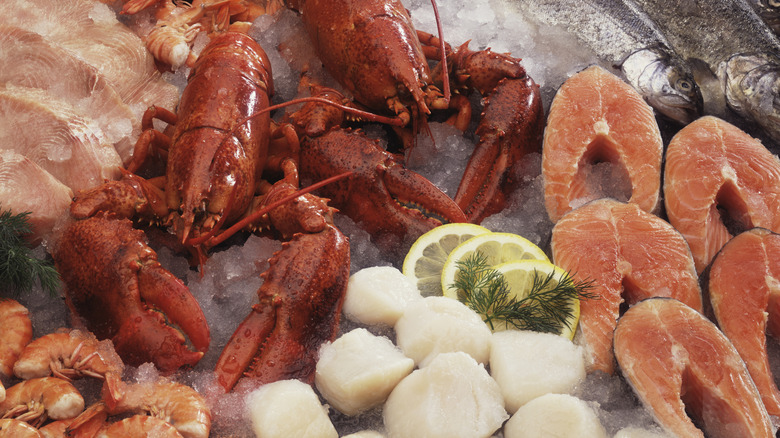
As important as greenhouse gases are, the environmental impacts of your preferred protein extend further. Factors like land use, water use, and sources of pollution are also important to consider, and seafood products once again have the upper hand. Beef is notoriously land and water intensive, using about 1,840 gallons of water and 1,600 square feet of land per pound of hamburger according to the USGS and Compassion in World Farming. The land use for wild-caught seafood is naturally zero, and aquaculture products also tend to be intensive, not requiring significant space or resource inputs. Additionally, while the earlier days of aquaculture may have been marked by things like antibiotic use and pollution, standards and practices have improved over the years, making a myth of the superiority of wild-caught fish over farm-raised.
By every metric — greenhouse gas emissions, land use, water use, etc. — seafood products come in above red meat. That does not, however, mean that all seafood products are created equally. When it comes to shopping for the most sustainable seafood, it does still pay to do some research. For example, wild-caught crustaceans are more carbon-intensive than others; and all wild fisheries need to be carefully monitored to ensure the continued health of the population. Fortunately for shoppers, organizations like the Marine Stewardship Council (MSC), the Aquaculture Stewardship Council (ASC), and the Monterey Bay Aquarium's Seafood Watch all have excellent resources to help you make responsible decisions.