

Steak Fat Cap Vs Silver Skin: How To Tell The Difference
Making the most of any piece of beef requires a certain amount of knowledge. Different cuts demand different cooking styles, and even truly excellent beef can be ruined if not prepared properly — such as when home cooks confuse fat cap and silver skin. To help explain the difference between these two elements, as well as what to do with each of them, we sat down with chef K.C. Gulbro, owner of FoxFire Steakhouse in downtown Geneva, Illinois.
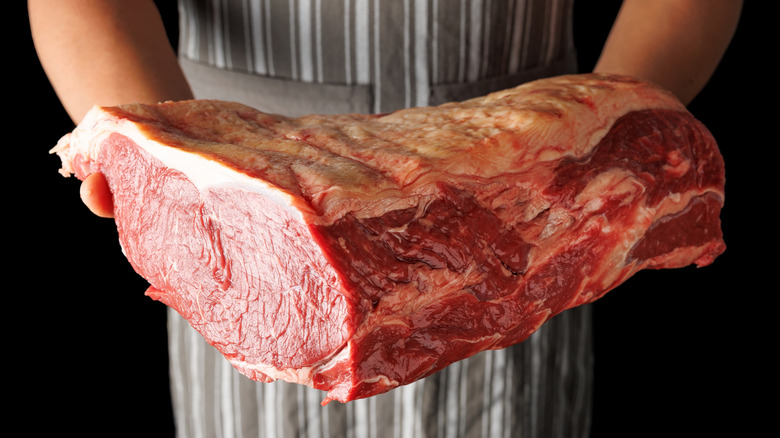
"Silver skin is shiny, thin, tight, and tough," says Gulbro. "It looks almost like plastic." It is a silvery-looking very fine layer of connective tissue that can be difficult to remove and, as the steakhouse chef notes, "It does not melt into the steak." By comparison, "A fat cap is softer, creamier white, and thicker," states Gulbro. The fat cap, when cooked, will render, which can have various benefits like adding flavor and keeping the meat moist. Because of how differently they respond to cooking, the fat cap and silver skin need to be treated very differently — and the first step there is telling them apart.
"A beginner can tell the difference by touch," Gulbro says. The fat cap is soft and can easily be dented with a finger or shaved off with a knife. Silver skin, on the other hand, is hard to cut through and harder to peel away. "If it looks shiny and feels tough, it is probably silver skin. If it looks creamy and feels soft, it is probably fat," Gulbro says.
Should you remove the fat cap and silver skin from steaks?
Once you've figured out the difference between silver skin and a fat cap, the next step is deciding how to treat them. As Gulbro explains it, silver skin equals chew and fat cap equals flavor. As a result, his method is simple: "Silver skin I will remove. Fat I will manage."
Even though it can be a pain to peel it off, you should always remove the silver skin. Leaving it on will ruin the texture of the meat as it shrinks, twists, and gets even tougher when cooked. For the simplest removal, cut a tab of silver skin that you can hold onto and slip a sharp knife underneath. Slide the knife down while pulling on the silver skin membrane, keeping the blade angled away from the meat until the silver skin comes free, and you can use the knife to help strip it away.
The situation with the fat cap is slightly more complicated. "A fat cap can be useful," Gulbro says. "It can protect the meat, add flavor, and help baste the roast as it cooks." But while a little bit of fat melting into a steak is wonderful, it is possible to have too much of a good thing — and that includes excess fat on a steak. "Too much fat can block seasoning and prevent browning on the meat itself," Gulbro explains. That said, he likes to leave some fat cap on many different cuts of beef. In addition to roasts like prime rib, he suggests leaving some of the fat cap on steaks like New York strips and ribeyes. For flat iron steaks and filets, on the other hand, Gulbro trims all the fat away.