

Many Plant-Based Milks Are Full Of Seed Oils — Here's Why
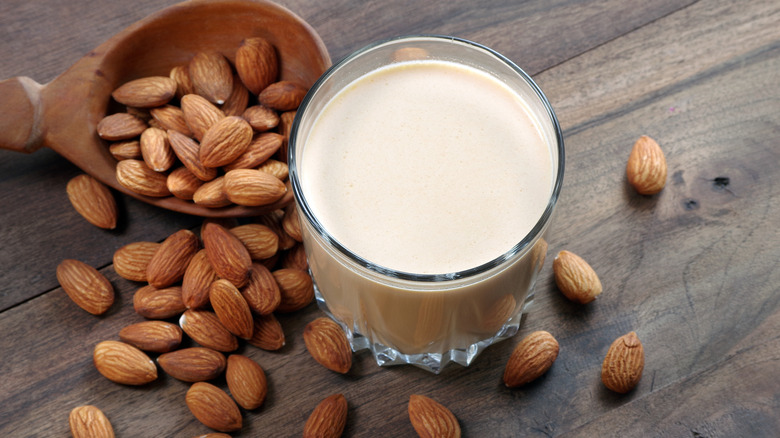
If you haven't been staying up to date on the latest health news or health-centric food fads, you should know that seed oils are having a moment — and not in a good way. They're called all sorts of nasty (and often untrue) things, especially in regards to their purported inflammatory effects. These negative connotations have been tacked onto foods containing seed oils, including one popular option that many vegans and lactose-free folks have in their fridges: plant-based milks. But why would seed oils need to be in a product labeled as "milk" in the first place? We asked registered dietitian Angel Luk for some clarification.
According to Luk, the inclusion of seed oils in these beverages has a lot to do with the mouthfeel of the beverage, which makes sense, as companies are trying to pass it off as dairy milk-like. "Plant foods such as almonds or soy do not have the same type or amount of fat when pressed and processed into a liquid form and therefore, seed oils are often added to mimic the taste profile of cow's milk, while also helping to emulsify the product so it doesn't separate as easily," she says.
Luk also explains that seed oils specifically – which can include flaxseed oil, grapeseed oil, and sunflower oil — have a neutral flavor, meaning they can add to the creamy mouthfeel without detracting from the natural taste of the beverage. "Non-seed oils, such as olive or avocado, have a much stronger flavor profile that would become more dominant and likely less acceptable to consumer taste buds," she adds.
Should you be concerned about seed oils?

Steak 'n Shake switching from oil to beef tallow at its locations was only the tip of the iceberg, and it's showing how public fear has resulted in some major product changes for brands looking to cater to consumer preferences. The fuss over seed oils further aligns with the crusade against ultra-processed foods (a term with a loose definition at best). Regardless, it's worth noting that there's no evidence to suggest that seed oils — in plant-based milks or otherwise — are actually dangerous to people.
Some health influencers argue that seed oils are inflammatory, but there is insufficient evidence to state that the omega-6 fatty acids in seed oils lead to inflammation in humans. There is, however, research to suggest that consuming moderate amounts of seed oils (and the omega-6s in them) can actually contribute to positive cardiovascular health outcomes. The chemical solvents used in the production of seed oils have also been shown to be safe.
Luk credits social media for this false narrative around seed oils. "There is a lot of information on social media that creates a high level of fear, anxiety, and confusion around seed oils and their potential damaging effect," she says. It's also worth mentioning that while we want definitive answers when it comes to nutrition, not everything can be put into those boxes. "Realistically, the nuances of 'moderation' often feel like a greater mental load than a more simplistic 'eat this and not that' approach," Luk says.