

Why Farm-Raised Salmon Can Actually Be Safer Than Wild-Caught For Raw Consumption
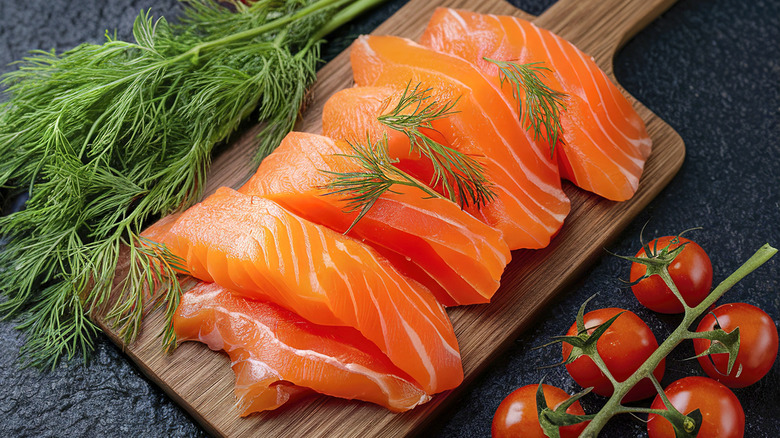
For seafood lovers, the term "wild-caught" can automatically sound like the superior choice. One immediately imagines chilled Alaskan streams with schools of salmon frolicking merrily. And wild salmon is often praised for its natural diet, rich flavor, and sustainability. But if you're planning to eat salmon raw, the rules are a little bit different. Here to explain is Dora Swan, founder of fin — your fishmonger, located in the Capital District of New York state. Swan starts by stating what fish labels really mean, saying, "Let's start with the term 'sushi-grade' first, when we're talking about eating raw fish. It's a made-up marketing term. It's not an FDA-regulated term. Now you know," she clarifies. "But, it does connote a certain quality standard that one expects from the seafood purchase, right? Super-fresh, high quality, etc."
Swan brings up a crucial point. Not everyone knows that the enforcement of a sushi-grade label is all up to the fishmonger. "We used that shorthand term in our seafood shop simply because it speaks to the expectations that one has about the seafood they're purchasing," Swan explains. So what's the advantage when it comes to farm-raised? "Responsibly farmed salmon (meaning no artificial hormones, coloring, or antibiotics) can be safer than wild salmon for eating raw because the diet of the fish is controlled," she says. "Seafood in the wild eat what's available." These wild salmon have quite a buffet of food choices, and when they consume smaller fishes or crustaceans, they can pick up parasites.
Farm-raised salmon is highly regulated and controlled
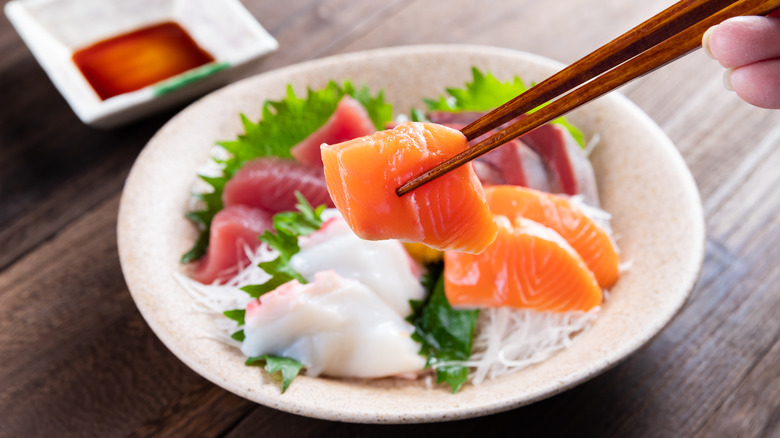
That wild diet is precisely what Swan is concerned about: "Let's talk about that diet — is what the fish is being fed also sustainably harvested? Are there other contaminants (like PCBs) in the concentrated feed? It's a big circle of complication, isn't it? This is why it's so important that you trust your source for seafood purchasing and to use an app like the Monterey Bay Aquarium Seafood Watch." This app not only guides you in picking out reputable suppliers, but also if your seafood choice is even sustainable.
However, you don't have to totally rule out wild seafood if you trust your source or local fishmonger. Swan explains, "It's also okay to purchase wild seafood for eating raw if it's been frozen properly. That means being maintained at -4 degrees Fahrenheit for seven days or -31 degrees Fahrenheit for 15 hours." These very specific, highly controlled conditions can kill parasites, but there's always a risk of foodborne illnesses when eating raw proteins.
That's why Swan believes that "responsibly farmed seafood can be better than eating wild seafood raw if you have asked the right questions." There are many myths and misconceptions about farm-raised salmon, which is why it's a good reminder that when it comes to food safety, wild doesn't automatically mean better. When choosing between wild and farmed salmon, a fish raised in a carefully managed environment may actually be the safer choice for your next plate of sashimi.