

That Tough Strip On Your Steak Isn't An Accident — Here's Why Butchers Leave It On
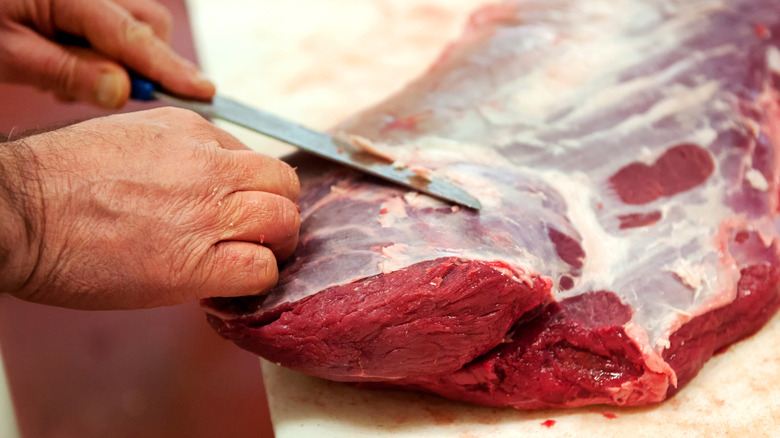
For people who love cooking a steak, there is one part that can often be a hassle: the silver skin. You won't find it all the time, but anyone who has trimmed steak or smoked some ribs knows how annoying that sliver of transparent membrane can be. While the silver skin is made from connective tissue — just like collagen and the gristle on steak — it won't break down the way collagen does when cooked. Instead, the silver skin gets even tougher and inedible. Which is enough to make you wonder why butchers leave it on the steak at all? We spoke with K.C. Gulbro, owner of FoxFire Steakhouse in Geneva, Illinois, and he tells us there is a practical reason butchers leave the silver skin alone.
"Silver skin can protect the meat during storage and handling," Gulbro says. "Leaving it on can also help preserve yield because removing it takes time and skill. If it is trimmed poorly, you can waste good meat." So while keeping it on may create a chore for you, it can be necessary to maintain your steak's good quality. While you may think a butcher is supposed to do as much of the work for you as possible, that isn't always the tradition with some meat. "Some cuts are also sold with the expectation that the cook, butcher, or chef will do the final trimming before cooking," Gulbro adds.
Silver skin can help protect your steak before it's ready to be cooked
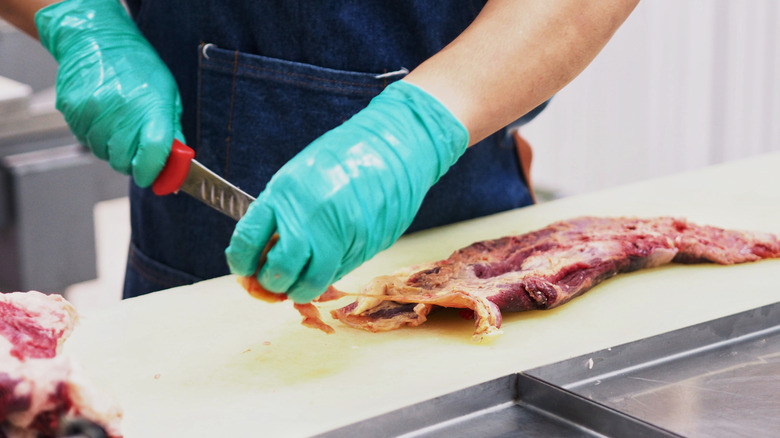
Plenty of different steak cuts are sold without the silver skin, while others usually have it. "You commonly see it on cuts like tenderloin, filet, sirloin, flank, skirt, flat iron, tri-tip, and some roasts before they are fully trimmed," Gulbro says. "It looks like a thin, shiny, silvery-white membrane sitting on top of the meat." It's important to know the difference between this and fat, which will be creamy and opaque white.
Gulbro recommends trying to remove the silver skin if you can, but there are exceptions. "If the silver skin is helping hold a delicate piece together and is not in a bad eating spot, you might leave it," he says. There will be times when trying to remove it can do damage to a steak. Depending on the location, which may make it tough to remove, you can also tackle it after cooking. "If the steak has a vein running through it or silver skin, slice before serving," he adds. I"t prevents a beautiful steak from being ruined by overchewiness."
If the silver skin is in a flat, easy to remove location, all you'll need is a sharp pairing knife. Carefully use the tip of the knife to get under the skin. If it is slippery and you're having trouble gripping it, a paper towel will help you hold on. Then lift the skin and gently pull up as you slide the knife between the meat and membrane. Once you get the first part separated it should actually come off rather easily, so you don't need to make your butcher do too much work on your beef.