

How And When To Prune Tomato Plants For The Best Growth All Season
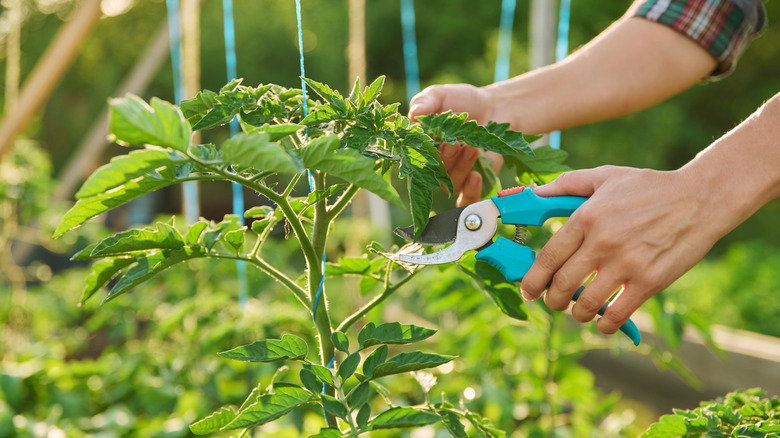
Growing your own tomatoes might sound like a guaranteed way to have a fresh summer bounty all season long, but it's not easy. Tomato plants can be quite finicky, with specific maintenance needs that include when, how, and why you need to prune tomato plants. Even that's not straightforward: Certain types of tomato plants don't need to be pruned, while for others, it's imperative. In these cases, it's best done when your tomato plant has reached about 12 to 18 inches in height, early in the morning on dry days.
Before you start pruning, you need to know if your tomato plant is determinate, indeterminate, or semi-determinate. Determinate tomato plants have a small, bushy shape and are a common pick for container planters or compact spaces. This variety doesn't need to be pruned. In fact, you're likely to decrease your yield if you do. Indeterminate tomatoes, on the other hand, are tall, vining plants that need to be pruned to see the best results. Otherwise, you run the risk of an overgrown mess of leaves and stems.
Semi-determinate plants fall between the two. They're smaller and bushier, but they're also technically indeterminate, as the shape comes from their shorter vines. This combination means they should be minimally pruned — more than determinate tomatoes, but less than true indeterminates. For both indeterminate and semi-determinate plants, there are a few pruning rules worth following.
Top tips for pruning tomato leaves
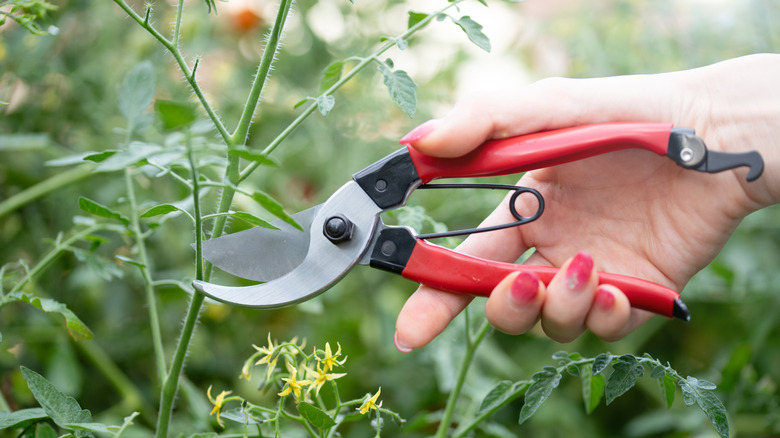
Once you've confirmed you have a tomato plant that needs careful pruning, you'll want to clip off any leaves that touch the soil, as excessive foliage at the base can increase humidity and lead to mildew and other diseases. It's also important to move any leaves crossing each other from the base up, so that your plants can focus energy on doubling your harvest. As you work, remove excess shoots or suckers so more air and light can reach all parts of your plant — ultimately yielding a higher yield.
You should be able to pull most shoots and suckers off manually by pinching at the base of the growth closest to the stem, or you can use pruning shears on more stubborn stems. Higher up, when thinning out the canopy of your tomato plant, prioritize keeping areas with flowers, as this indicates a stronger stem. As with the base, pruning away additional leaves is key to improving airflow, but also allows better access for pollinators to reach the top of the plant.
Then, once removed, don't throw away your excess plant parts. Suckers can be placed in water to root and turned into new plants, and the leaves can be mixed with water and turned into a plant fertilizer. Simply steep in water for five days, dilute with a mixture of 1:5 parts water, and pour around your garden for added nutrients.