

Cowboys Often Ordered This Fizzy Drink In Old West Saloons: Here's How You Can Try It In 2026

The scene is a familiar trope: A cowboy sidles his way through the swinging doors of an Old West saloon, waddling his way up to the bar after a long day in the saddle, and orders himself something that sounds like "sasparilla." Cliche though it may be, the fizzy brown soda that arrives in a brown glass bottle was actually a popular drink of the time and region, though the actual name is sarsaparilla, after the vines whose roots are used to flavor the soda.
Several vines of the Smilax genus native to Central and South America — the same genus to which the more familiar greenbriar belongs — were used to make sarsaparilla. The original name, "zarzaparilla," comes from the combination of two Spanish words, "zarza," meaning bramble, and the diminutive form of "parra," meaning "vine." Much like greenbriar, sarsaparilla is a spiky little vine, though this one was long considered to be useful for treating a wide variety of ailments.
When Europeans arrived in the New World, indigenous populations were already brewing health tonics with sarsaparilla, and these colonizers quickly adopted the practice. By the 19th century, these drinks were a widely available treatment for all sorts of conditions, from rheumatism and psoriasis to headaches, stomachaches, and even a handful of STIs. Obviously, none of these claims were based on true scientific observation, but that didn't prevent these drinks from becoming quite popular. The other factor in its extensive popularity, of course, was the flavor. Sweet sarsaparilla soda is very similar to root beer, with the two terms sometimes being used interchangeably.
True sarsaparilla soda isn't so easy to find these days
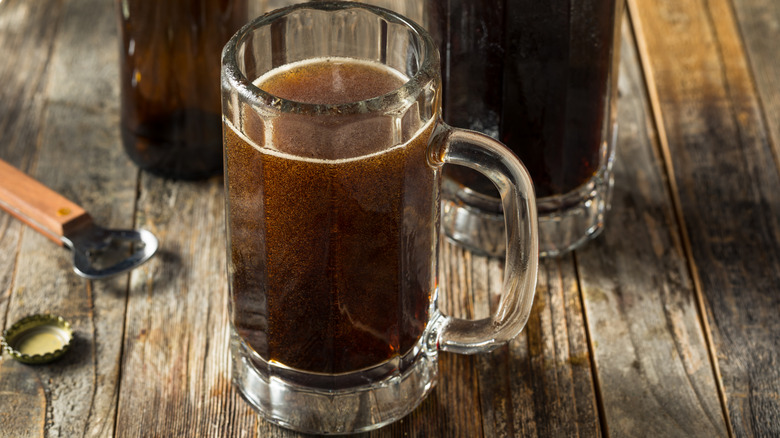
Compared side by side, straight sarsaparilla soda is still distinct from root beer. The flavor of this root alone is earthy, woody, and a touch bitter. The reason that these two names have become so intertwined is that sarsaparilla was one of the ingredients that gave traditional root beer its flavor. The full complement of ingredients, however, includes sassafras root — which you would likely recognize as the dominant root beer aroma — as well as wintergreen, vanilla, and licorice.
If you would like to get your hands on a traditional sarsaparilla soda, there are still some brands out there making the stuff, but you'll want to do your homework. You can, for example, pick up a few bottles of Rocky Mountain Soda Sarsaparilla or Kansas City Sarsaparilla Soda online, but not everything labeled "sarsaparilla" actually contains the eponymous root. The other option, if you want to really get the Old West experience, is to make it yourself.
Pick up a bag of Ecovista Sarsaparilla Root online and make yourself a concentrated syrup mixed with soda water — as in this homemade ginger ale recipe. Or you can really do it the old-fashioned way. To create a fizzy drink like the old days, brew up a sugary mixture of roots, spices, and water, add some yeast, and then cap it and let it ferment for a few days before sticking it in the fridge. This version will be very slightly alcoholic, but it'll be just the sort of thing those cowboys used to sip.