

If Your Homegrown Carrots Have Holes Inside, Here's Why
There's nothing quite like the satisfaction of growing your food from seed and being able to bring it to the dinner table. So if you discover holes around the core after harvesting what looked like healthy-looking carrots, your heart may inevitably sink. Your first thought is probably pests, but if the outside of the carrots is unblemished, bugs are unlikely to be the culprits. Insects will burrow from the outside in and create holes of irregular sizes and shapes. If your carrot has evenly spaced holes just around the core, it's more likely due to a watering problem.
When you slice a carrot, the holes you see are actually cross sections of longitudinal splits, running top to bottom. These splits can occur anywhere in the carrot, often breaking it open, but it's these smaller internal ones that cause more of a surprise — and are more likely to be mistaken for insect damage.
Splits in a carrot often occur if the surrounding soil becomes dry, then suddenly gets a lot of water. Carrots are a fast-growing vegetable, and when taking in this extra water, the inside can expand beyond what the outside can keep up with. The resulting pressure causes cracks. Splitting is also common in carrots that have been left in the ground too long after they have reached maturity. The core becomes rigid and won't expand at the same rate as the surrounding tissue.
Preventing splits in carrots
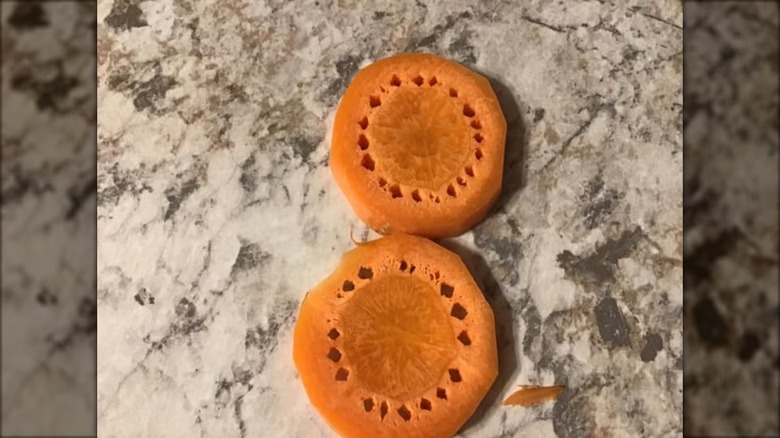
Carrots with these types of holes are generally safe to eat, but there is a chance that bacteria from the soil can enter the cracks. And although there's a certain decorativeness to the small holes that surround the core, larger splits can make it difficult to cut even slices or make carrot matchsticks for tossing into meals.
Prevention is all about consistency in watering. And while you might not have any control over a sudden downpour, you can focus on ensuring that the soil doesn't dry out too much between waterings. The best time to think about this is when you prepare the garden for planting. Mixing plenty of organic matter into the soil will help it retain moisture, as will adding mulch around the plants themselves. Then there is the choice of the carrot as well. Smaller carrot varieties are less prone to cracking, since the larger varieties have a greater capacity to absorb water.
Once your carrots are in the ground, the soil should be kept consistently moist. While it might seem logical to give them a light watering more regularly, this won't be enough to get the soil sufficiently wet. The exact watering schedule will depend on your climate and soil conditions, but you want to ensure that the top 2 inches of the ground are always moist but not soaked.