

Before Shopping Carts Became Essential, Many Customers Refused To Use Them

These days, most of us grab a shopping cart at the grocery store entrance without giving it a second thought. But when shopping carts debuted in the 1930s, many shoppers wanted nothing to do with them. The very first shopping cart was introduced in 1937 by supermarket owner and inventor Sylvan Goldman, head of the Humpty Dumpty supermarket chain in Oklahoma City. Goldman noticed that his customers often stopped shopping once their handheld baskets became too heavy. He suspected that if people could carry more groceries with less effort, they'd undoubtedly buy more.
His first design was inspired by a folding chair: a metal frame mounted on wheels with two wire shopping baskets attached to make a double-level cart. Despite the obvious practicality, shoppers weren't convinced. According to Goldman, many women rejected the carts because they reminded them of baby strollers, while some men refused out of fear of looking weak or unmanly. It seems silly now, but this gender dilemma almost prevented grocery carts from existing. The invention seemed destined to fail.
But Goldman was not deterred. Instead, he accidentally made history by conducting one of retail's earliest product demonstrations. He hired good-looking men and women to confidently walk around his stores with their shopping carts, gender stereotypes be damned. Believe it or not, his ploy worked. As more people embraced the newfangled carts, the advantages became obvious. And for grocery stores, the benefits were even better: More purchases meant more sales and more profit.
Shopping carts have gotten bigger every decade
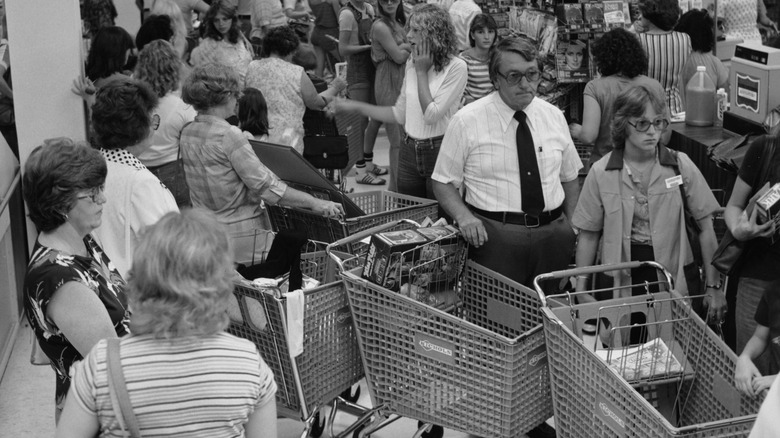
As supermarkets expanded during the postwar boom, shopping carts became an essential part of the shopping experience. Stores grew bigger, product selection widened, and shoppers began purchasing a week's worth of groceries at once instead of shopping daily. It's not surprising then that these days, grocery carts have gotten bigger so that you'll buy more groceries. That was no accident — if one's cart looks relatively empty, shoppers feel they haven't bought much yet and continue to shop. In fact, shopping carts today are nearly three times the size they were in the 1970s, reflecting the rise of warehouse stores and bulk buying.
Carts were just the beginning. Today, there are all sorts of tricks grocery stores pull to boost sales. Most stores place fresh flowers and colorful produce near the front to invoke healthier, more optimistic attitudes — or in other words, get you in a good mood to shop. Staples like milk, bread, and eggs are usually placed toward the rear of the store, forcing shoppers to pass numerous tempting snack aisles to increase the odds of impulse buying. Grocery stores also cleverly stock products they most want to sell at eye level, cheekily called the "buy level" by retailers.
What began as a simple solution to heavy baskets ended up becoming a symbol of the modern shopping experience. Nearly 90 years later, Goldman's invention remains one of the most influential innovations in grocery store history, for better or for worse. Now, if only we could convince people to return their grocery carts to the corral instead of abandoning the cart mid-parking lot.