

One Of The Biggest Sources Of Mercury In Fish Isn't What You'd Think
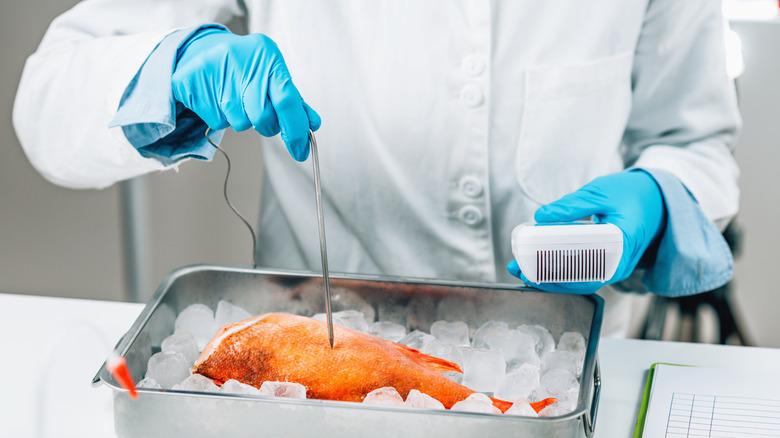
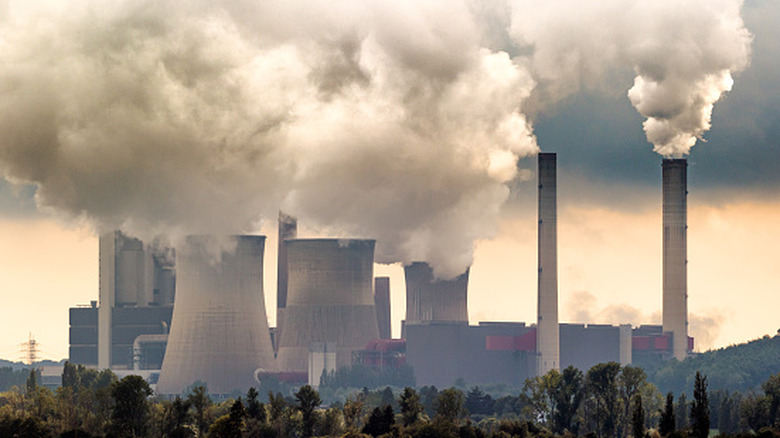
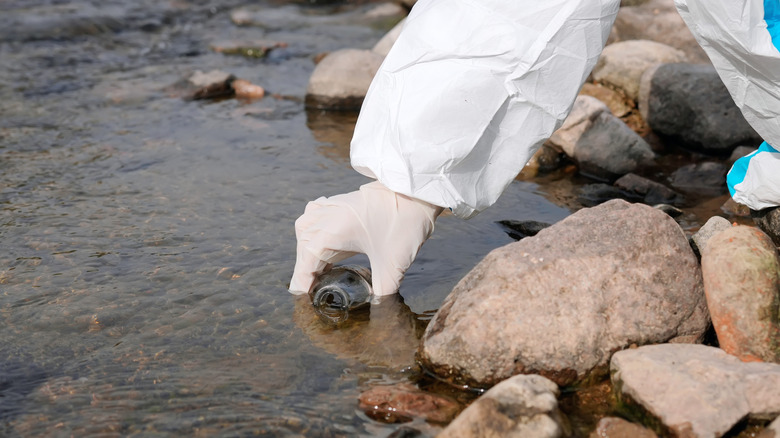
With frequent stories circulating about toxic runoff poisoning waterways, you might expect hazardous mercury to enter the fish we eat by companies dumping it into rivers, lakes, and oceans. However, the unfortunate truth is that mercury isn't just dispersed wider than that, but higher. Mercury released into the atmosphere in large quantities gets captured and collected by rain and snow, or otherwise drops to the ground, before entering groundwater and water flowing into lakes and oceans. Here, bacteria transforms mercury into methylmercury, the toxic organic form we find in the fish we eat. According to 2016 paper published by the Journal of Hazardous Materials, around 77% of the world's mercury air emissions come from anthropogenic (human-made) sources. According to Environment America, the biggest contributor of mercury emissions into the air is coal power plants, as mercury exists as a trace metal in the coal they burn.
Mercury is a potent neurotoxic metal, meaning that it causes irreversible damage to the brain, particularly in developing or unborn infants, relating to lower IQ and cognitive and developmental issues. What makes mercury of particular concern, is that it's bioaccumulative, meaning it collects in animal tissue and transfers as it gets promoted up the food chain, starting with the smallest organisms in water sources absorbing methylmercury. The bioaccumulative nature of mercury is so effective that according to the United States Geological Survey, "Methylmercury levels in predatory fish are typically more than one million times higher than methylmercury levels in water that the fish inhabit."
Some good news, some bad
The grim reality is that at this point, it's almost impossible to find fish in the U.S. with no traces of mercury. Historically, the worst regions for methylmercury concentrations in fish have been in the eastern states featuring plenty of wetlands and forests with a high density of connecting streams, with the southeastern coastal plain a focal point of mercury concentration.
Certain species of ocean fish also collect high levels of mercury, and not necessarily in the same region. Notably, the fish with the highest concentration of mercury contamination by far is an ocean fish called the Gulf of Mexico tilefish. You may not be eating tilefish regularly, but other larger common fish like king mackerel, swordfish, and big eye tuna, are also in the list of the most mercury-contaminated fish.
The good news is that governmental control of mercury emissions from coal power plants has had a drastic influence on reducing the mercury released into the air, ground, and water. A 2023 study from Harvard focusing on the decade from 2010 to 2020 found that, once the U.S. EPA's restrictions — known as the Mercury and Air Toxics Standards (MATS) — went into place in 2012, methylmercury entering the atmosphere decreased by 90%.
More mercury on the horizon
As of 2026, for the second time, the Trump administration has moved to soften the guardrails set out in MATS. They were first loosened in 2020, and then strengthened again by the subsequent administration in 2024. The administration's initial move argued economic opportunity outweighs the cost of national health and the environment.
According to Environment America, "The U.S. Environmental Protection Agency (EPA) is allowing coal-burning power plants to release more mercury and other toxic pollutants into the air.... [The] agency's repeal of the 2024 update to the Mercury and Air Toxics Standards (MATS) also means that coal plants will not be required to continuously monitor their emissions." These changes could jeopardize the progress made since 2012, if (or when) coal power plants ramp up operations and release higher levels of mercury into the atmosphere.
So, are there any fish you can eat? There are a few seafood species that exhibit lower levels of mercury contamination. Fish that are lower on the food chain or simply have shorter lifespans don't have as much opportunity to absorb and collect methylmercury. Atlantic mackerel, tilapia, and crab are some seafood options to consider. If you simply must have your tuna melt, you can read the can for evidence that it's not one of the more mercury-laden species. Look for smaller species like skipjack, and avoid albacore, which has been seen to contain three times as much mercury as the former.