

Do Fast Food Sauce Packets Expire? Here's What To Know Before You Hoard Them
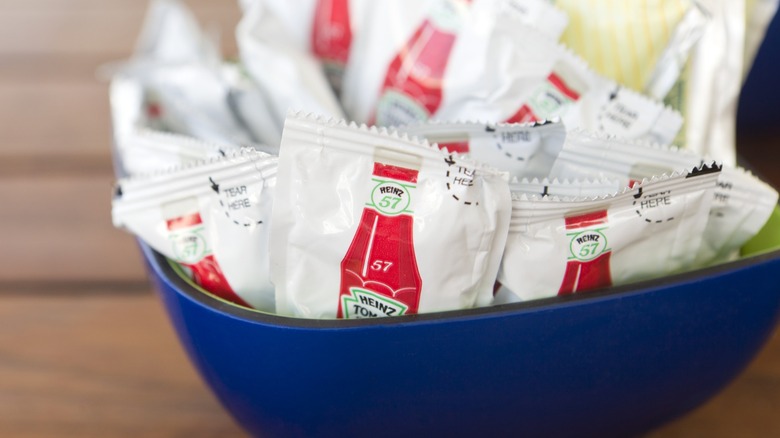
Fast food sauce packets are the loose change of food. Stashed in your car, a kitchen drawer, the bottom of a purse, or swallowed by the couch, their value is ostensibly small — until you need one. Just like a handful of coins can mean your kid gets an ice cream on a hot day, a handy hoard of petite packets can save you from the letdown of ketchup-less fries or a mustard-free corn dog. But before you stockpile this convenient commodity you should know that, with just a few exceptions, these condiments do, in fact, go bad.
Because these fast food flavor favors usually don't have expiration dates on them, many people assume they keep for eternity. But it's not that the expiry info doesn't exist, it's just marked on the manufacturer boxes they come in rather than the individual packs. So unless you work on that side of the counter, you're on your own, especially since the Food and Drug Administration (FDA) offers no sauce pack recommendations regarding use-by date, since the information will be on the bulk box.
Let's cover the few exceptions first. Due mainly to its high sugar and low moisture content, honey doesn't expire (ditto on sugar and salt packets). For the rest, it largely depends on their ingredients, which usually aren't listed on the individual packaging either. If you're starting to think these packets sort of live in no man's land, you're not wrong. Luckily, there are some general rules of thumb you can follow to consume single-serving sauces safely, adding to your knowledge of how long condiments last.
Sauce packet safety 101
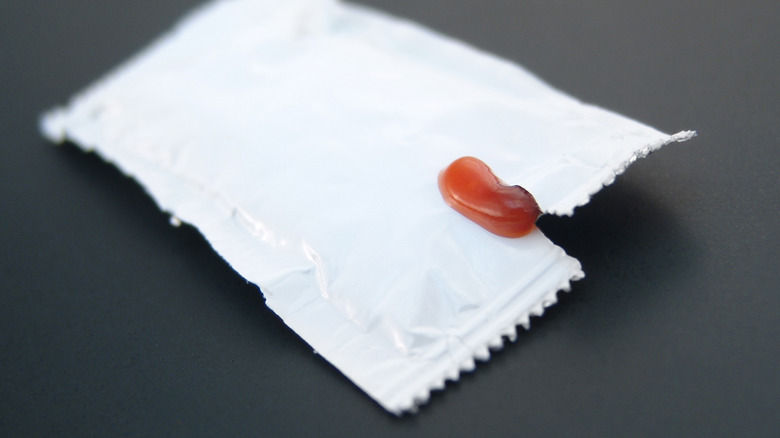
First, with egg or dairy-based condiments like mayonnaise, ranch, or tartar you might wonder if you need to refrigerate these at home like their standard-size counterparts. The answer is no, as long as they are unopened, they're okay at room temperature. But beware that these egg and dairy-filled dippers have a shorter shelf-life than sugar and vinegar-based ones like ketchup, mustard, barbecue sauce, hot sauces, and relish. That said, information varies on exactly how long these condiments last. The one-year mark is often used as a general recommendation, with a few extending beyond that.
Because these estimates are only so helpful, common sense should make the final call. After all, you don't know how long those sauce packets were hanging around in the restaurant before they found their way to you. Paper packets are more susceptible to going bad faster, as opposed to typical plastic and foil ones that are meant to stave off degradation by keeping out light, air, and moisture. First, look for obvious visible damage like tears, leaks, or generally vintage looking branding. Also, if the packet appears bloated or poofed out that's a telltale sign of bacteria growth. In any of these instances it's best to toss them.
Finally, trust your senses. If the condiment smells or tastes off once you open it, or feels wrong texturally, listen to your gut — it will thank you later. Better safe than sorry. Of course, to get the longest life out of them, it's good to know the best way to store your fast food sauce packs. Hint: It's definitely not between the cushions of your couch or in a hot glove compartment for the last five summers.