

14 Of The Unhealthiest Cereals On Grocery Shelves
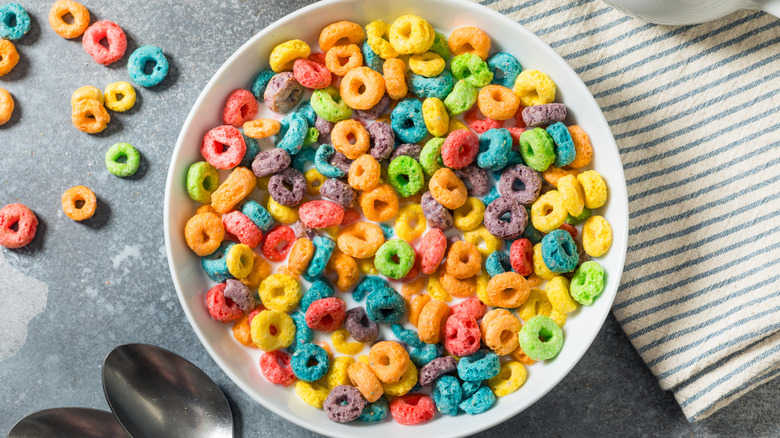
When you're a kid, going to the cereal aisle and picking out a product or two is like winning a golden ticket to Willy Wonka's Chocolate Factory. The abundance is hard to compute, and the colors, flavors, and logos are overwhelming in the best way. But for anyone reading the back of those boxes, shopping for cereal is a very different experience. "Ultra-processed foods, which are what most cereals would be considered, have more and more evidence that links them to increased cardiovascular disease mortality, type 2 diabetes, obesity, depression, anxiety, and all-cause mortality," said Kalyn True, RDN, CSOWM, LD, NSCA-CPT, an Outpatient Dietitian at Memorial Hermann Health System. No matter how delicious they taste and how convincing their marketing, many cereals are hurting rather than helping our health.
Not all cereals are created equal, though. While some could genuinely be categorized as nutritious, others are full of ingredients that set off alarm bells for nutrition professionals. To get a better sense of which products to avoid, we spoke with three experts — True, Lindsay Malone, MS, RD, LD, an Instructor and Clinical Dietitian at Case Western Reserve University School of Medicine, and Michael Sandoz, MS, RD, LDN, CDCES EJGH, an Outpatient and Wellness Center Dietitian. The main takeaway is that added sugar is the main ingredient to look out for. Luckily, there are plenty of delicious no-sugar-added cereals out there to pick instead.
Post Golden Crisp
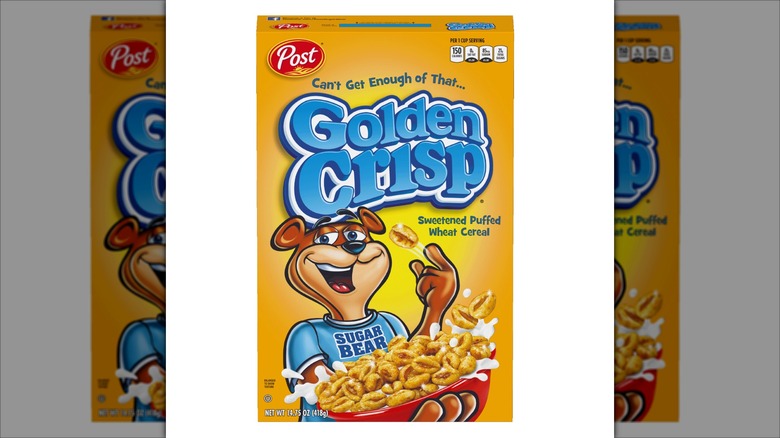
Golden Crisp contain 21 grams of added sugar per serving, which is a staggering amount, even by the standards of ultra-processed cereal. Kalyn True noted that the American Heart Association recommends that women consume no more than 25 grams of added sugar per day and men consume no more than 36 grams, but most popular cereals approach those limits within a single serving. "And that would be if people are sticking to an actual serving size," she added.
One cup of cereal isn't very much, and it's easy to imagine pouring yourself a portion of Golden Crisp that exceeds your recommended daily limit of added sugar without even making you feel full. Part of the reason for that lack of fullness may lie in the fact that the product contains 0 grams of fiber and only 2 grams of protein. This is a common issue with sugary cereals, Lindsay Malone told us, noting that a lack of fiber and protein "can leave you hungry soon after eating." In other words, you'll probably either end up increasing your portion size or eating more calories from another source.
Great Value Magic Treasures Whole Grain Oat with Marshmallow
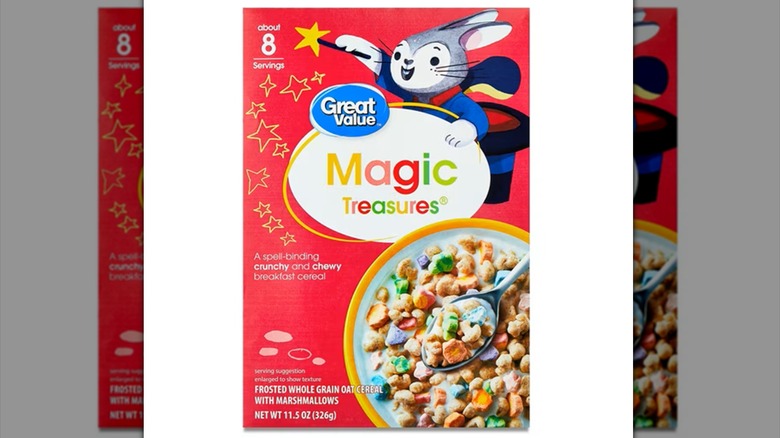
You might assume that Magic Treasures would be similar to Lucky Charms. They are similar in appearance, and their name is clearly a variation on the General Mills product. Nutritionally, they have significant differences. Lucky Charms has 12 grams of added sugar, which is more than the 10 grams that Michael Sandoz recommended as the maximum for a serving of cereal, but much less than the 17 grams in Magic Treasures. Even when accounting for the discrepancy in serving sizes (Lucky Charms considers 1 cup to be a serving and Magic Treasures calls 1 ¼ cup), the difference is still meaningful. Magic Treasures also contains artificial colors, which all three of the experts we spoke to suggested avoiding.
Whole grain oat flour is listed as the first ingredient in the product, and the front of the box advertises the contents as "frosted whole grain oat cereal," but as Lindsay Malone told us, that doesn't always mean that a product is healthy. "Words like 'natural,' 'made with whole grains,' or 'multigrain' can create a healthy image even when a cereal is loaded with added sugar," she explained. When balanced with its high sugar content and artificial dyes, the whole grain element is not enough of a redeeming factor to make it healthy.
Cap'n Crunch's Crunch Berries
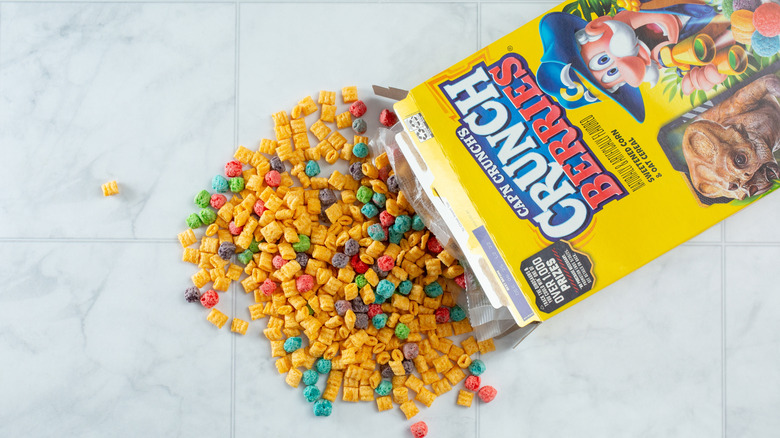
Like Honey Crisps, Cap'n Crunch's Crunch Berries contain more than half of the recommended daily intake of added sugar. One cup of these colorful morsels contains a full 17 grams of added sugar, along with less than 1 gram of fiber and 2 grams of protein. Additionally, the product contains artificial food dye, which might make children hone in on it when perusing the cereal aisle, but which, as Kalyn True noted, has been associated with behavioral effects. Lindsay Malone said that they can also impact gut health, inflammation, and metabolic health.
There are very few mitigating factors that would offset the negatives in Cap'n Crunch, as far as health goes. There are no whole grains and the amounts of fiber and protein are negligible. In other words, it's a cereal that impacts your health for the worse, with few redeeming qualities. You could make an argument about the relative value of the flavor, of course, but unlike nutritional value, that is purely subjective.
Kellogg's Honey Smacks
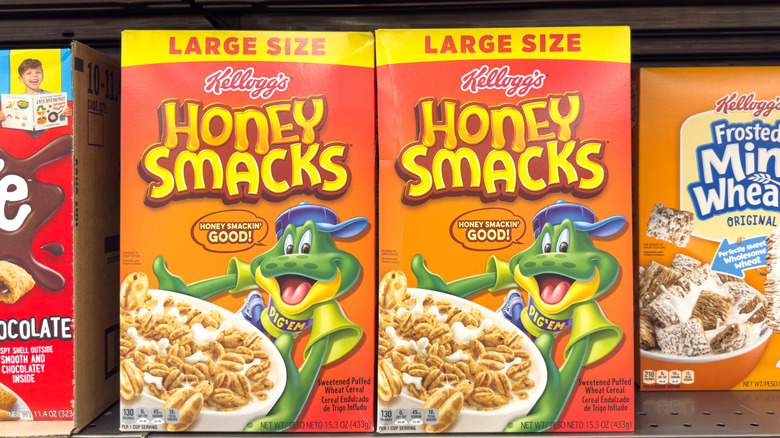
Honey Smacks contain relatively few ingredients compared to other popular cereals — fewer than 10 compared to well over 20 in Magic Treasures. However, just 1 cup of it contains 18 grams of added sugar, which accounts for half of the recommended daily intake for men and more than ⅔ of the amount for women. The first ingredient is whole grain wheat, which indicates that it's the main ingredient. However, that doesn't tell the whole story. "Added sugars can hide under many names," Lindsay Malone cautioned, "including cane sugar, brown rice syrup, corn syrup, honey, and fruit juice concentrates." Indeed, the second, third, and fourth ingredients in Honey Smacks — sugar, glucose syrup, and honey — are types of sugar. When combined, they account for a sizeable proportion of the product.
Like many other ultra-processed cereals, Honey Smacks don't contain a meaningful amount of fiber or protein — just 2 grams, respectively — which makes it difficult to recommend them for any nutritional reasons.
Post Marshmallow Fruity Pebbles
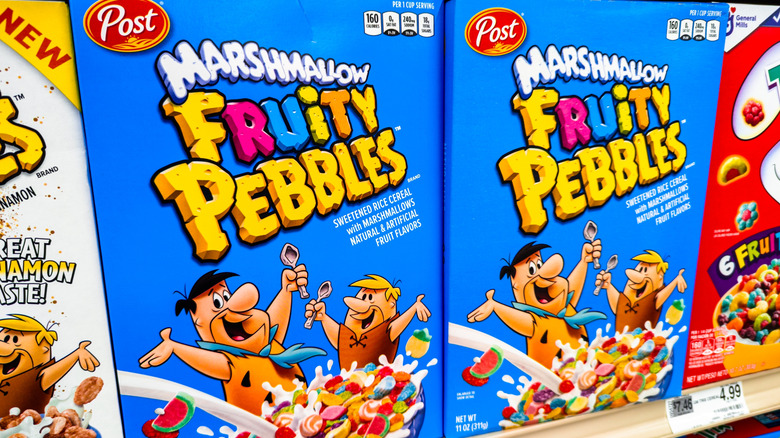
Marshmallow Fruity Pebbles hit all three of the characteristics that Kalyn True mentioned when discussing what type of cereal to avoid: more than 10 grams of sugar per serving, artificial food dyes, and refined grains as the primary ingredient. "Usually if a cereal is marketed primarily to children, think boxes with cartoon characters and bright colors," she said, "it will more than likely have all of the above characteristics." The box for Marshmallow Fruity Pebbles is, in fact, covered in colorful, kid-friendly cartoons. More importantly, one serving of the cereal contains 18 grams of added sugar, four different artificial dyes, and rice (not whole grain) listed as the first ingredient.
Additionally, there are a few redeeming factors. The fiber content is 0 grams and the protein content is a scant 1 gram. You could point out that there are plenty of vitamins in the ingredients list, but True and Michael Sandoz noted that vitamin fortification does not automatically make a product nutritious. "Many cereals are heavily fortified," True told us, "[But] fortification doesn't compensate for the metabolic harm that excess sugar and ultra-processing can lead to."
Post Oreo Puffs
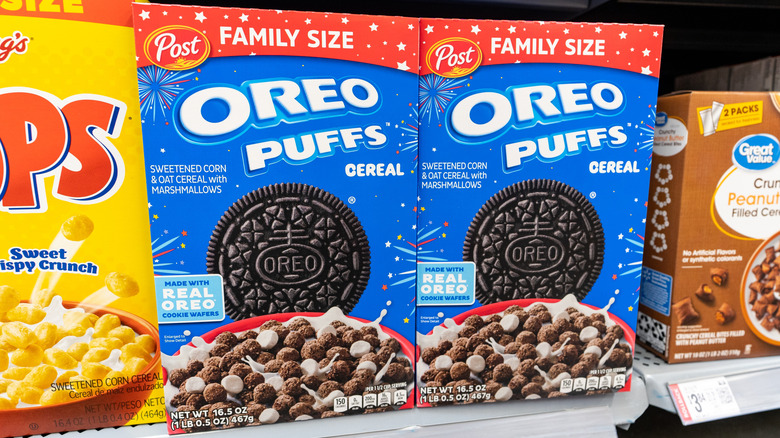
When we asked Lindsay Malone what her dealbreaker was when choosing cereal, she responded succinctly: "When cereal is mimicking a dessert." Oreo Puffs make no pretense about their sweetness. Where other brands emblazon their packaging with health claims, Oreo Puffs show a huge picture of an Oreo, letting everyone know that this product is inspired by a cookie rather than whole foods. When you get into the nitty gritty of the ingredients and nutrition facts, things get even more concerning for the consumer. The first ingredient is yellow corn flour (not whole grain), and the second and third are sugar and marshmallows, respectively.
Interestingly, the sugar content in Oreo Puffs is lower than in other cereals that don't take their names from a dessert. One serving contains 16 grams, which is quite a bit more than the recommended maximum of 10 grams, but is significantly less than many of the other cereals on this list. That is even more notable when you realize that the serving size for Oreo Puffs is 1 ½ cups rather than 1.
Kellogg's Apple Jacks
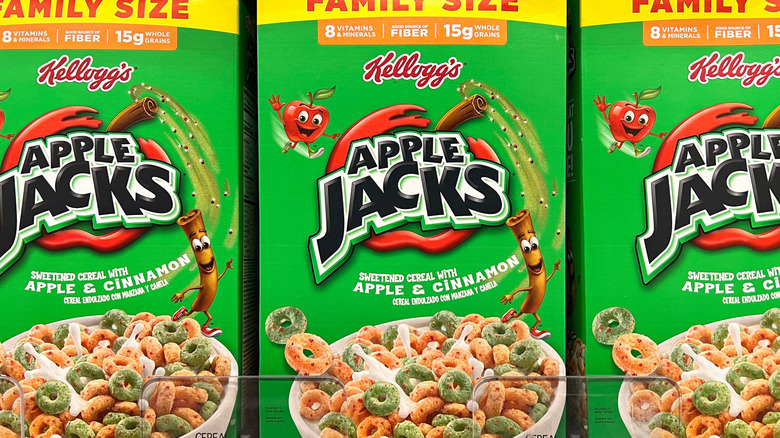
If you just read the front of an Apple Jacks box, you'd be more than justified in assuming that they were nutritious. The packaging claims that they are a good source of fiber, have 15 grams of whole grains, and contain apples and cinnamon. As Michael Sardoz told us, however, there is always more to the story than what the front of the box tells you. In the case of Apple Jacks, the fine print reveals that while whole grain corn flour is the first ingredient, sugar is the second and refined grains are the third. Additionally, the apples and cinnamon that are advertised on the front are down at the bottom of the ingredients list, along with four types of artificial food dye.
Kalyn True put a name to this type of marketing: health halos. "Things like images of fruit, honey, or nature on packaging create an impression of a whole food, nutrient dense, health food, that may not truly reflect the food," she explained. Apple Jacks tout the apple part of their product, leading shoppers to believe that the fruit plays a significant role in the product. On the contrary, it hardly features and is upstaged by refined grains and 13 grams of added sugar per serving.
Kellogg's Krave Double Chocolate Brownie Batter
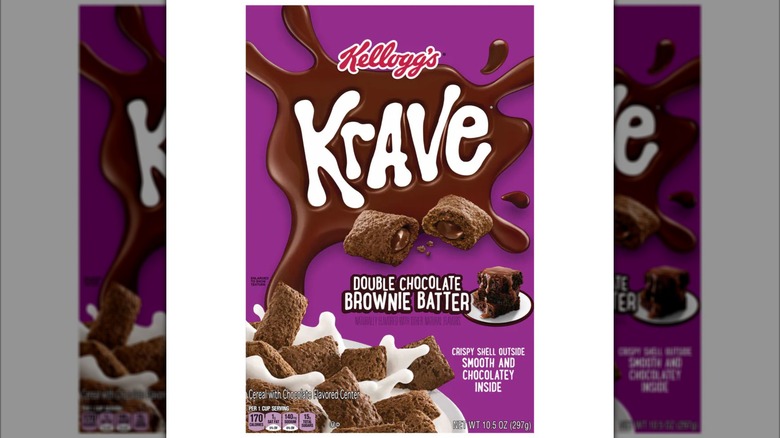
Like Oreo Puffs, Krave Double Chocolate Brownie Batter is unabashed about its sugariness. Although the packaging touts its whole grain content, it doesn't make the case for other forms of nutritional value. One cup contains 14 grams of added sugar, which is less than some of the other cereals in this list, but is still above the 10-gram threshold that Kalyn True and Michael Sandoz recommended. In fact, sugar is the main ingredient, listed as both the first ingredient of the chocolate filling and the first ingredient of the outer coating.
More surprisingly is the fact that this cereal has artificial dyes. You might assume that because they are chocolate-flavored and brown on the outside with a slightly darker brown filling, their color would come from the chocolate. But the listing of Blue 1, Red 40, Yellow 5, and Yellow 6 proves otherwise. Another factor to consider is the saturated fat content. Although most cereals are relatively low in fat compared to other breakfast items like bacon and eggs, the soybean and palm oil in the filling adds 1 gram of saturated fat, which is 5% of the recommended daily intake.
Kellogg's Special K Chocolatey Delights
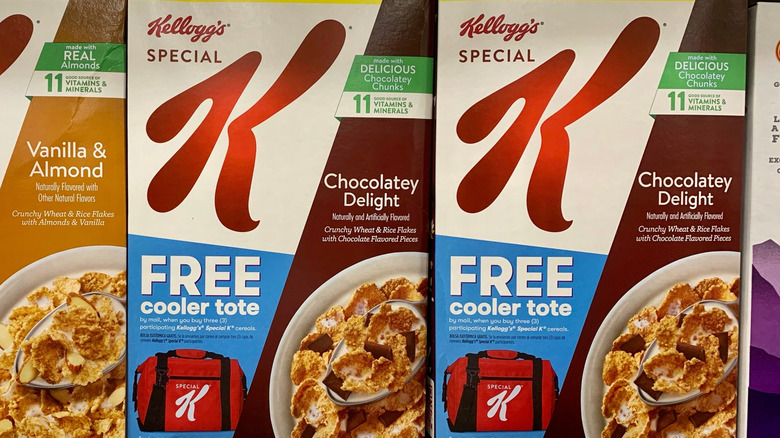
Special K does not cover its packaging in cartoons to grab the attention of children, nor is it obviously unhealthy the way cereals made to mimic desserts are. On the contrary, its boxes usually advertise its many health benefits, such as its inclusion of real fruits, whole grains, and vitamins. When you look past the so-called health halos of its images of whole foods, however, you'll find that the fine print of the brand's Chocolatey Delights cereal is barely better for your health than Oreo Puffs or Fruity Pebbles. Twelve grams of added sugar in just 1 cup is above the 10-gram threshold, and even though the first ingredient is a whole grain (whole grain wheat), the second (rice) is a refined grain. Kalyn True pointed out that products that champion their whole grain credentials are often not made exclusively with whole grain. "Products classified as 'whole grain' need only contain ≥51% whole grain by weight," she explained. Then, there are two grams of saturated fat, which accounts for 10% of your recommended daily intake.
Another claim that you'll find on the front of the packaging is that there are 11 vitamins and minerals in Chocolatey Delights, which you'll find reflected in the ingredients list as well. However, as Michael Sandoz pointed out, fortification like this often just makes products appear healthier than they really are. Overall, the health claims on this cereal are technically true, but the sugar content and refined grains offset any health benefits.
Post Honey Ohs
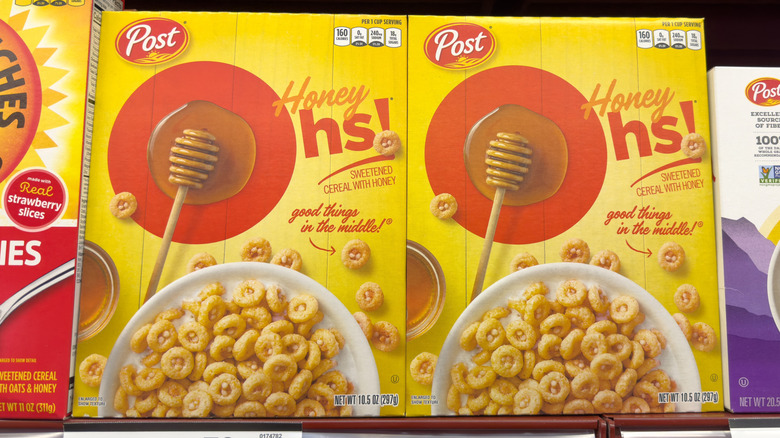
Post's Honey Ohs might seem a little healthier than other cereals because they aren't vibrantly colored or coated in frosting. However, looks can be deceiving, and these innocent looking Ohs are packed with ingredients that are less than advantageous to your health. Just 1 cup contains a whopping 18 grams of sugar, which makes this product even sweeter than Oreo Puffs and Krave Double Chocolate Brownie Batter. Plus, that light honey color is not the natural hue of the grains or the sugar. Look towards the bottom of the ingredients list and you'll find that this cereal contains two artificial dyes, Yellow 5 and Yellow 6.
Honey Ohs do contain whole grain oat flour, but it's only listed as the third ingredient behind corn flour (not whole) and sugar. This is another product that contains multiple forms of sugar as well, including molasses and corn syrup. And although honey has some nutritional benefits over sugar, it's only listed as the 10th ingredient.
Cheerios Oat Crunch Oats 'N Honey
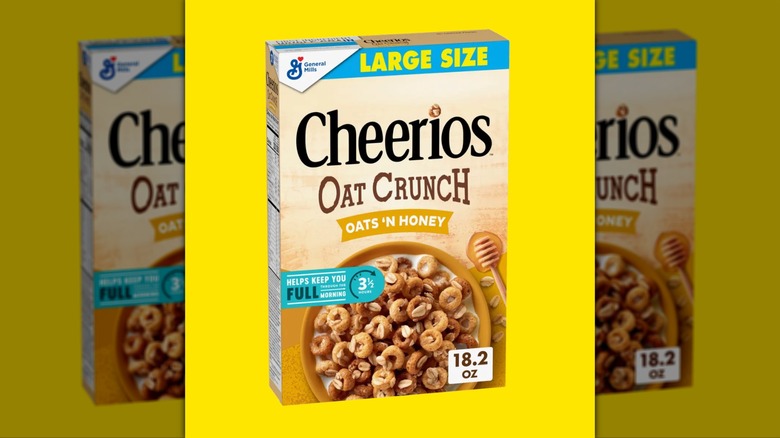
Cheerios are the Fruit of the Loom of cereal — sensible, unglamorous, but indispensably practical. Original Cheerios have just 1 gram of added sugar in a 1 ½ cup serving, which is remarkable even by the standards of other healthy cereals. Wheaties, for example, contains 5 grams of added sugar. But not all Cheerios products can say the same, and Oat Crunch Oats 'N Honey is far from nutritious. One serving contains 15 grams of sugar, but it's worth noting that, while Original Cheerios deem 1 ½ cups to be a serving, Oat Crunch Oats 'N Honey shrinks that serving size to just 1 cup.
The packaging boasts 31 grams of whole grain per serving, but as usual, the marketing omits other key details. Sugar is the second ingredient, for example, and there is both modified corn starch and rice flour, which offset the whole grain credentials. Oats 'N Honey Cheerios do have more protein than most of the other products on this list, an element that Michael Sandoz recommended looking for first when reading food labels. "Higher-protein cereals can help make your breakfast more filling," he explained, "Especially when paired with a good source of fiber." However, this particular product only contains half of Sandoz's recommended threshold of 8 grams per serving, which is nowhere near the amount that is on offer in some high-protein cereals you can find at the grocery store.
Kellogg's Cracklin' Oat Bran
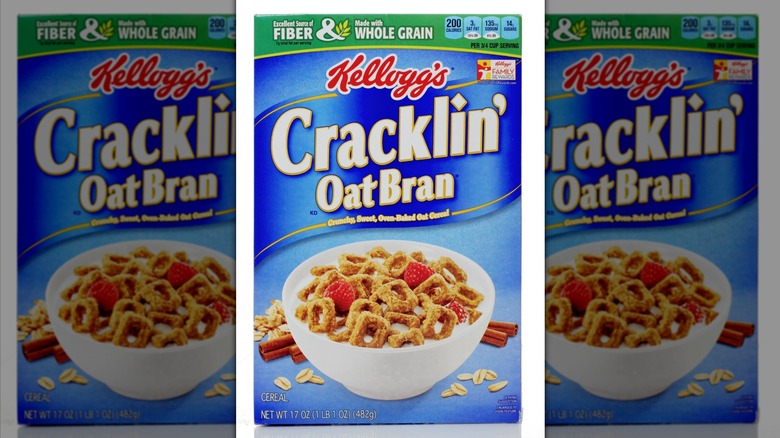
Oat bran is the hard outer shell of an oat groat, and it's famous for being high in fiber. It's also among the foods that help lower cholesterol. As such, you might assume that any oat bran product would be relatively healthy when compared to the many cereals made of refined grains, but as usual, the main ingredient does not provide a full picture. Kellogg's Cracklin' Oat Bran contains 15 grams of added sugar per serving, putting it well over the 10-gram threshold that the experts we spoke to suggested.
More significant, however, is that the amount of fiber is less impressive than all the marketing on the front of the box would have you believe. "I like to see 3 [grams] of fiber per 100 calories or more," Lindsay Malone told us. "More is better but it's hard to find," she adds. For a 230-calorie serving, Cracklin' Oat Bran contains 7 grams of fiber, which is more than any of the other cereals on this list, but which just barely reaches the 3-gram threshold per 100 calories that Malone prescribes.
Nature's Path Envirokidz Organic Koala Crisp
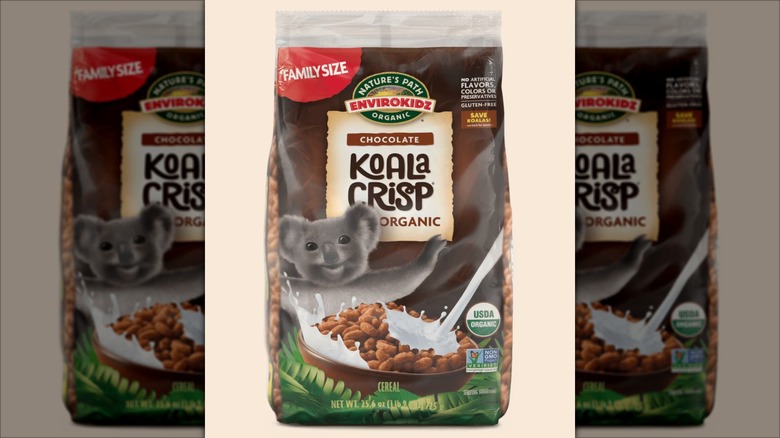
When it comes to health halos, Nature's Path ticks most of the boxes. Not only does the name of the brand suggest purity, but most of its products feature images of nuts, whole fruits, and furry animals. It also stresses that its ingredients are organic, which has no impact on how much sugar or refined grains are in a product (such assumptions are just one of the many myths about organic food that need to be debunked). The marketing for Koala Crisps uses a handful of buzzwords, including "Gluten Free," "Non-GMO," and "Fair Trade." All of these have their benefits, but again, they tell you nothing about the product's nutritional composition.
For every serving, there are 11 grams of added sugar, which is better than many products, but is still slightly more than Froot Loops if you account for their differing serving sizes. Compared to the other cereals on this list, Koala Crisps are more nutritious. However, when you weigh up their ingredients and the information on their nutrition label, they're less healthy than many other products that do not boast whole grains, organic ingredients, and a lack of artificial dyes and flavors.
Kellogg's Choco Krispies
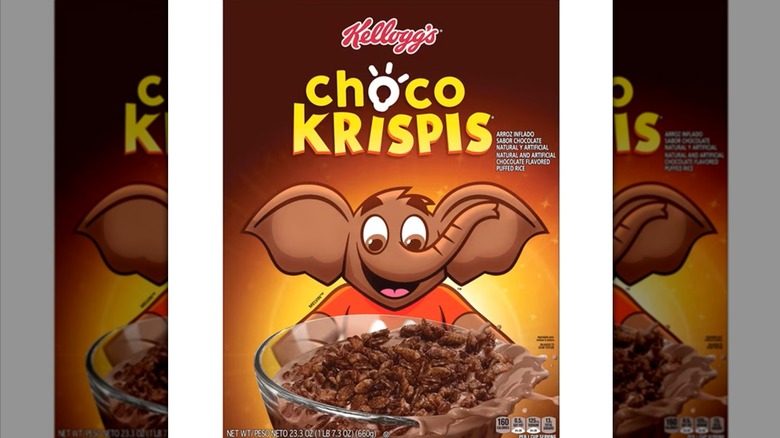
At first glance, Choco Krispies don't look particularly unhealthy, especially when compared to other chocolate-flavored cereals. Rice, sugar, cocoa, and maltodextrin are their main ingredients, with just 2% or less of the remaining ingredients. However, none of those four main components are healthy. The first is not a whole grain, and the sugar content is high — 13 grams for a 1-cup serving. Maltodextrin is also worth avoiding. According to multiple studies, the additive, which is used as a thickener in many highly processed foods, leads to intestinal inflammation. With only 2 grams of protein and no fiber, Choco Krispies are not likely to keep you full for very long either, which might make shoppers more inclined to eat larger portion sizes, increasing their sugar and maltodextrin intake.
Another factor to consider is the presence of artificial food dyes. As is the case with Krave Double Chocolate Brownie Batter, the chocolatey color of this product is not derived from the cocoa in the ingredients list but from Red 40, Yellow 6, and Blue 1.