

What Blue Marks On Grocery Store Beef Actually Mean

All beef that is sold commercially needs to pass a USDA inspection first. Before the animals even go to slaughter, they are inspected to make sure they're healthy. Then they are inspected again after slaughter for any signs of disease or contamination. The marks that are sometimes seen on meat in stores, typically on the exterior fat, provide information about where the meat was inspected.
In the United States, these inspection stamps are made with a food-safe blue or purple ink. Other countries may use different-colored ink and different-shaped stamps. There's no harm if you consume them, but since they're usually on fat it's easy enough to trim off as well. The stamps are also not required to be on every single cut of meat. Typically, they are on the primal cut and not the portion cuts, so that if your beef is broken down into steaks you may not see the mark on the cuts you buy.
Meat that has been inspected bears a stamp that says "U.S. Inspected and Passed by Department of Agriculture." This will be followed by the letters EST and a number. EST stands for establishment, and indicates where the meat was inspected, and the number represents the facility number assigned to that establishment. This mark can also be located on the packaging.
Oftentimes, when you see a product in the store, the ink has absorbed or smudged so much that it's no longer legible. At that point, it can look like a strange bruise on the exterior, which can cause confusion, but it is the same mark.
Breaking down beef marks
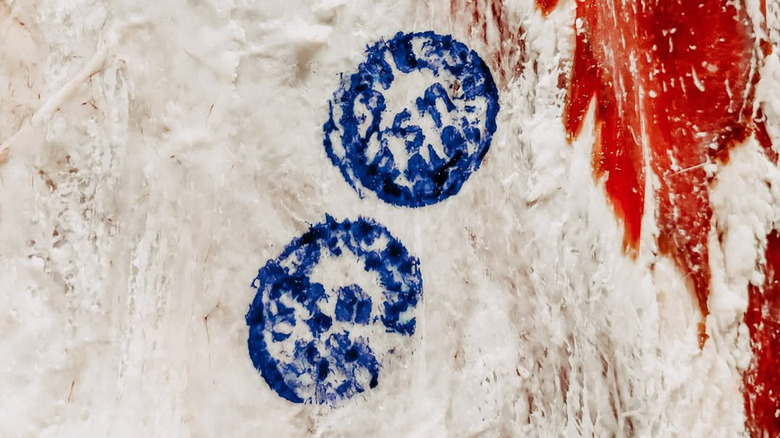
There is no specific formula for what goes into this ink. The ink is supplied by the establishments where the meat is inspected, and it is periodically reviewed to ensure it meets USDA requirements. The only stipulation the USDA has is that it cannot contain F.D. & C. Violet No. 1 and it must be made from harmless ingredients.
The USDA lists examples of ingredients that are safe for use, like water, dextrose, and alcohol. Coloring agents like cochineal, annatto, saffron, and turmeric can also be used. Because the formula can change based on the facility making it, there is no specific recipe or ingredient list.
Federal meat inspections have been mandatory in the United States for over 100 years. However, finding those marks is uncommon because most butchers and processors remove them before the meat is sold. The meat looks better without a big stamp on it, and if the stamp becomes smudged, it can cause concern among consumers who fear it may indicate some sort of contamination. Because the stamps are rarely explained at the retail level, not every customer is familiar with them.
While inspection marks are mandatory, beef grade marks are not, but you may still find those. These marks are not a circle but a shield and they indicate whether beef is prime, choice, or select. If you find a stamp on a cut of meat you buy, and this can even include ground beef, it's nothing to worry about. You can either trim the stamp off or ignore it.