

What's The Actual Difference Between Helles And Pilsner?
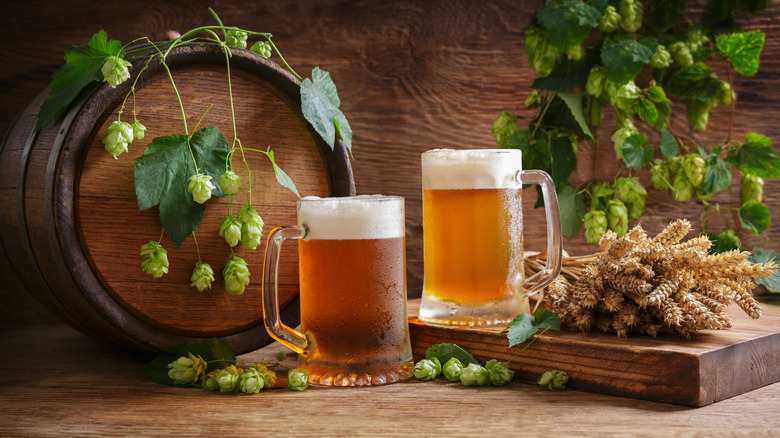
Set side by side, glasses of pilsner and helles can be nearly indistinguishable to the naked eye. They are both clear and gold, seemingly identical in color and body. However, if you lift them each to your nose — or, much better, to your lips — the difference begins to make itself clear. These beers do share some key characteristics, as well as a deeply intertwined history, but they are quite different on the palate.
Both helles and pilsner are lagers, meaning that they are brewed and conditioned at cold temperatures with a bottom-fermenting yeast. This production method is responsible in part for the clear, crisp taste shared by both varieties. Beyond that, these two beers also often rely on very similar grain bills, meaning the quantities and types of malted barley used in the brewing process can be nearly identical. Under the German beer purity law that, of course, leaves just one thing that could be the difference: hops. With helles and German pilsner, the major difference comes down to the pilsner having a much more pronounced hop character. Both beers are light and crisp, but German pilsners have a distinct bitterness and hop aroma, while helles is dominated by a clean, bready malt flavor.
Looking at the difference between these two German beer styles, however, is ignoring one very important factor. Both helles and German pilsner actually owe their existence to a third beer variety. To really understand these beers, we must cross the border into Czechia, to a town called Plzeň (Pilsen), where the Czech pilsner was first created.
The invention of pilsner and helles
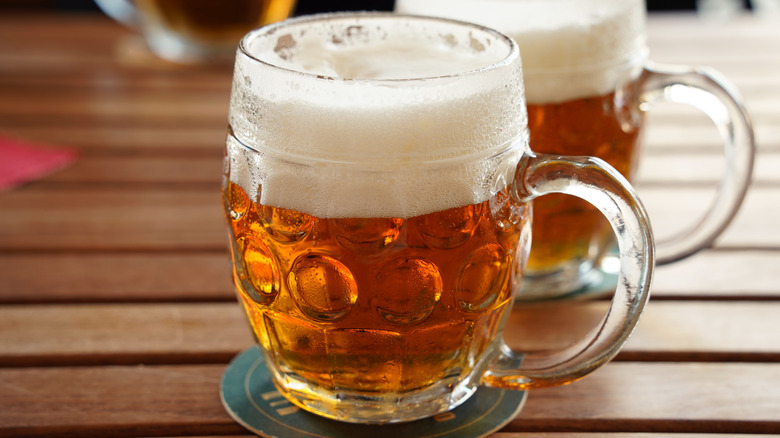
In 1842, a Bavarian man by the name of Josef Groll brewed the first pilsner on behalf of Burghers' (Citizens') Brewery in Plzeň, Bohemia — now Czechia. He brought with him the techniques of lagering, which were quite new at the time, and combined them with the local ingredients of soft water, pale barley, and the aromatic local Saaz hops. The result was a beer that immediately caught on, and one that you have likely sampled yourself. That special Czech beer is called Pilsner Urquell, which translates to "original pilsner," and it is still in production in that very same town — and available for sale around the world. Being so close to the source of that first pilsner is likely no small part of why Czechia drinks the most beer per capita.
At the time that this first pilsner began to take hold in Bohemia, the beers brewed over in Bavaria still tended to be on the darker, heavier, and sweeter side. That, however, was about to change. This light, crisp lager grew in popularity and spread outward, eventually finding a foothold in Germany. By the 1870s, German brewers were producing their own pilsners, often also called simply pils, which had a similar makeup to the Czech original, but often deviated particularly in the realm of hop varieties.
Another couple of decades down the road, these light beers finally took hold even in Munich. leading to the introduction of helles (pale) lager in the 1890s. With notably less hop flavor than either Czech or German pilsners, it too changed the way beer was made, and is often credited as the root from which all of the pale and relatively flavorless lagers of the world drew their inspiration.