

What's The Purpose Of Adding Rice To Beer?
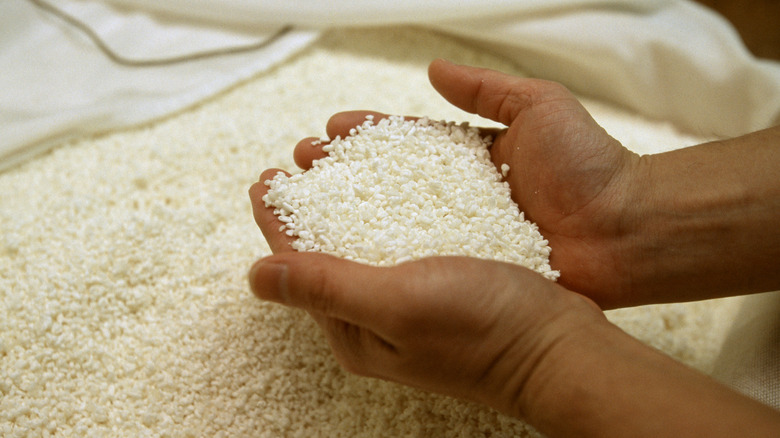
When you think of an alcoholic beverage made with rice, your mind likely jumps to sake. Sake is often called a rice wine, which is technically not correct since "wine" refers to fermented grapes — it is actually a fermented rice beverage. It's far from the only drink that can be made with rice, though. One major example? Rice lagers.
Lagers made with rice often utilize malted barley, too — which is why you can't always assume a rice beer is gluten-free. So, why use rice for brewing beer? Because it makes lagers especially light, crisp, and dry. Rice is considered an "adjunct" in beer. Brewers add it into their grain bills because it's entirely fermentable. When malted barley is fermented, it leaves behind at least some level of residual sugar. But yeast easily gobbles rice up and converts it to alcohol — nothing left behind, which boosts that thirst-quenching dry finish. Malted barley is still used as a base because it has diastatic power, enzymes that convert its starches to sugar when it's heated in water; those sugars are what the yeast needs to ferment. Rice does not have this capability, so it must be used with malted barley or special enzymes.
You may be familiar with the controversy around macro breweries like Budweiser using rice. When people learned their light lagers included rice, some saw it as a cheap filler. While we can't speak for the cost-cutting measures that may or may not be at play for those big brands, we can bust the myth that rice automatically equals lazy or lower-quality beer. In many cases, it's quite the opposite.
A history of extra-refreshing rice beer
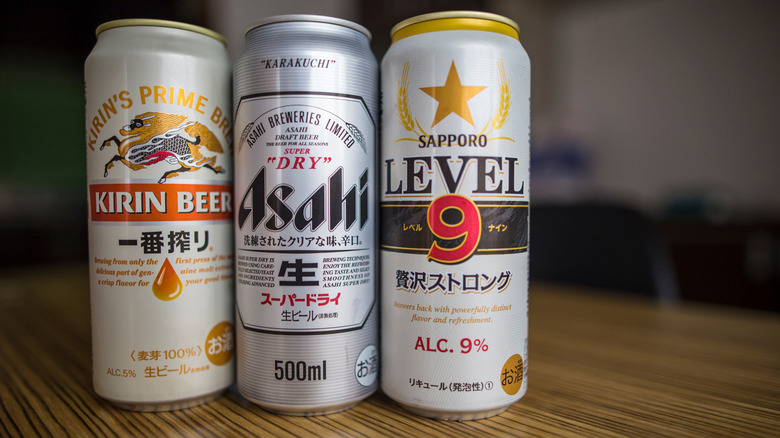
People have been fermenting rice into beverages for centuries, and beer has long been made using whatever ingredients were readily available in a given region. European settlers in America began implementing corn instead of strictly barley after being introduced to the crop and its uses by Native Americans. By the 19th century, German brewers were also experimenting with rice, and Japanese brewers soon adopted the ingredient for their own lagers, in part because locally grown barley could impart undesirable characteristics. Over time, Japanese lagers became known for their signature crispness and clean finish. Today, many of Japan's most famous breweries, including Asahi Breweries and Sapporo Breweries, have built their reputations on refreshing rice lagers.
While Japanese rice lagers thrived in Japan and found a niche at some Japanese restaurants in the United States, American beer drinkers long believed rice to be a flaw in a lager recipe. It's only in recent years that craft breweries have begun to embrace this style. Some of the best breweries in the U.S. are showing consumers that rice simply makes beer lighter, crisper, and more refreshing — and who doesn't want that in a lager?
Thanks to these producers, there's never been a better time to get into rice lagers. Some breweries are complementing the rice with ingredients and flavors commonly found in Asian cuisines, like lemongrass, Thai chili, basil, cardamom, galangal, yuzu, and even shiitake mushrooms. While rice itself contributes relatively little flavor, it creates a beautifully crisp canvas that allows those other notes to shine.