

No Self-Rising Flour? Toss 3 Pantry Staples Together To Make Your Own
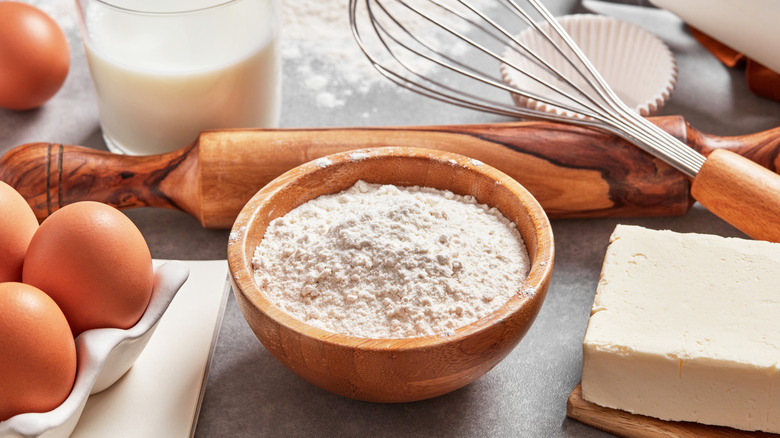
If you've ever found yourself spontaneously wanting to bake a treat, only to realize that you don't have the self-rising flour the recipe calls for, join the club. The great news is that you can replicate it at home with three simple pantry staples. Simply add salt and baking powder to regular all-purpose flour, and presto — it will work perfectly and save you an unexpected trip to the store.
There are a few reasons people use self-rising flour instead of all-purpose. Self-rising flour is made from a soft wheat, which is also lower in protein than the hard wheat typically used to make all-purpose flour, resulting in lighter and softer baked goods. It also offers convenience, as salt and baking powder, the key ingredients in self-rising flour, are already added.
Baking powder is the leavening agent that causes your baked goods to rise, thanks to a chemical reaction that produces carbon dioxide when the powder comes in contact with liquid. This creates bubbles which expand the mixture, resulting in fluffy and soft baked treats.
Self-rising flour is a staple in recipes like fluffy Southern-style biscuits, but you can also use it when baking pancakes, scones, cakes, and muffins if you're looking for the end results to have a moist and tender crumb. However, because baking powder has an expiration date, self-rising flour is also perishable. Considering it's best not to bake with expired self-rising flour, making it fresh as needed will save you from any unwanted surprises.
Important tips for making and using self-rising flour

Before you mix your batch of homemade self-rising flour, make sure your baking powder isn't past its expiration date. It won't give you food poisoning, but it won't have the desired leavening effect since its chemical components degrade over time and lose their potency. To be on the safe side, use Julia Child's trick to test baking powder.
As baking depends on precise chemistry, it's important to add the right amount and ratio of baking powder and salt to all-purpose flour so your biscuits and cakes come out as fluffy and lovely as you expect. For every cup of all-purpose flour, you need to add 1 ½ teaspoons of baking powder and ¼ teaspoon of salt. After mixing your self-rising flour, label it and date it so you know when it might be time to discard it, as demonstrated by @aireca_smith in the Instagram Reel below.
The uses for self-rising flour aren't limited to baked goods. It is the key ingredient for the crispiest fried chicken, and it's great in a batter for frying anything — from tempura to fish and chips. If you're enticed, you should know that you can also use it in reverse order. So, if you find a recipe that calls for all-purpose flour, baking soda, and salt, in most cases, you can just omit them in place of self-rising flour.
Take note that this substitute works best for recipes that include ½ to 1 teaspoon of baking powder per 1 cup of flour. If your recipe calls for more, you should add additional baking powder. If the recipe also calls for baking soda, be sure to use it as indicated. You can start with an easy pancake recipe to see how it works.