

The Right Way To Substitute Active Yeast With Instant Dry Yeast
We may receive a commission on purchases made from links.
If you successfully bake a delicious loaf of bread, you better share the credit and give that hardworking yeast its flowers, not just its flours. Baking has very little tolerance (if any) for guesswork, and yeast can be particularly unforgiving when you use the wrong type or fail to use a certain type correctly. But fear not, when you get a recipe that specifies using active dry yeast but you only have instant yeast on hand, there are adjustments you can make to get the best from your favorite microorganism. To help us navigate the business of substituting active dry yeast with instant dry yeast, we got some expert advice directly from Nathan Myhrvold, the founder of Modernist Cuisine and co-author of "Modernist Bread at Home."
"Not all yeasts are the same," Myhrvold explains, "Nor can they be replaced in equal amounts among their different available forms." Active dry yeast is easy to buy, but, "because of the production process (the dormant yeast cells are coated with a protective layer of dead yeast cells), there is less living yeast by weight than with instant yeast — and therefore you'll have to use more." But Myhrvold says, "My team and I prefer instant yeast."
Myhrvold has some simple math to replace active dry yeast with less of the instant variety for a predictable ferment: "Simply multiply the weight by 0.75." So, if a recipe says to use 1 teaspoon of dry active yeast, that equals 5 grams, so use 3.75 grams of instant yeast, or three-quarters of a teaspoon. Myhrvold also offers a formula for the inverse scenario, saying to multiply the weight of instant yeast in a recipe by 1.33 to work out how much active dry yeast is needed.
Both amounts and method need adjustment when switching yeasts
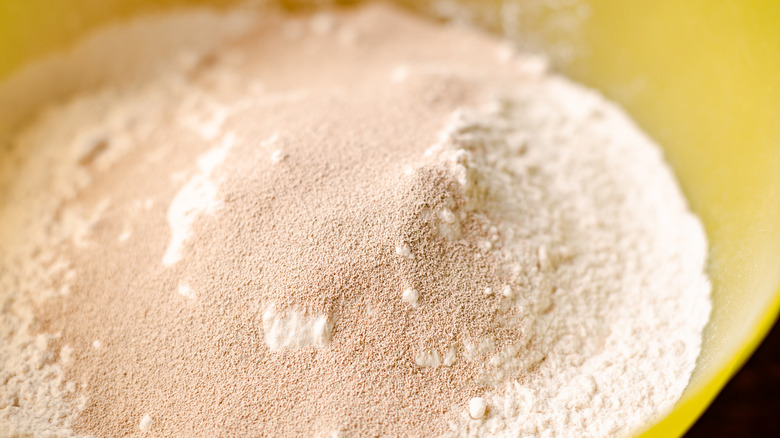
Myhrvold also explains that the dead yeast cells which coat the living cells in active dry yeast also impart something called glutathione, which relaxes dough. Because of this, and to permeate the cocoon of dead yeast, Myhrvold explains that active dry yeast needs to be activated in a warm liquid, "a process known as blooming." When making the switch to instant yeast, this step can be left out. He says, "Instant yeast is truly instant — it does not need to be activated ... you can add it directly to your dough — and, as soon as it comes into contact with moisture, it will begin the fermentation process." Instant yeast particles are also finer and more porous, which help them dissolve and rehydrate more easily.
When transitioning to instant yeast, it's also important to use the right one, as there are different types suitable for different purposes. "The one you choose will depend on the type of dough you make. For example, enriched doughs with larger proportions of sugar require osmotolerant yeast," states Myhrvold. Enriched doughs make breads like challah, brioche, and milk bread. One good osmotolerant instant yeast brand is Le Saffre Saf Instant Gold, available on Amazon. This requires less water than the instant yeast used in lean doughs.