

The Biggest Kosher Salt Myth You Probably Believe (But Shouldn't)
We may receive a commission on purchases made from links.
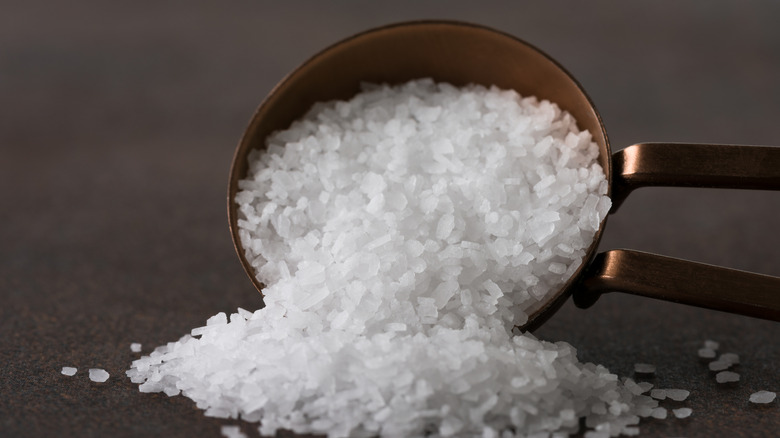
Food myths abound regardless of the type of food or the way it's prepared — even more so when involving one of the most ancient, widespread, edible substances known to man: salt. The simple white substance is even more intriguing and mythical due to its use as a life-changing food preservative, its role in religious observances, and its value as a component of currency and trade in centuries past. That's why it's no surprise that, like false facts about salt in general, a specific myth about kosher salt endures, one we've all likely believed at some point, even if subconsciously.
It involves the actual name of what we know as "kosher salt," easily assumed to be self-explanatory as a salt that's been certified as kosher or even ritually blessed or treated as such. But the name is more than a little misleading. It would be more accurate to call the coarse, white crystals "koshering" salt, because its traditional job is to make meat kosher by drawing out the blood. This type of salt is now commonplace in home kitchens and restaurants, regardless of religious affiliations or desires to "purify" meat.
That said, the name remains, and kosher salt is still used to facilitate Jewish dietary laws in which consuming blood from meat or poultry is prohibited. Properly slaughtered kosher animals still need to go through a process that removes remaining blood before the meat is eaten. One traditional way to make that happen is to soak the meat in water, then drain and cover it with coarse salt, letting it sit so the salt can pull out blood, and then thoroughly washing the salt away. In other words, kosher salt got its name because its specific coarse composition was well-suited to the required koshering process.
Why kosher salt works so well for kosherizing meat
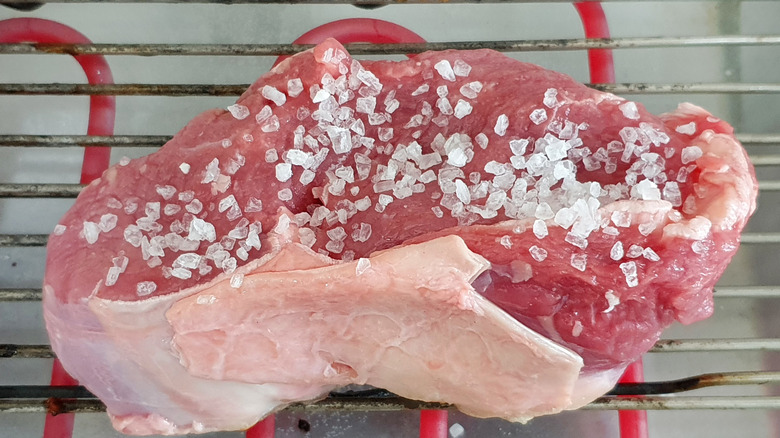
It's easy to think just any old salt would do for the original, traditional, food-prep purpose of kosher salt, which is to remove the blood from meat and thereby purify it. But other salts won't do the trick because of their textures. Fine table salt tends to dissolve too quickly into the meat, while some coarser, chunkier salt crystals may not stay positioned well enough to do the job evenly. Kosher salt, on the other hand, is designed as larger, irregular crystals that are coarse enough to sit on the surface and draw out liquid, while still being easily rinsed away after the salting step is complete.
Then there's another important detail about kosher salt that's not often recognized: kosher salt doesn't have iodine, which is typically added to table salt to prevent iodine deficiencies and related thyroid health issues. But for koshering meat, that same lack of iodine is partly why it's used. The iodine added to table salt is often accompanied by a dextrose preservative to control moisture, and that dextrose comes from corn or wheat starch, which can be unacceptable for Passover.
Kosher salt in everyday cooking

For everyday cooking, kosher salt has increasingly earned kitchen cred for reasons that have nothing to do with religious food traditions. Many chefs and recipe developers love it because the larger grains are easy to pinch, scatter, and control by hand. That makes it better for seasoning meat, roasted vegetables, or anything where you want the salt to be evenly distributed across the surface instead of pouring out in little piles. The smaller, more compact crystals in table salt also tend to pack more tightly, potentially making a teaspoon of table salt taste unpredictably more salty than a teaspoon of kosher salt.
So all in all, the big myth most folks have been believing is not that kosher salt is somehow bad or misrepresented. It's simply that the name doesn't mean what it's assumed to mean. Kosher salt is only called that because it helps kosher meat become kosher. And even if you're not using it for that purpose, the coarse, chef-friendly texture of kosher salt, like the Diamond Crystal brand available on Amazon, is exactly why you might want to keep it stove- and table-side as often as possible.
For deeper diving into the world of kosher salt, check out these differences between kosher, table, and sea salts. You can also learn more about why it's harder to over-season food when using kosher salt.