

This Canned Campbell's Product From The '50s Would Have People Cringing With Disgust Today
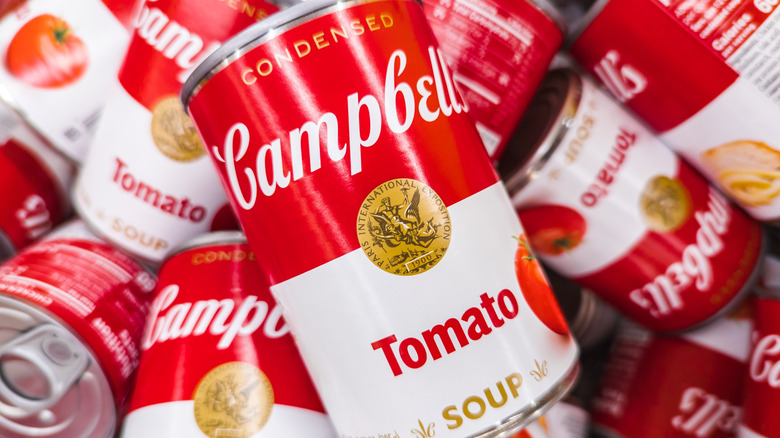
The iconic red-and-white cans of Campbell's Soup have stocked American pantries for over 130 years. While tomato soup is its longest-running flavor, Campbell's is known for its assortment of soups, from cream of mushroom to clam chowder and everything in between. It's no surprise, then, that over the course of the company's history, its selection of soups has reflected the public's changing tastes. Today, there's one flavor you'll find confined to the history books: Campbell's mock turtle soup.
Mock turtle soup was a well-known and beloved dish decades ago. As the name suggests, the dish was designed as a budget-friendly knockoff of turtle soup, which was made with actual turtles and was a massive culinary craze from the mid-19th century into the early 20th century. In its heyday, you could find it in upscale establishments like Delmonico's in New York or at the dinner table of the White House; U.S. President William Howard Taft reportedly loved turtle soup. Because genuine turtle meat was expensive, some home chefs made their own "mock" turtle soup with cheaper meat. In the case of Campbell's canned version of the soup, the "mock turtle" meat in question was actually calves' head. To modern consumers, the idea of boiling down a calf's head to mimic reptile meat probably sounds unappetizing. But Boomers enjoyed untraditional meats like liver, sparking demand for Campbell's mock turtle soup.
The cooking process for mock turtle involved simmering a calf's head to replicate the distinct, gelatinous texture of turtle fat. Combined with a purée of tomatoes and an assortment of herbs and spices, this soup impressed millions.
The surprising history behind this odd soup
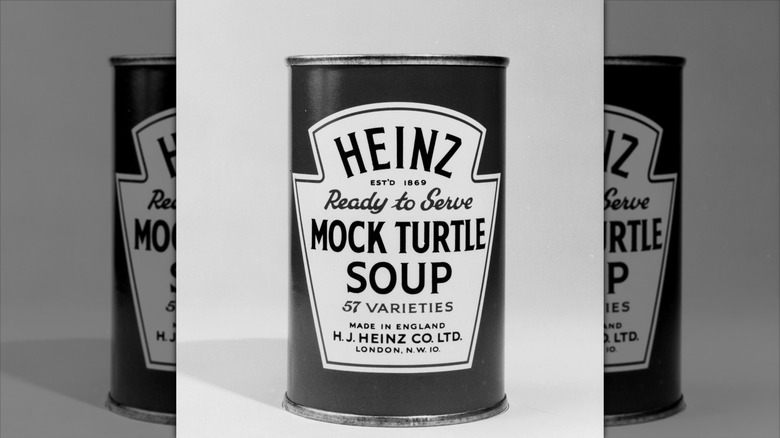
A Campbell's advertisement from 1927 touted its "unusual flavor" as a European-style delicacy that used only the finest cuts of calves' head meat. Even Andy Warhol, the artist most famously associated with the brand's iconic imagery, once said mock turtle soup was his favorite Campbell's flavor.
Although the recipe started as a knockoff, the mock version was eventually just as well-known as the real deal. And thankfully so — the original turtle soup craze of the 1800s led to over-hunting and nearly wiped out the terrapin turtle species in the Chesapeake Bay. Luckily, the population was saved thanks to Prohibition; authentic turtle soup relied heavily on sherry as an ingredient, so the lack of legal alcohol caused the dish to fall out of rotation on restaurant menus. As real turtle soup faded in popularity, Campbell's mock turtle soup stepped in to fill the void, remaining a dinner table staple through the 1950s. But the public's tolerance for weird, gelatinous foods took a nosedive in the 1960s, and mock turtle soup was no exception.
While Campbell's stopped its production of canned mock turtle soup prior to 1960, it's still eaten in America today. If you grew up in Cincinnati, Ohio, you might still be familiar with it as a local specialty. Worthmore's canned mock turtle soup remains on the market today as the only major producer of the soup, which uses a traditional recipe of beef hearts, ketchup, hard-boiled eggs, and lemons. That means it's not too late to try it out yourself!