

This Old-School Cast-Iron Meat Tool Was In Kitchens Everywhere (And Now It's Rarely Seen)
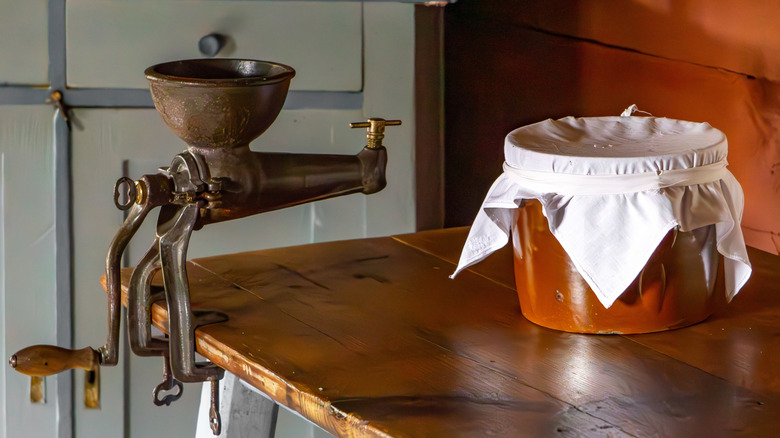
There are countless things in the kitchen that can evoke warm memories of the past. It may be the smell of your grandmother's gently simmering Sunday Gravy, or the sight of a box of meticulously organized handwritten recipes. For many, this nostalgia trigger will be the presence of a cast-iron meat grinder, a kitchen tool that was once in kitchens everywhere, but is now much more rarely seen.
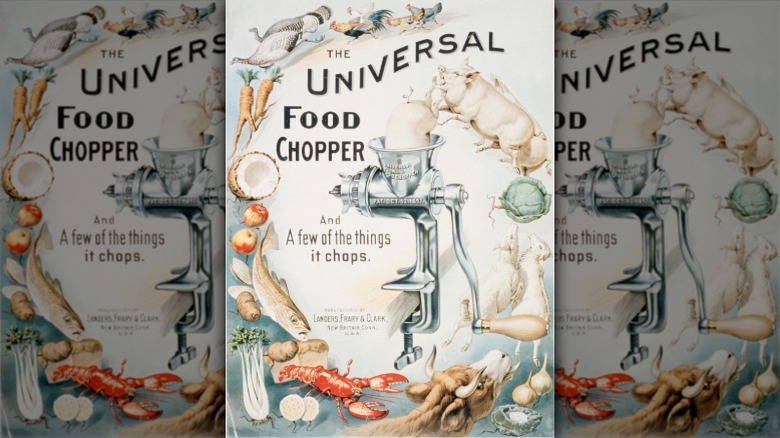
German inventor Baron Karl Drais invented the manual meat grinder as we would recognize it today — with its funnel, hand crank, and screw conveyor — in the 19th century. It would reach the United States when it was unveiled at the 1876 Philadelphia Centennial Exposition. One popular example of the cast-iron grinder was the Universal Food Chopper, a model first produced by L.F.&C. in 1897. It would remain in the company's catalogue for more than six decades. According to the National Park Service, L.F.&C.'s chairman said in 1955 that thanks to the Universal Food Chopper, "odds and ends could be turned into hashes and casseroles with ease." Due to their durability, many examples of this model survive today, despite the company that produced them going out of business in 1965.
A key disadvantage of any manual meat-grinder is fairly obvious — using it for any large amount of food is a laborious process (but a worthwhile one if you're working on your upper-body strength), so it is no surprise that many opted instead for electric alternatives once they became available. This, combined with the rise of refrigeration and the increasing availability of ground meat in supermarkets, saw the popularity of the cast-iron meat grinder steadily decline — though they did enjoy something of a resurgence in the 1980s among devotees of from-scratch cooking.
What to bear in mind if you're looking for a cast-iron meat-grinder today
This does not mean the cast-iron meat-grinder does not have fans today, however. A post on the Facebook group "Cast Iron Experts" from someone who had found one of these grinders while going through their grandfather's possessions provoked feelings of nostalgia for numerous commenters, while one user stated, "I've just started using one, and I love it", adding that the steak they had ground for hamburger using the cast-iron grinder "cooks with a much better texture and flavor than store bought hamburger." Much like a cast-iron coffee grinder, some may enjoy the rustic aesthetic that a cast-iron meat grinder can bring to your kitchen. Also, if you're lucky, you may even be able to find one that comes with a pulley that can be hooked up to an electric motor, giving you a less arm-aching option.
While various cast-iron grinders can be purchased new, some models have received mixed reviews and been compared unfavorably to the more old-fashioned kind, so if you're looking for the sort of classic black grinder you may recall from your parents' or grandparents' kitchen, your best bet for finding one easily is either eBay or the local antique store. If you are buying a vintage grinder, make sure that all components are present and in good condition, as getting parts replaced or blades sharpened may be difficult or costly. Finally, if you do get one of these old-school gadgets set up in anticipation of making your own burgers or meatballs, remember to take our beef-grinding advice and cut your beef into two-inch cubes, then chill them in the freezer for 30 minutes before grinding — thus yielding a smoother, more consistent result.