

Blast Stubborn Grill Grime Off Fast With This Easy Ice Cube Trick
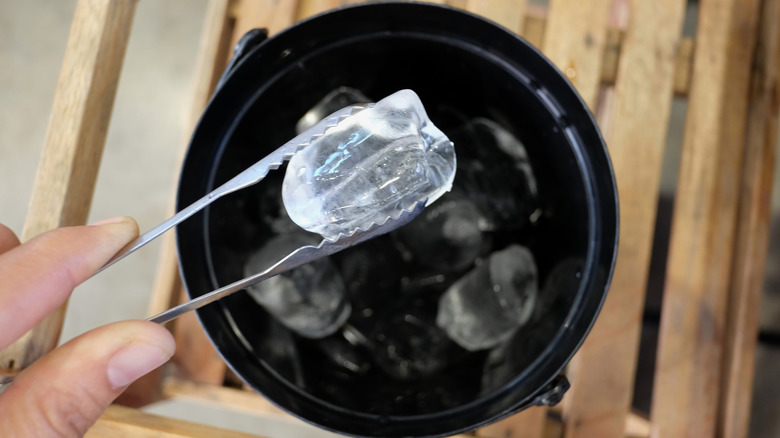
Wire barbecue brushes are tricksy. There are a few reasons why you should stop using a wire brush to clean your grill: They either embed metal bristles onto your cooking surface, or otherwise waste time being ineffective at eradicating deep grease, grime, and hard, burnt-on material. Then there's the chemicals, perhaps effective at dissolving grease, but can you be certain you've removed it from the same surface you put your burgers on? A simple solution – well-known to some in the service industry — is to use something that's as cheap and readily available as frozen water. It is, in fact, frozen water.
Placing ice on a hot grill creates a reaction that lifts burnt-on debris with minimal scraping, ridding the cleaning process of both food grease and elbow grease. But before you empty a cooler's worth onto your Weber, there are some important things to know, and some safety considerations.
The trick works on both barbecue grills and griddles, and is straightforward to execute. Get your grill or griddle ripping hot. Then, when it's up to temperature, drop some ice-cubes onto the surface. The carbonized debris (that's a fancy term for the burnt-on black stuff) should lift off with an easy scrape. This is due to the effects of thermal shock on the carbonized debris, which is the rapid and irregular contraction of the material, causing it to fracture, disintegrate, and separate from the molecularly expanded, more resilient hot metal of the grill. The steam that's created almost instantaneously introduces material agitation that helps to move grease off as well.
Cold as ice, but willing to sacrifice your grill?
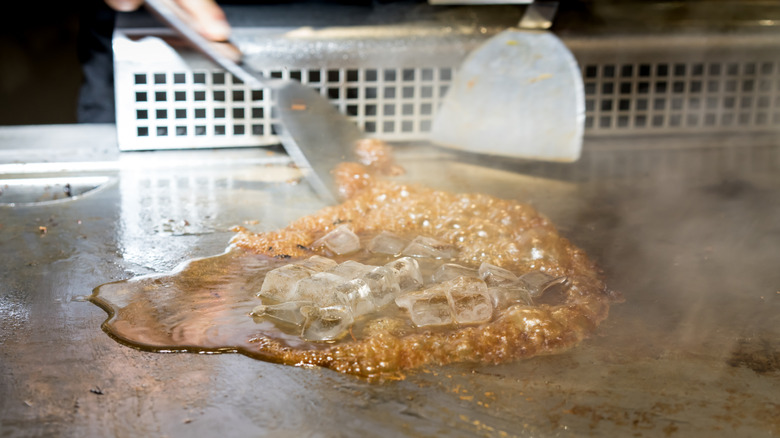
This method is easy to execute, but there is a "proceed with caution" sign for this process. Advice from Foodservice Equipment Reports says to avoid cleaning your grill with ice, as thermal shock can even fracture the equipment, not just the debris caked onto it. Still, this practice is fairly common, and there are approaches that work, so long as you understand the risks to your equipment or yourself, which include being burnt by the rapid creation of steam. Stainless steel is more resistant to thermal shock, so grills and griddles made from this material can be more safely cleaned with the ice cube method than those made of metals like cast iron. Avoid thermal shock entirely for materials like glass and ceramics. Anecdotal discussion online also points to the potential damage rapid cooling and heating can have on welds in even stainless steel constructions. Warping is another common side effect of thermal shock, which is bad news for flat grills and griddle surfaces.
There are approaches you can take, if you have a cast-iron grill on your barbecue, to reduce the intensity of the thermal shock you administer. Using smaller ice cubes can cool the surface of a grill less intensely than bigger blocks. If you're worried about cracking your equipment, there are other grilling hacks to try, such as using the layered power of an onion to clean. Or, simply choose the right time to clean your grill to get it ready for summer by attacking it with a scraper as soon as you're done cooking.