

13 Regional Seafood Dishes Everyone Should Try At Least Once
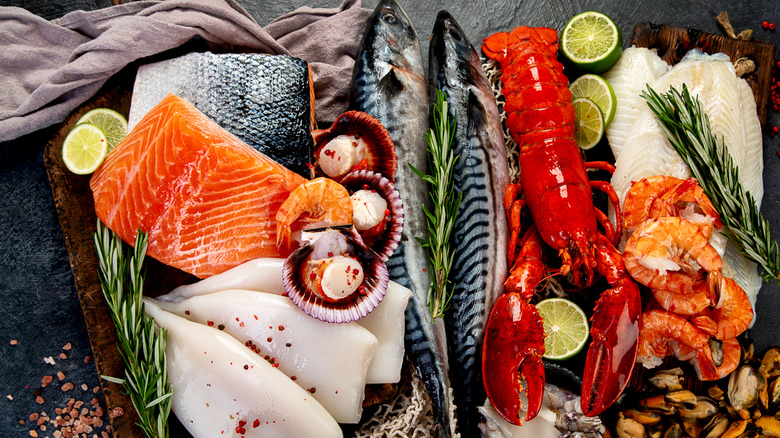
American seafood dishes are as diverse as American cuisine itself, from the Japanese influences on the West Coast and Creole and Cajun cuisine of Louisiana to the history of shellfish in New England. Our relationship to seafood has changed significantly over the years, with the constant shifts in the fishing industry and the climate. In the 17th and 18th centuries, for example, lobster was so plentiful that indentured servants began to stipulate in their contracts that they would only eat it three days per week. This fact would no doubt astound modern-day consumers who might spend as much as $75 for a single lobster.
It would be impossible to make an exhaustive list of American seafood classics, but there are some that stand out as unmissable. Who could go on a trip to New England without ordering an appetizer of clams casino? And if you happen to be in the Bay Area, you wouldn't want to miss out on some local cioppino. From hidden gems like Frogmore stew to cultural icons like the California roll, here are 13 seafood dishes from around the country that you can't miss.
1. California roll
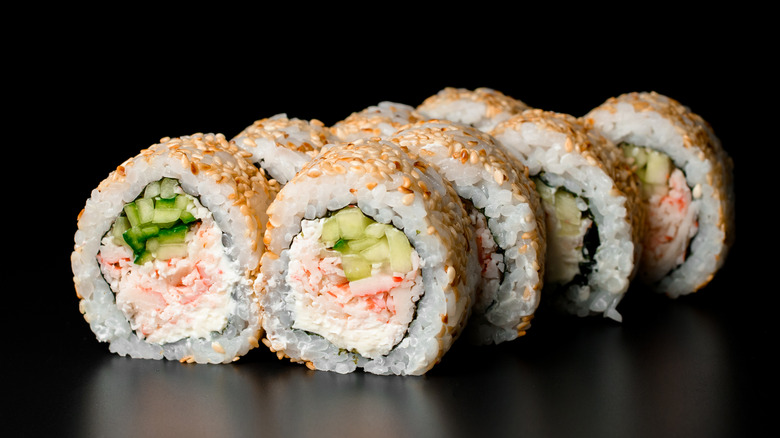
Despite the name, the origins of the California roll are hotly contested. On one hand, you have Ken Seusa, a Tokyo-born chef who worked at Hollywood's Kin Jo restaurant in the 1960s. On the other hand, you have Hidekazu Tojo, an Osaka-born chef who worked in Vancouver. That's right — one version of the story (and the one most widely cited as fact) claims that the California roll is neither Californian nor American. Noticing that Canadians shied away from seaweed and raw fish, Tojo decided to make a sushi dish that would appeal to local tastes. Raw fish was replaced with locally-sourced boiled crab meat, and the seaweed was hidden under a layer of rice.
There are other chefs who also claim to have invented the dish, including Kanai Noritoshi and his head chef Ichiro Mashita, both of whom worked in Little Tokyo in Los Angeles in the 1970s. At this stage, it's impossible to know who the true inventor was, but there is no question that it quickly became a ubiquitous offering at West Coast sushi restaurants where American diners were thrilled to find a type of maki that was tailor-made for their limited tastes.
2. Étouffée
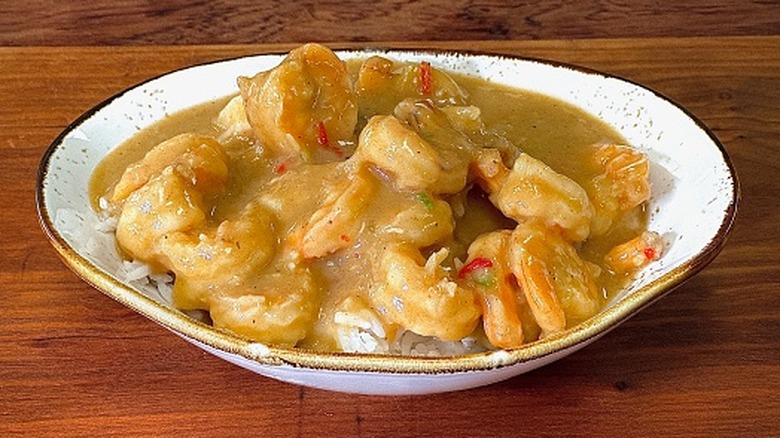
In French, étouffée means "smothered," which is the method by which this classic Cajun dish is prepared. The central ingredient is crawfish, which are smothered in spices and cooked in a roux. Although recipes for the dish vary, the original buttery flavor was attained through crawfish liver, otherwise known as crawfish fat. Interestingly, it is now illegal to use crawfish liver commercially, so the most authentic étouffée you can get nowadays is homemade, not from a restaurant.
The recipe originates from Breaux Bridge, a small city just Northeast of Lafayette, Louisiana. Crawfish has been such a staple ingredient in the city's famous cuisine that the state dubbed it "the crawfish capital of the world" all the way back in 1959. The local legend surrounding the dish is that it was invented somewhat inadvertently in the 1940s or '50s when a Lafayette businessman asked Breaux Bridge restaurant owner Aline Champagne what she was making. She responded, "I am simply smothering my crawfish tails." The businessman tried the broth and was so overwhelmed by its deliciousness that he brought his colleagues the next day. Regardless of the historical specifics, the dish has become a Cajun classic, and no trip to Breaux Bridge is complete without it.
3. Hangtown fry
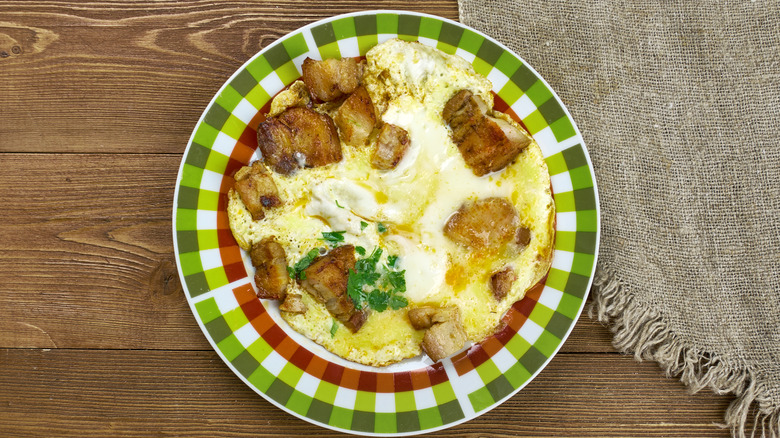
Hangtown fry might not reach the levels of fine dining that Oysters Rockefeller or caviar do. Still, it has a fascinating regional history that makes it more than just an unusual menu item. It's an omelet or hash made with eggs, bacon, and oysters, and it was named after the place where it was invented during the California Gold Rush in the 1840s. These days, Hangtown is known as Placerville (the original name was a reference to its history of extrajudicial lynching and was, not surprisingly, changed), but the recipe hasn't lost its historic moniker.
Located to the northeast of Sacramento, Placerville was once near the epicenter of the Gold Rush. There is no definitive origin story of the Hangtown fry, but the local tale goes that in 1849, a prospector who struck gold went to the local saloon and requested the most expensive dish on the menu. He was told that eggs, bacon, and oysters were the priciest items, so he demanded to have a dish made with all three. Nowadays, you can find versions of the Hangtown fry throughout Northern California, sometimes with the oysters breaded and fried.
4. Clams casino
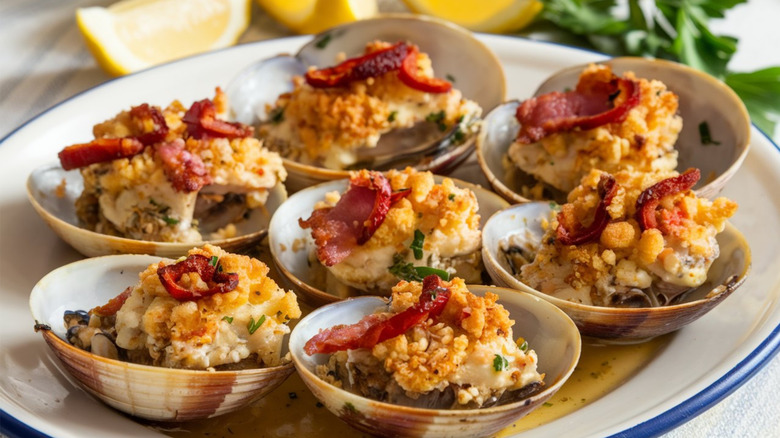
Bacon is the crux of many dishes, even if it isn't credited in the title. Like cheese, it provides a salty, fatty, umami richness that turns recipes into instant crowd-pleasers. Clams casino is one of them. This New England classic is made of littleneck clams served in their half shells like little open-faced sandwiches and covered in shallots, pepper, garlic, bacon bits, dry sherry, and breadcrumbs that become crispy and buttery when baked.
Some sources claimed that the dish was invented in New York City in 1917, but thanks to some digging by Providence Journal reporter Arline A. Fleming in 2005, we can now be fairly certain that it was invented long before then in Narragansett by a man named Julius Keller, who worked at Louis Sherry's Narragansett Casino in the 1890s. When socialite Mrs. Paran Stevens asked him to make her a special dish of clams for a luncheon, he delivered, and the formula soon began cropping up on menus around New England, where it remains a fixture. If you want to see what all the fuss is about but don't live near a restaurant that serves the dish, you'll be glad to know that you can make clams casino at home, too.
5. Fish boil
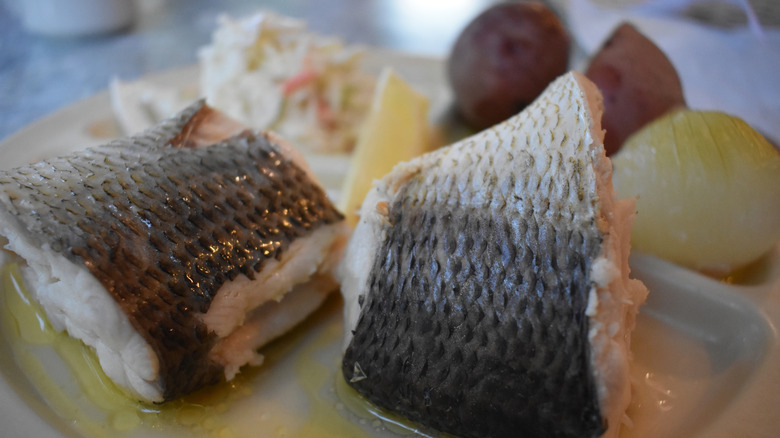
Fish boils are both an event and a dish, and they are one of the most hyper-regional foods you'll find. They originate from the landlocked state of Wisconsin, but are mainly associated with Door County, a peninsula that rests between Green Bay and Lake Michigan. Fish boils were brought by Scandinavian settlers in the late 19th century, and though different master boilers have their own twists on the formula, they usually consist of locally sourced white fish, potatoes, onions, and corn boiled in heavily salted water over an open fire.
This isn't your average restaurant experience. Fish boils are invariably prepared outdoors and have a communal quality about them, like a town picnic. Whether you attend one as part of a wedding or at a local restaurant, they are as much a spectacle as a meal. Nowadays, they are festive occasions and a key source of tourism to the area, but they were originally just an economical way to serve a large group of laborers, either fishermen or loggers, depending on who you ask. Although it's not technically part of the dish, don't skip the cherry pie for dessert if you're offered a slice. It, too, has become part of the tradition.
6. Oysters Rockefeller
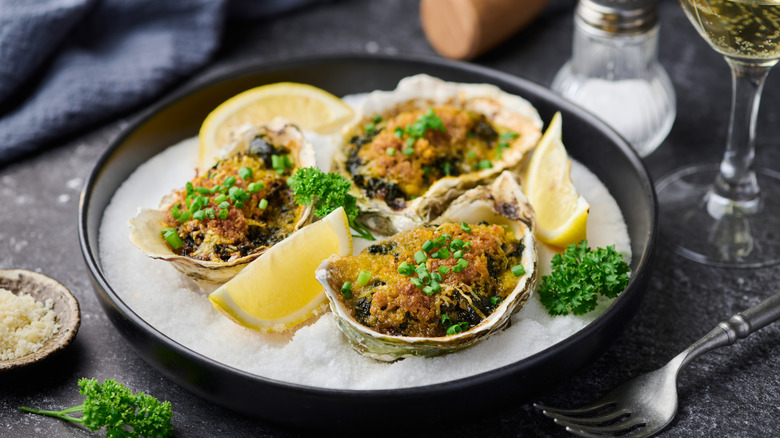
If you've never tried oysters Rockefeller and only know of it by name, it probably sounds a bit pretentious. After all, oysters are a pricey ingredient, and the name Rockefeller is shrouded in misty associations with immense generational wealth. It's true that oysters Rockefeller was named after the richest man in the world at the time, John D. Rockefeller, but don't let that deter you from ordering the dish if you have the chance. The basic recipe consists of oysters in their half shell with butter, breadcrumbs, shallots, spinach, herbs, and rock salt. Variations abound and are often closely-kept secrets. Anise-based liqueur is a common addition, sometimes in the form of absinthe and sometimes in the form of Pernod. You may also find versions with capers, Tabasco sauce, and bacon.
As to why they're named after the once-world's richest man, it has more to do with the decadent flavor than with Mr. Rockefeller himself. Legend has it that in 1899, New Orleans restaurant owner Jules Alciatore needed a new menu item to replace the escargot that had become difficult to source. His oyster concoction was so luxurious that a patron dubbed it "as rich as Rockefeller," and the name stuck.
7. Frogmore stew
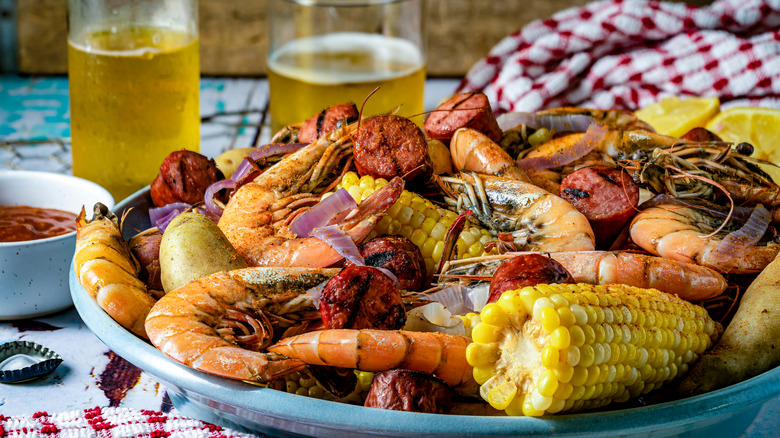
Contrary to what its name suggests, Frogmore stew does not contain any amphibious ingredients. It's a one-pot meal that hails from the Lowcountry of South Carolina and is made of shrimp, corn on the cob, new potatoes, and smoked sausage. It's a full meal unto itself, with enough flavor variation between the sweetness of the corn and the smokiness of the sausage that you hardly need seasonings.
To understand its distinctive name, you have to take a trip through the state's history. The dish originated on the island of St. Helena (the one just off the coast of South Carolina, not the British territory in the South Atlantic), which used to have a small community called Frogmore, named after a British estate. That anglophile name belies the true origins of the dish, though.
Frogmore stew might have been named by a former resident of the community, but the ingredients and culture surrounding the dish were created by the Gullah Geechee people, a group formed by descendants of enslaved West Africans on the Southern Atlantic coast. Although the word "stew" might have soupy connotations, Frogmore stew is often served on paper plates, with newspaper spread out across a table, and offers a communal eating experience.
8. Clam pie
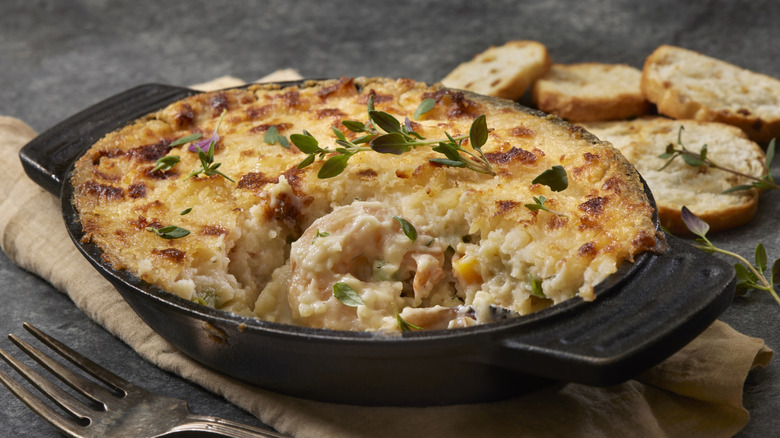
Another hyper-regional dish, clam pie hails from East Hampton, a town situated on the eastern end of Long Island. Despite its highly specific origin, it takes many forms. Like any good casserole, it can contain whatever the cook has on hand, be it fresh garden veggies or cheese. Recipes for the dish date all the way back to the late 19th century and initially called for a scant handful of ingredients, including eggs, milk, and butter, with no crust. Later recipes include Swiss cheese and onion. Most modern recipes call for a double crust, like a classic apple pie, making the dish all the more hearty and comforting.
The pie is part of Long Island's extensive history of clamming, and the fact that it hasn't caught on in other parts of New England is rooted in history, too. There was a period when clams were considered to be low-class fare by those outside the area, associated with Indigenous communities and people who lacked the money to buy higher-end shellfish. Many of the recipes are passed down from home cooks rather than restaurants, and although you're less likely to find it on a menu than clam chowder, it's worth seeking out or making yourself.
9. Poke
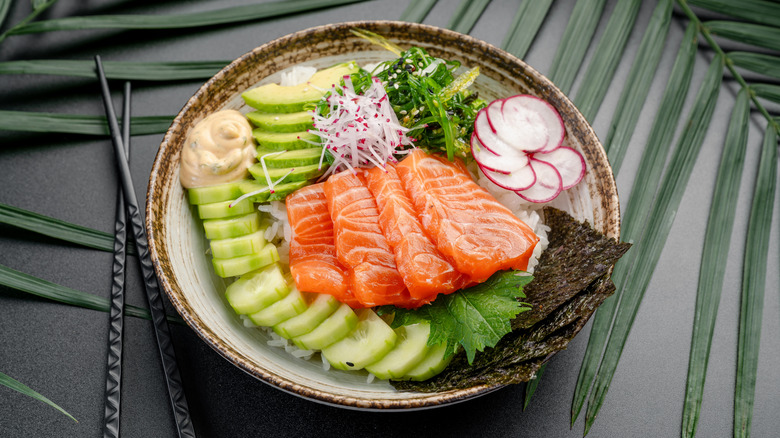
You might have first discovered the wonderful Hawaiian poke bowl in the mid-2010s when the gloriously photogenic dish began to decorate Instagram feeds, but its history dates back much farther than that. In its current iteration, the poke bowl typically contains sushi-grade raw fish, rice, soy sauce, and an assortment of fresh ingredients like avocado slices, radishes, seaweed, and edamame, all arranged in discrete parts of the bowl to create a colorful collage.
In Hawaiian, poke means "cut pieces," which hints at the thrifty origins of the dish. Although the precise era is uncertain, Polynesians living in modern-day Hawaii made sure that none of their food went to waste by chopping up leftover bits of fish and zhuzhing them up with seasonings and vegetables. Soy sauce and rice became staples of the dish when Japanese immigration influenced the local cuisine in the 19th century. Following several waves of migration by Hawaiians to the mainland a century later, poke bowls became popular around North America, too. If your mouth is watering just at the thought of this delicious dish, make sure to read our tips for making poke bowls at home. It's easier than you might think.
10. Crab cakes
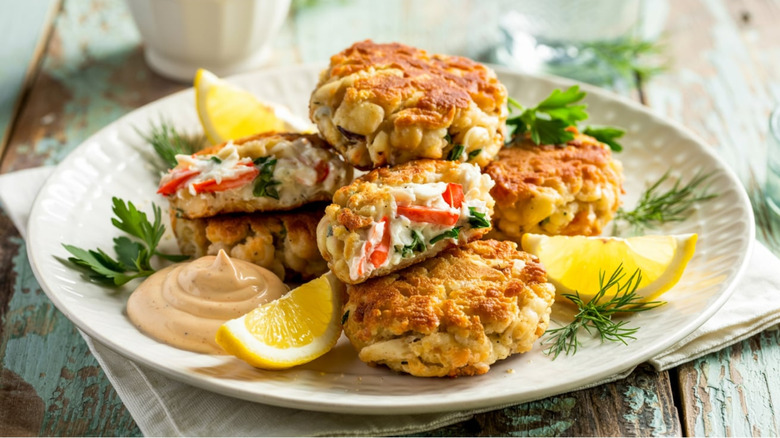
No trip to Maryland is complete without a taste of the state's famous crab cakes. In their truest form, they are a celebration of crab meat, not the breading or the filling. Chesapeake Bay is home to the blue crab, which has been a crucial ingredient in Maryland cuisine for centuries. As early as the 16th century, Indigenous people made crab cakes with herbs, vegetables, cornmeal, and crab meat and fried them in bear fat, a recipe that is strikingly consistent (bear fat aside) with today's recipe.
These days, any coastal restaurant in Maryland, especially on Chesapeake Bay, is almost guaranteed to offer some version of crab cakes. You'll find crab cake egg rolls and crab cake Benedicts, but don't forget the golden rule: crab cakes should be mostly crab meat. Anything else is just unnecessary tampering with a flawless formula. If you're lucky enough to be visiting Maryland soon, check out our guide to the best spots for crab cakes in Baltimore before you go.
11. Lomi lomi salmon
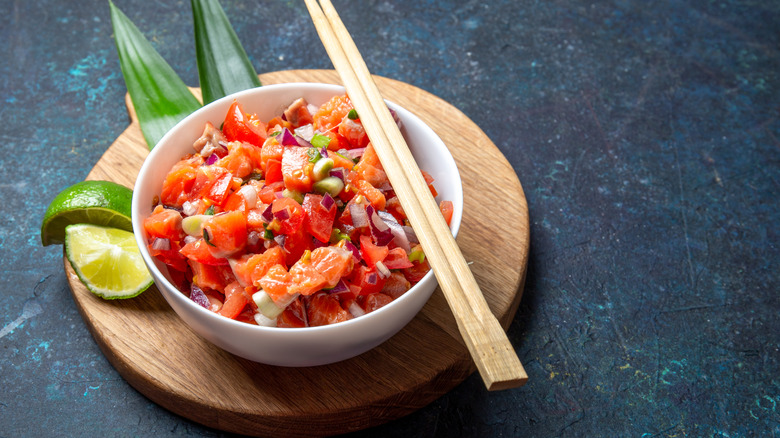
If you're visiting Hawaii and have a craving for something fresh and flavorful, lomi lomi salmon should be at the top of your list of dishes to try. Made with small pieces of raw, salt-cured salmon mixed with tomatoes, onions, and seasonings, lomi lomi gets its name from the word for "to break into small pieces," and is also a type of massage. Interestingly, although lomi lomi salmon is considered to be a Hawaiian dish, none of its ingredients are native to Hawaii.
Onions arrived on the islands in the 18th century with the British explorer James Cook, and tomatoes were popularized there by Spanish horticulturalist Francisco de Paula Marin soon thereafter. Salmon was the last of the main ingredients to arrive, though it didn't take long. By the 1830s, there was a robust trading relationship between British Columbia and Hawaii, with thousands of barrels of salmon being exported to Hawaii and Asia each year. These days, all the ingredients for lomi lomi salmon are readily available on the islands, and it has become a staple menu item alongside poke bowls.
12. Monterey Bay cioppino
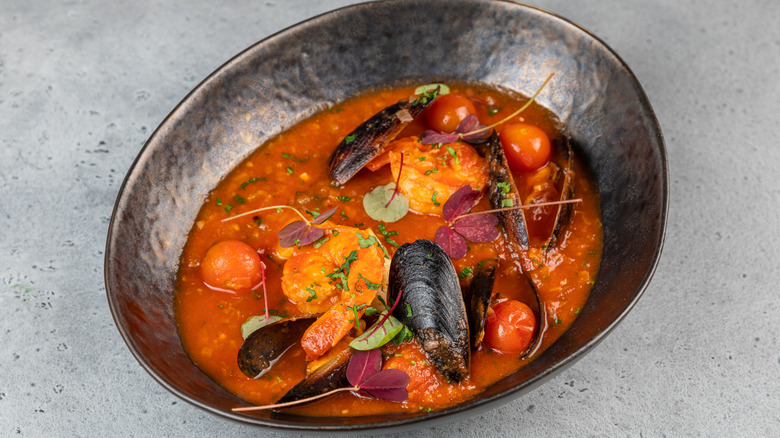
If you've ever swooned over the intense savoriness of a bowl of cioppino, it may have solidified your love of Italian cuisine. And why wouldn't it? But in reality, this flavor-packed seafood soup is an American creation. It is a cornucopia of seafood, featuring Dungeness crab, shrimp, scallops, fish, clams, mussels, and calamari, simmered in a potent broth of tomatoes, garlic, chilis, and white wine. There is nothing subtle about this dish. For seafood lovers, it's the holy grail. For people who aren't the biggest fans of aquatic ingredients, it's something of a nightmare scenario.
Although cioppino did not originate in Italy, we do have Italian immigrants in San Francisco's Fisherman's Wharf to thank for it. Back in the early 1900s, these fishermen would make a simple one-pot meal by tossing pieces from their daily catch into a big bucket and adding seasoning. As for the name, some people claim that it's a derivation of the Italian-accented calls to "chip in" to the communal meal. Other historians claim that it is more likely a derivation of the Northern Italian word "il ciuppin," meaning "little soup." Either way, you will find cioppino on the menu throughout the Bay Area, and for seafood lovers, ordering it at least once is a necessity.
13. Oyster loaf
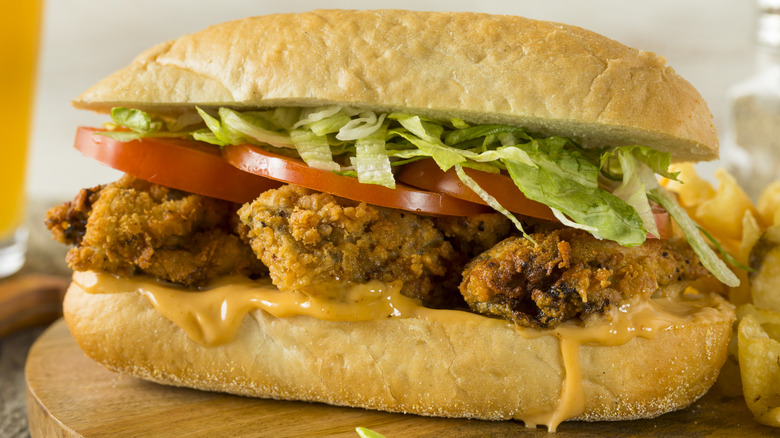
Oysters are often lovingly served over ice as if they were art as well as food, but as dishes like the Hangtown fry prove, they are also delicious when smothered in eggs and paired with bacon. The oyster loaf follows this logic, presenting a dish that is nowhere near as gourmet-looking as a silver platter of raw oysters in their half shells, but which — we'll come right out and say it — might be equally as delicious. Made by hollowing out a crusty loaf of toasted, buttered bread and filling it with breaded and deep-fried oysters, the oyster loaf may scandalize seafood purists, but they should try it first before condemning it. Salty, crunchy, and indulgent, it's a gourmet late-night snack if ever there was one.
This humble delicacy dates back hundreds of years, and believe it or not, it wasn't particularly luxurious back then. Like lobsters, oysters were once plentiful in the waters around North America, and they were priced accordingly. Americans paid half as much for a pound of oyster meat as they did for beef, and the ingredient made its way into everything from stuffed turkey to scrambled eggs. The oyster loaf emerged in the latter half of the 19th century and, according to New Orleans lore, was dubbed "la médiatrice," or "the peacemaker," due to its ability to calm the temper of women whose husbands stayed out drinking all night.