

If Peanut Butter Has High Levels Of These 2 Ingredients, Put It Back On The Shelf
We may receive a commission on purchases made from links.
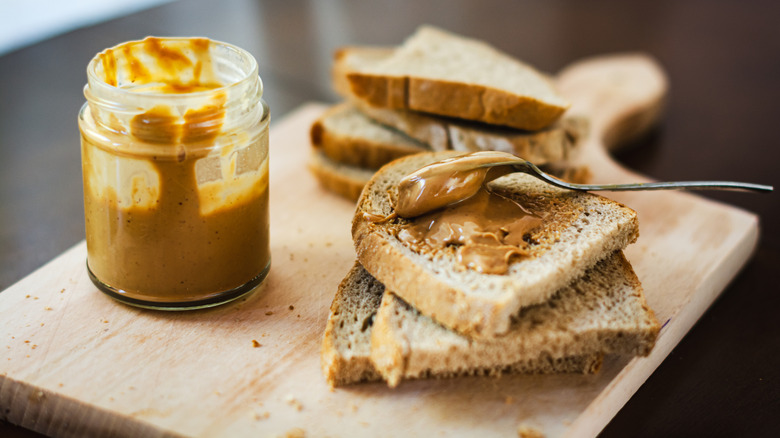
In its simplest, most unadulterated form, peanut butter comprises ground roasted peanuts – that's it . The nuts' natural oils provide all the moisture necessary for transforming peanuts into a luscious, spreadable paste. Take a walk through your local grocery store's PB aisles, however, and a glance at nutrition labels will quickly reveal that most commercially processed brands contain a lot more than just peanuts.
Preservatives (potassium sorbate and sodium benzoate, for instance), stabilizers, and hydrogenated oils are often in the mix, especially with those that offer additional flavors. Salt and sugar are also common additives, sometimes in the form of high-fructose corn syrup. While fine in small amounts, if a peanut butter has too much of either, it can be an health red flag. For this reason, there is such a thing as eating too much peanut butter.
PB is (or should be) a nutrient-dense spread rich in plant-based protein, fiber, and healthy fats. To get the most out of that nutritional potential, look for brands that forego unnecessary extra ingredients. Start by giving the jar's label a closer look: Peanuts should be listed as the first ingredient. It's even better if they're the only ingredient. Next, look for no added sugar (5 total grams or less) and a low-salt content. But what counts as low?
High sodium and added sugar are nutritional red flags for store-bought PB
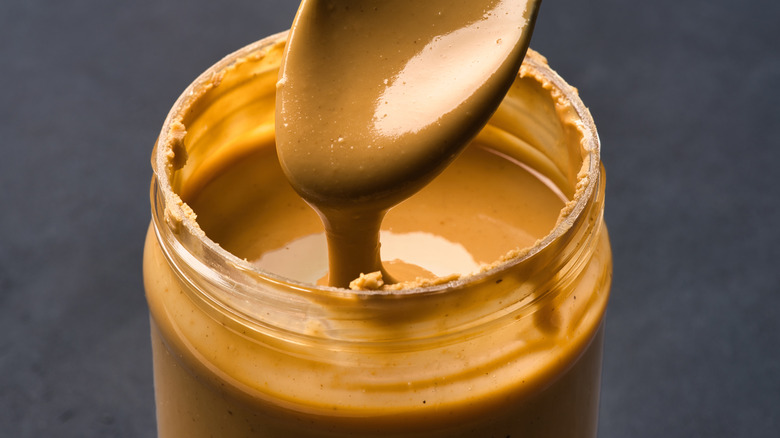
Peanut butter brands with no added sugars can be found just about anywhere these days. Just About Foods' Organic Peanut Butter, Creamy, for example, contains 2 total grams of sugar, no added sugars, and 70 mg of sodium per a 2-tablespoon serving. By comparison, for the same amount, Jif Natural Creamy Peanut Butter Spread (labeled as "low sodium") has 4 total grams of sugar (including 2 grams of added sugars) and 80 mg of sodium. On the other end of the spectrum, more highly processed options pack a whopping amount of sodium per serving, such as Jif Creamy Peanut Butter with 140 mg and Skippy Creamy Peanut Butter at 150 mg.
While both sugars and sodium are crucial to maintaining normal bodily functions, too much of either can negatively impact health. According to the American Heart Association, an adult in the United States consumes, on average, about 17 teaspoons of added sugar daily — nearly 300% of the daily recommendation of 6 teaspoons for women (9 teaspoons for men). When it comes to sodium, American adults routinely ingest more than 3,300 mg per day, well over the CDC recommendation of less than 2,300 mg.
Discerning consumers should take an especially close look at reduced fat peanut butter offerings. To compensate for the fat-stripped flavor profile, these often contain the highest amounts of added sugar and salt, counterintuitive to its health-conscious marketing.