

Garage, Basement, Or Somewhere Else: How To Choose The Best Place For Your Freezer
We may receive a commission on purchases made from links.
Picture an overflowing freezer, stuffed with bits and pieces or carefully planned stock-up items, some residing in frozen corners and cubbies so long you've forgotten they exist. If that sounds familiar, reset that mental image to include spacious, organized shelves and bins, and reachable items you'll actually use. That's when a standalone home freezer suddenly seems essential — if you just knew where to put it.
We hear you, and can offer some helpful intel on choosing the best place for your new (or old) freezer. To ensure you're well-versed in the options, we reached out to an expert on the topic, Amy Chernoff, VP of marketing and appliance expert at AJ Madison. From garages to basements or somewhere else, it really all comes down to the space conditions and how they affect freezer performance.
"Ideally, a stand-alone freezer should live in a climate-stable, well-ventilated space that's still easily accessible," Chernoff shares, recommending options such as a utility room, pantry extension, or lower-level storage area. "Consistent ambient temperatures help the compressor run more efficiently, which improves both performance and longevity," she says. "Accessibility matters too, since a freezer that's inconvenient to reach often becomes disorganized and underused."
Whether choosing the best chest freezer or opting for upright, compact, or deep freezers, it's worth further exploring the reality of freezer-friendly spaces — and where to absolutely not put your standalone freezer.
Fluctuating climates wreak havoc on home-freezer performance
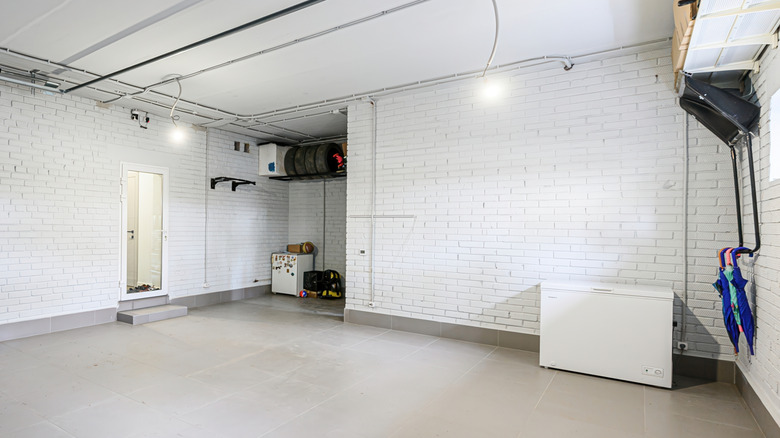
Many assume the garage is a perfect spot for standalone freezers, as there's often extra unused space and easy accessibility. That's true, but only up to a point. "A garage can work well, particularly in moderate climates," Chernoff says, "but extreme heat or cold can strain the appliance unless it's specifically rated as 'garage-ready.'" Garage-ready essentially means the freezer is built to perform well in a wide range of fluctuating temperatures. Many professionals agree that, to prevent damage to the appliance, freezers should ideally stay at temperatures above 0 degrees Fahrenheit and below 110 degrees Fahrenheit. A garage-ready designation takes care of that issue.
Chernoff notes that basements are often better from a technical standpoint, "because temperatures tend to stay more stable year-round, which is ideal for compressor efficiency and food preservation." But basements can be less convenient, depending on your personal home layout and accessibility to the freezer.
As for absolute no-go spaces for standalone freezers? "I would avoid placing a freezer anywhere with extreme temperature swings, poor ventilation, or direct heat exposure, like enclosed patios, uninsulated outdoor rooms, or beside a furnace or oven," Chernoff says. "Freezers need adequate airflow to dissipate heat properly, and without it, the appliance has to work much harder. Over time, that can impact both energy efficiency and lifespan.
To maximize your newfound love for bountiful freezer space, check out the ingredients that 14 chefs say they always have in their freezer, and why you should freeze some foods instead of canning.