

6 Potato Myths People Actually Still Believe
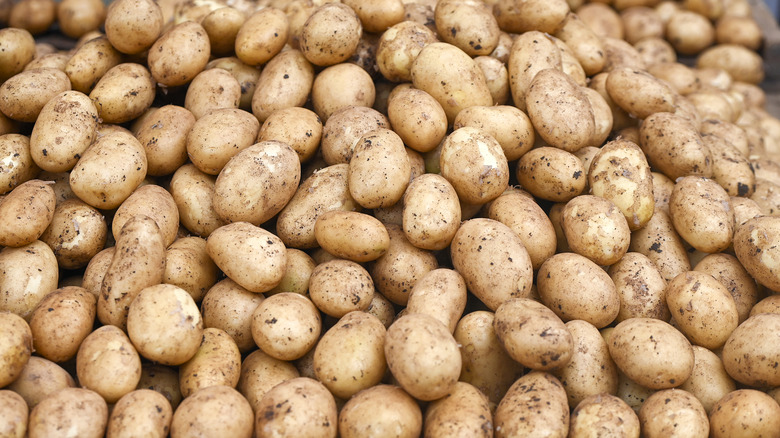
Potatoes aren't the prettiest vegetables in the produce section, but it's hard to imagine life without them. From their affordable price to the myriad of ways to prepare them, try thinking of a more useful vegetable. Potatoes have been an important part of the global diet since Indigenous South Americans introduced them to Spanish colonists centuries ago, who sailed them all the way back to Europe, where they gave rise to modern industrial agriculture. Today, there are over 4,000 potato varieties, and potatoes are the third-most important food crop in the world, per International Potato Center.
When something has such a pervasive presence in our daily lives, people naturally have a lot to say about it. And a lot of misconceptions about these starchy tubers have developed as a result. But of everything you've ever wondered about potatoes — whether they're a remedy for over-salting, a cure for disease, or a diabetic's nightmare — at the end of the day, they're just a humble, versatile tuber. Here are some potato myths people actually still believe.
Sprouted potatoes are toxic to eat
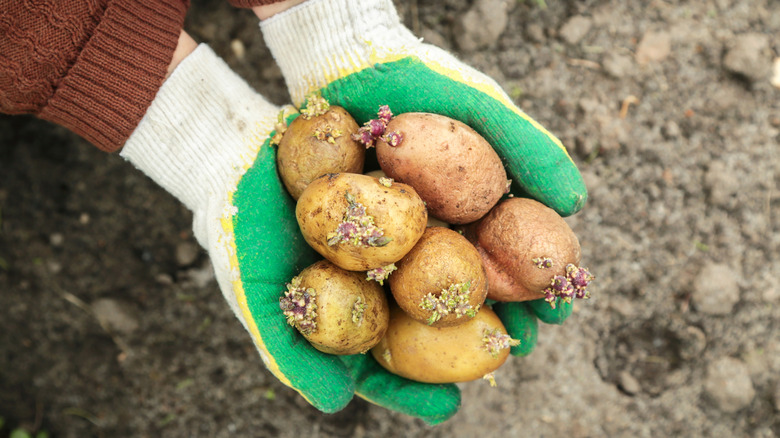
Anyone who's spent time on a farm or that buys produce from the farmer's market knows that appearance isn't always the best indicator of freshness. Most people will pick a sprout-less potato over one with little nodules, even if both are perfectly edible. There is some truth to the myth that sprouted potatoes are toxic to consume, but there's more to the story.
According to Poison Control, potatoes contain solanine and chaconine, two glycoalkaloids that are toxic when consumed in high quantities. Potato sprouts, along with the leaves, flowers, dents, and green skin, contain the highest concentrations of glycoalkaloids. A visible amount of green skin could indicate a surplus of glycoalkaloids, and therefore, a higher possibility of getting sick — but it could also just as easily be a sign of increased chlorophyll due to light exposure.
In truth, most domesticated potatoes have less than 10 milligrams of glycoalkaloids, per Cultivariable. And while high doses can be fatal, cases of people dying due to glycoalkaloid consumption are very rare, which, makes this less of a myth and more of a "it depends." Sprouted potatoes are safe to eat (so long as you remove the spouts), and glygoalkaloids are a natural pest deterrent and have a bitter taste that adds complexity to flavor profiles. Just make sure the skin isn't green and that you remove all sprouts.
Potatoes desalinate over-salted water
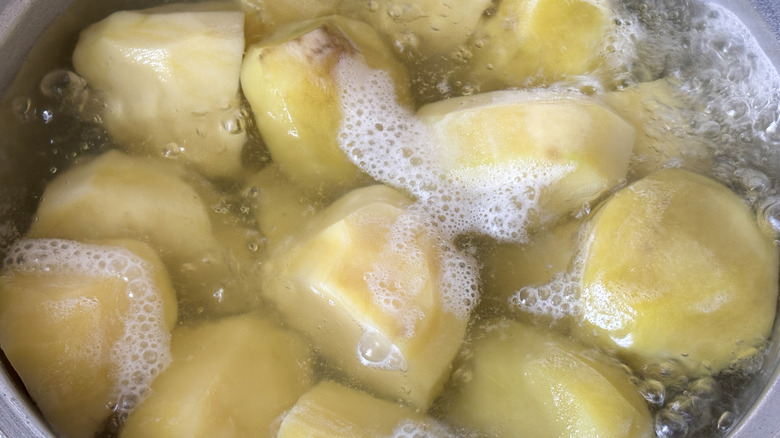
Over-salting by accident is an inescapable part of the cooking experience, whether you misread a recipe or use the wrong measuring spoon after a tiring day's work. Salt is the furthest flavor from shy, and even the tiniest mis-measurement can ruin entire dishes. So, naturally, it follows that countless people have attempted ways of removing excess salt, with varying degrees of success. You're likely familiar with one of the most well-known methods: using a potato.
The hack is typically reserved for soup, and it supposedly works by placing a potato into the pot, either whole or cubed, to absorb salt from the water as it boils. However, there isn't actual scientific evidence to back that up. It makes some sense — if you don't think too hard about it — because potatoes naturally absorb liquid. But, the truth is you can't fix soup with a potato. Tubers aren't selective with what ingredients they absorb from broth. Adding one to the pot will only result in a cooked potato, which will infuse the soup with its flavor.
Regular potatoes are unhealthy
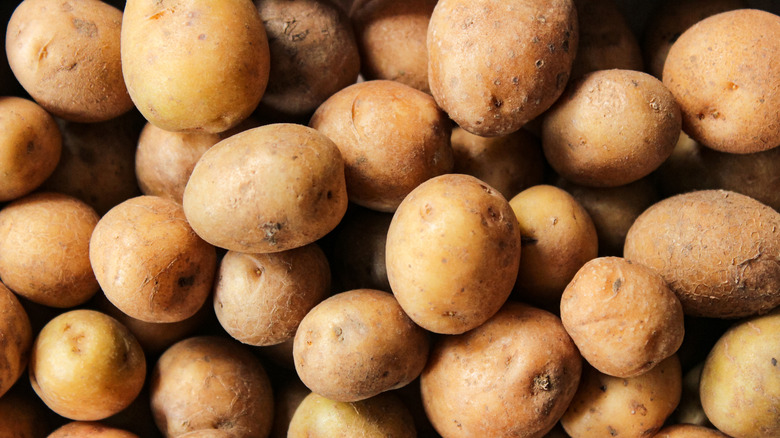
An article from The Seattle Times partially blames a 2011 observational study by Harvard researchers for popularizing the myth that regular potatoes are unhealthy. The study alleged there being a relationship between high potato intake and weight gain, but didn't indicate a specific method of preparation, or whether or not the potatoes were consumed alone or with other foods. For example, there's a big difference between French fries, which are high in calories and fat, and boiled potatoes.
According to Healthline, cooked potatoes with skin are loaded with vitamins and minerals, including vitamins C and B6 in the flesh, and potassium and folate in the skin. While cooking does, in fact, remove nutrients from potatoes, it doesn't remove them completely, and the amount largely depends on how you cook them. Baking or boiling with the skin still on reduces nutrient-loss considerably. Potatoes also catch flack for their glycemic index, which is typically considered unsuitable for people with diabetes. However, a 2016 systematic review of 13 distinct observational studies, as published by the American Society for Clinical Nutrition, found no verifiable link between potato intake and a higher risk of obesity, Type 2 diabetes, and cardiovascular disease.
Sweet potatoes are healthier
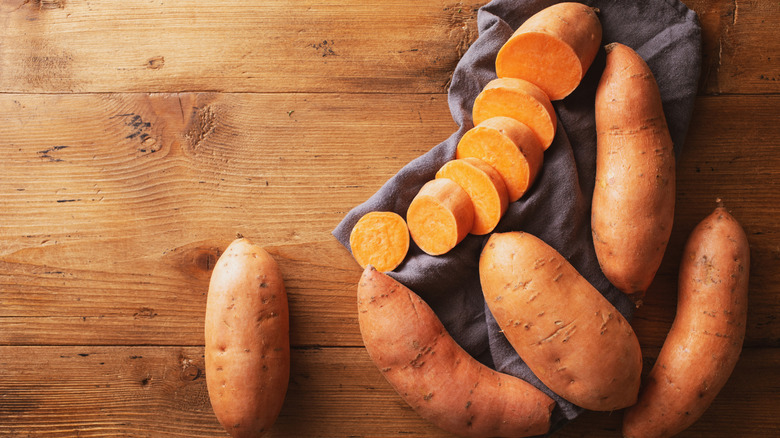
There's a lot of misinformation regarding the relationship between regular potatoes and the sweet variety. If the myth about regular potatoes being unhealthy is far from the truth, the belief that sweet potatoes are healthier is even farther. In actuality, both tuberous roots are highly nutritious and contain many of the same vitamins and minerals, just in different quantities, per Healthline. In a side-by-side comparison of a white and sweet potato with skin, both weighing 3 1/2 ounces, there were more similarities than differences.
Both contain 2 grams of protein, 0.15 grams of fat, and 21 grams of carbs. Things diverge when it comes to the percentage of daily value, though. A sweet potato delivers 107% of daily value vitamin A, compared to a white potato's 0.1%. The fiber content is similar, with the sweet potato delivering only about a gram more. And vitamins B6 and C, along with potassium, are all within 10% of each other. Besides that, both potato varieties are basically the same. A better question to ask is if yams or sweet potatoes are more nutritious (spoiler alert: It's sweet potatoes).
Potatoes can cure rheumatism
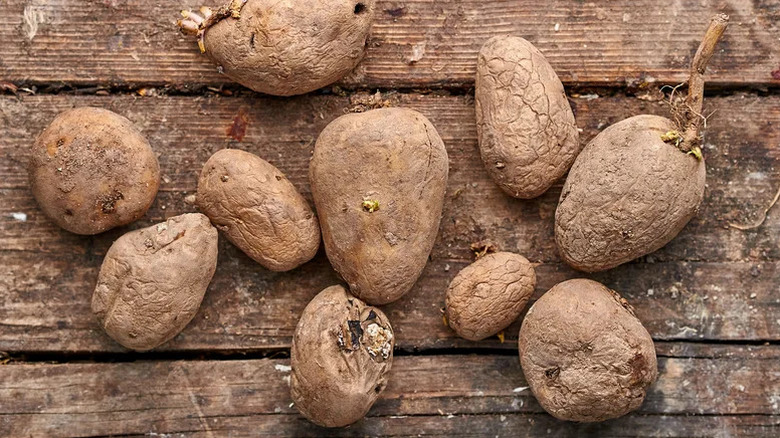
Rheumatism is an old-world term sometimes used in place of rheumatoid arthritis, which is a condition that causes joints, bones, and muscles to become inflamed, and affects 18 million people worldwide, per the World Health Organization. Before learning how rheumatoid arthritis worked, people relied on folk remedies, superstition, and plain ol' magic. One of these eccentric remedies involves using a potato in an unusual way. And it became so popular that if your doctor handed you a potato during the Victorian-era for joint pain, you wouldn't bat an eye.
The tradition has roots in British and American culture, and what's funny is that you can't just use any potato either — it must be a stolen one. The myth put such a chokehold on society that a small, pocket-sized bag was created especially for the afflicted, where a wrinkled potato could be carried to absorb rheumatism on-the-go. According to a first-hand account from someone who lived during those days, people believed the pain would dissipate as the potato shrank. If you find potato history fascinating, the University of Oxford's Pitt Rivers Museum has the actual tubers used for therapeutic purposes back then.
Sweet potatoes and regular potatoes are the same species
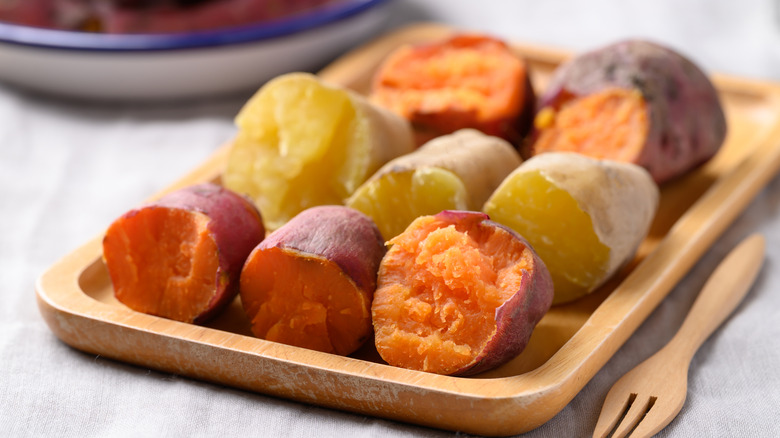
The best myths fly eerily close to the truth, like the one about sweet potatoes and regular potatoes being the same species. Based on the obvious similarities, it's easy to see why lots of people still believe this myth, even if there are clear differences. If you count yourself among those who do, today you'll learn that sweet potatoes do not come from the same family as regular potatoes, but they are closely related.
While both originated from Central and South America, potatoes are from the nightshade (Solanaceae) family, while sweet potatoes come from the morning glory (Convolvulaceae) family. Other nightshade vegetables include tomatoes, peppers, and eggplants, while the morning glory family consists mostly of sweet potato varieties. Both types of potatoes taste and look different, and unlike regular potatoes, the consistency of a sweet potato depends on what type it is.