

Trader Joe's 99-Cent Orzo Vs 7 Name Brands: I Found Which One Is Actually The Best
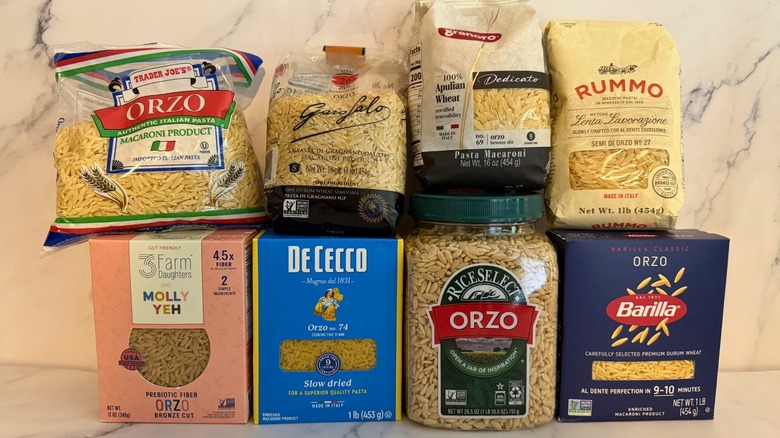
Orzo is something of a legendary food in my family. That's mostly thanks to my sister. For some strange reason, the tiny pasta had a chokehold on her (as did couscous — thank goodness she never found out about ditalini!) and my mom found herself making it for many a weeknight dinner. I never developed the same fixation with the food that my sister did, which isn't to say I wasn't fond of it — just that I haven't had it in many years. So, when I saw some online hype about Trader Joe's 99-cent orzo, I knew I needed to suss it out.
I inherently trust Trader Joe's, but as a good food journalist, I'm not afraid to let the brand know when it needs to step up to the plate. Today, I grabbed a bag of Trader Joe's orzo alongside seven other name-brand orzos to put it to the test. I cooked and tasted each to evaluate them on their texture, flavor, and size. My only disadvantage is that my sister lives across the country — I'm sure few people are more qualified than her to be on the panel of an orzo taste test!
Methodology
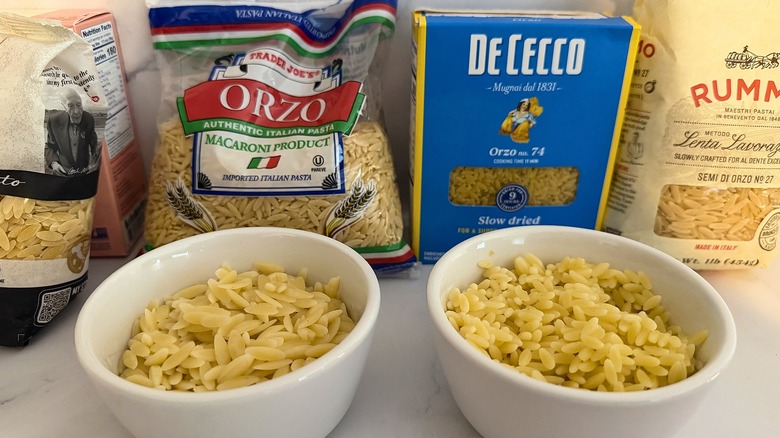
To taste test each of these orzos, I boiled ¼ cup of orzo in a small pot of salted water for the minimum time recommended on its packaging (for an al dente bite), using fresh water for each batch of orzo. I didn't add anything to the orzo after cooking it. I let each cool a little bit before eating a spoonful, and evaluating it based on its chew, size, and flavor.
Unsurprisingly, the orzos didn't vary widely from each other, so I also used their price per ounce as a point of comparison when picking which was the "best." Did Trader Joe's 99-cent bag reign supreme, or should you get your orzo fixation elsewhere? Keep reading to find out!
Taste test: Trader Joe's
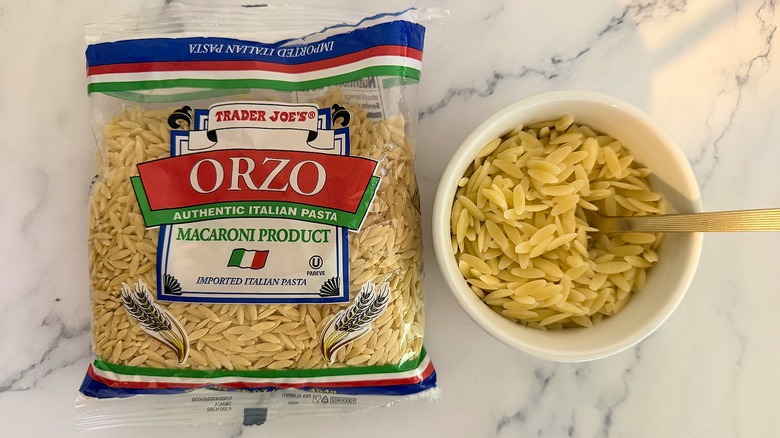
We'll start off by tasting the main orzo in question: Trader Joe's 99-cent orzo. At just $0.06 per ounce, it seems like a pretty unbeatable deal. Indeed, this orzo was good. Each grain was on the larger side in comparison to the other orzos I taste-tested, which would make this a great choice for something like orzo-stuffed peppers.
I also really liked the chew this orzo had. It was nice and toothsome, which I certainly can't say about every orzo on its list. That combined with its size does indeed make this a tough orzo to contend with — we'll have to see how the others stack up. On the whole, if you want orzo to be a prominent component of your meal and not just filler, you wouldn't go wrong with Trader Joe's offering.
Taste test: Rice Select
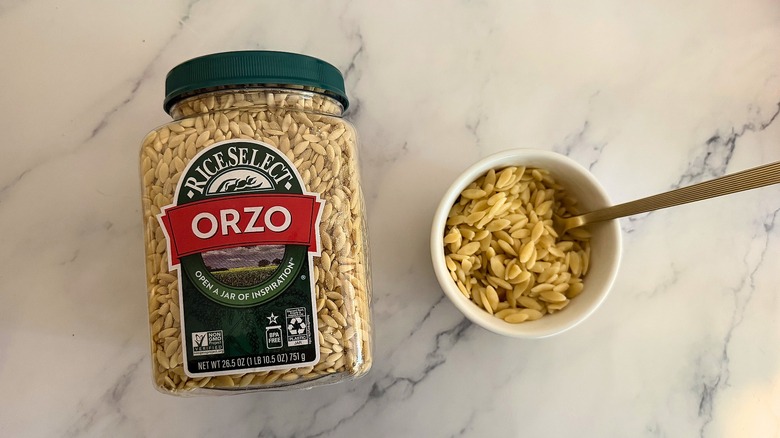
I had to resort to Amazon to get my hands on Rice Select's orzo; for some reason, the brand was out of stock at every single grocery store I checked (despite having other Rice Select products in stock. What gives?). Anyway, I spend $5.99 on the 26.5-ounce jar through Amazon, which comes out to about $0.23 per ounce. In other words, it costs nearly quadruple what Trader Joe's orzo does.
For that price, it better be good, right? Well, I'm pretty unhappy to report that Rice Select's orzo did not live up to Trader Joe's, making its price point even more egregious. It wasn't particularly toothsome or flavorful, despite cooking it for the minimum recommended amount of time. Its grains were about the size of Trader Joe's, if not larger, so I could see it pulling some weight in a chicken orzo salad. But I can't say this beats our 99-cent contender. Onto the next!
Taste test: Barilla
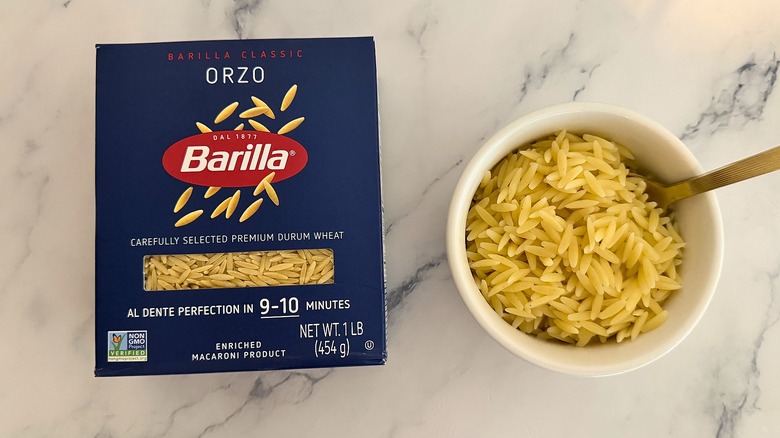
Barilla's orzo cost $1.99 for a 16-ounce box; or, $0.12 per ounce, which is again twice what Trader Joe's costs. When cooked, its grains were long and thin, not too dissimilar from basmati rice. I looked forward to seeing what this had in store for me after Rice Select's disappointing rendition, but still I wondered — could it beat Trader Joe's?
I definitely preferred the flavor and texture of this to the previous, and I think it has something going for it with its smaller size — I'd choose an orzo like this if I wanted to make a risotto-style orzo dish. I'm not sure its different size is enough for me to call it better than Trader Joe's, though. Each will be best used in different ways, and if I wanted orzo to be the main component of a dish, I'd probably still go with TJ's.
Taste test: De Cecco
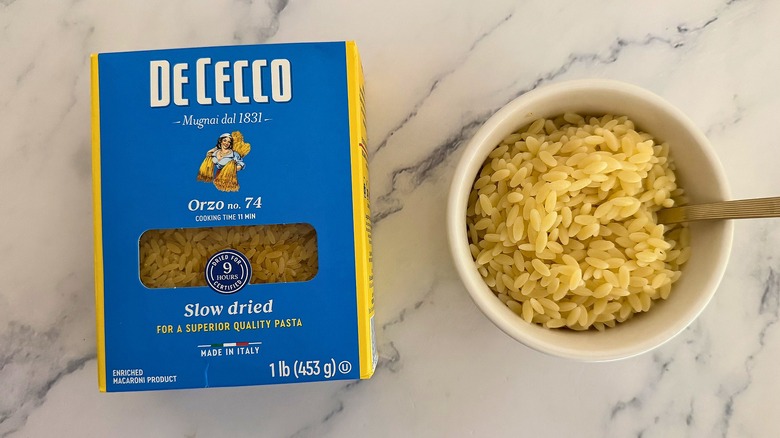
De Cecco's orzo cost me $3.49 for 16 ounces. At about $0.22 cents per ounce, we can consider it a mid-priced option of the selections on this list (yes, they do get more expensive further on!), but it's still sold at a much higher price than Trader Joe's.
De Cecco's orzo had the smallest grains of any I tried, which could work perfectly fine in some applications (in an orzo soup, perhaps?), but isn't my favorite thing when I'm eating orzo solo. I'd even say the grains were nearly as small as rice. On the plus side, it was very toothsome and had a good flavor, almost hinting at olive oil. I really liked this orzo, but would I pay almost quadruple for it? I'm honestly not sure, especially if Trader Joe's was readily available.
Taste test: Rummo
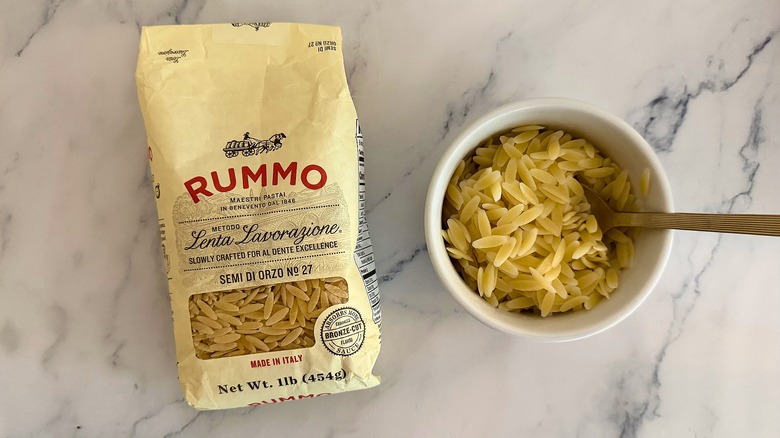
Once again, I had to source Rummo's 16-ounce bag of orzo from Amazon. This one cost me a whopping $8.99, and though it can brag about being made in Italy, I was still pretty skeptical about whether it was worth the price. At $0.56 cents per ounce, this had a lot to prove.
Well, I definitely liked the flavor here a lot. It had a similar size and bite to Trader Joe's orzo, but when eating it completely plain, you can definitely tell there's a difference in flavor — this one almost has a richer wheat taste to it. However, I really don't think you'd be able to tell the difference in the context of a meal, especially if the orzo was mixed in with plentiful other components (like in an orzo and chicken drumstick dish).
Taste test: Granoro
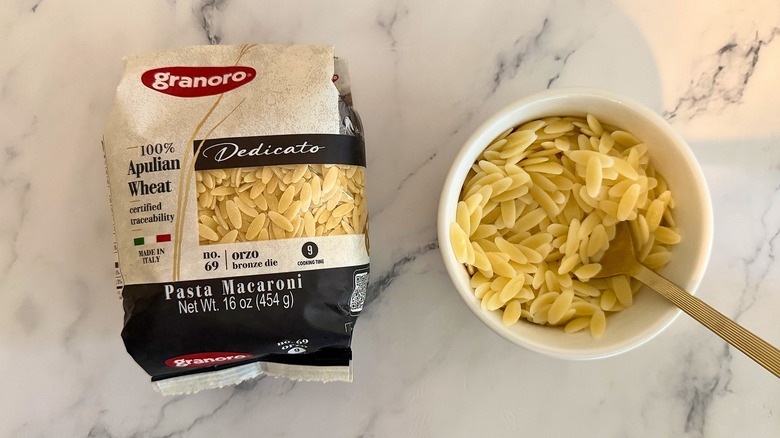
Granoro's orzo also came from Amazon, and I got two 1-pound bags for $14.99, which works out to $0.47 cents per ounce. This made it a little cheaper than the previous selection, but still far more expensive than TJ's. I'm not saying this is totally unreasonable — again, this is an Italian-made product — but I had to wonder if it was worth it.
The thing I loved the most about this orzo was its texture. The grains were pretty large and they had an excellent chew, making this something that definitely wouldn't shy away from being noticed in any dish. I don't have much to say about its flavor, though — it was fine, but nothing to write home about, except that something about it seemed distinctly high quality. The texture was really fantastic, definitely on par with Trader Joe's (and possibly a little better).
Taste test: Garofalo
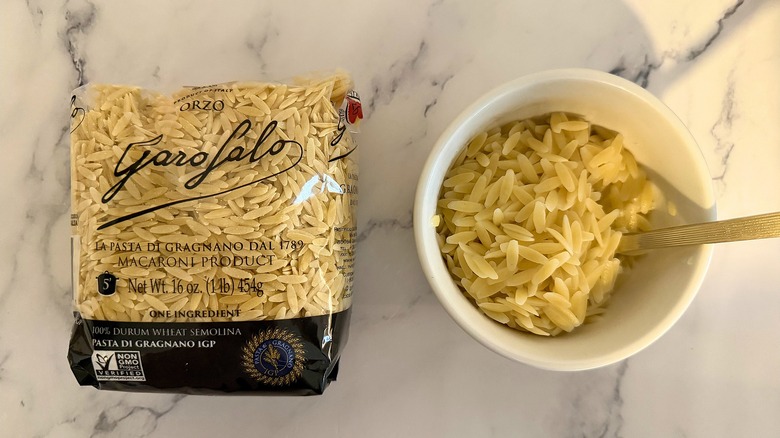
Garofalo's orzo also came from Amazon, and as a "Pasta di Gragnano," it can boast being produced in Gragnano, Italy with bronze dies and according to local regulations. Once again, I got two 1-pound bags for $14.99, making this the exact same price as the previous orzo ($0.47 cents per ounce).
And, similar to the previous orzo, Garofalo's tastes like a premium pasta. I'd put it somewhere in the middle as far as chew or toothsomeness is concerned — it doesn't have quite the textural appeal of some others on this list, but that's a very minor complaint. It's slightly smaller than Trader Joe's, but not by much. I can call it very comparable to TJ's in all aspects.
Taste test: 3 Farm Daughters and Molly Yeh
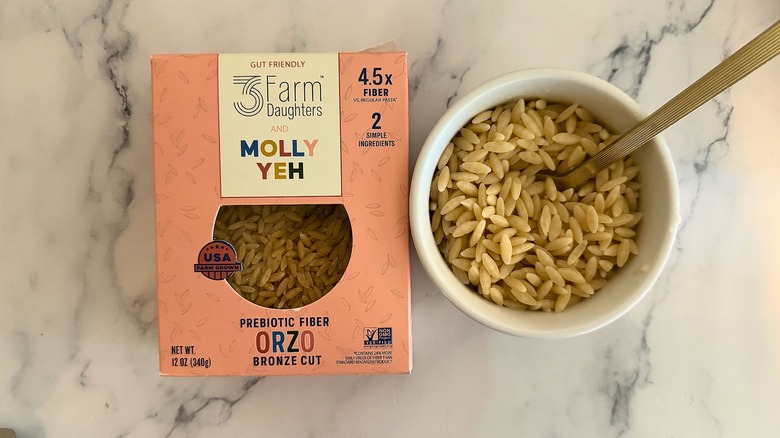
The above orzo by 3 Farm Daughters and Molly Yeh came to me via Amazon (unsurprisingly), and cost $9.96 for a 12-ounce box. That works out to exactly $0.83 cents per ounce, making this the most expensive option on this list. And, I'll be blunt — it was my favorite.
The orzo had a whole-wheat flavor that I just adored, and I loved their loose texture — they weren't starchy enough to stick together at all, which was a pretty pleasant surprise. The grains were also thick and had a great chew, similar to cooked rice. I finished the whole bowl of the above-pictured orzo happily, and the fact that it's packed with fiber was just a bonus. I'll be keeping this on hand for the foreseeable future. But, at almost 14 times the cost of Trader Joe's, is it really worth it?
Which orzo is the best?
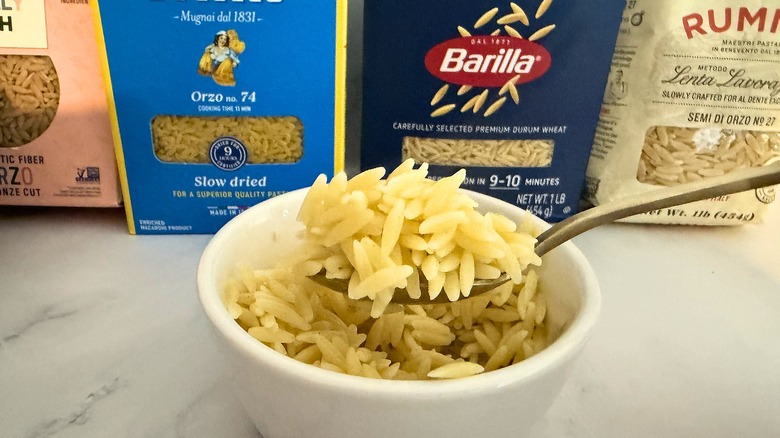
Ultimately, I have to hand the trophy to Trader Joe's. The next-cheapest option, Barilla, cost twice as much and didn't offer anything to write home about, nor did any of the other orzo brands I tried. They all tasted too similar to really set themselves apart, with the exception of 3 Farm Daughters & Molly Yeh's box — but I don't think the average consumer would fancy spending nearly 14 times more for a similar product.
Honestly, I didn't expect Trader Joe's to take the cake with this one, despite being such a massive fan of the chain. Given all of the Italian options on this list, I thought my verdict would easily go to one of them. But because price was a huge part of this comparison, Trader Joe's orzo wins by a mile. What are you waiting for? Go pick up a bag (or five) stat. It'll only set you back just under a dollar.